


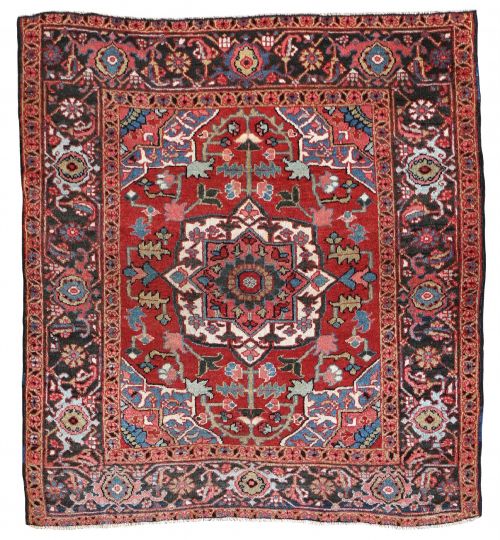


Serapi Style Rug
A serapi style rug brings bold geometry and rich traditional Persian artistry into a room.
Serapi Style Rug
When you search for a serapi style rug, you are looking at large antique carpets and runners originating from Northwest Persia. The pieces on this page span the late nineteenth century and the early decades of the twentieth century, capturing a distinct regional aesthetic. Most examples take the form of substantial floor coverings and hallway runners designed for domestic spaces.
The aesthetic bridges traditional Persian weaving with a graphic clarity defined by large medallions and geometric motifs. These carpets often display an all-over design or a central field structure that anchors a room. They function equally well as grand drawing room centerpieces or as striking runners for long hallways.
Materials and construction
These rugs are built from natural materials suited to heavy domestic use, employing wool pile woven onto a supportive cotton foundation. The combination of sturdy wool and durable cotton creates a resilient textile that maintains its structural integrity over generations of foot traffic.
Weavers utilised traditional hand-knotting techniques to build dense piles and crisp geometric lines. Natural dyeing methods yielded the deep reds, blues, and earthy tones characteristic of Northwest Persian Heriz workshops.
Serapi Style Rug Retail Price Guide 2026
Typical asking prices for serapi style rug among the pieces listed under this phrase on Sellingantiques today, from the lower quarter to the upper quarter. They describe what is for sale here now, not the wider market.
Listings feature pieces dated across six consecutive decades from eighteen-eighty to nineteen-thirty, all constructed from wool and cotton.
Factors that define quality
Quality rests in the precision of the geometric drawing and the balance of the overall composition within the field. A finer weave allows for sharper definition in the medallion outlines and secondary motifs, separating standard room-size carpets from exceptional pieces.
The condition of the wool pile and the integrity of the cotton foundation dictate the longevity and overall visual impact of the textile. Uniform pile height and intact original borders maintain the visual rhythm intended by the weaver.
The Serapi Style Rug Glossary
- Heriz
- A region in Northwest Persia renowned for producing large-scale geometric carpets and runners. The weaving tradition here favours robust structures and bold medallion designs.
- Medallion
- A large central ornamental design motif placed in the middle of the rug field. It serves as the primary visual focus around which the corner spandrels and border patterns revolve.
- Runner
- A long, narrow carpet format specifically proportioned for hallways, corridors, and staircases. These pieces provide functional floor coverage in high-traffic linear spaces.
- Pile
- The upright yarn surface of the rug formed by the knotted ends of wool. The density and height of this wool surface determine both the tactile feel and the durability of the textile.
- Foundation
- The underlying structural grid of warps and wefts, typically made of cotton in these rugs, that holds the wool knots securely in place.
Serapi Style Rug: Frequently Asked Questions
How do I clean an antique rug?
Regular gentle vacuuming without a beater bar removes surface dust and grit from the wool pile. Professional specialist cleaning is necessary for deep washing to protect the natural dyes and cotton foundation.
Water exposure should be managed carefully to prevent the cotton backing from shrinking or distorting. Prompt attention to accidental spills by blotting rather than rubbing preserves the integrity of the fibres.
Where should I place a runner?
Runners suit long hallways, narrow entryways, and transitional corridors where linear floor coverage is required. Their proportions allow them to define walking paths while adding warmth and colour to otherwise bare floors.
They also work effectively in kitchens between cabinetry and islands or alongside large beds. Placing a suitable non-slip underlay beneath the cotton foundation keeps the piece secure on hard flooring.
How do I date these carpets?
Dating relies on stylistic markers, structural analysis of the wool and cotton, and comparison with documented Northwest Persian production periods. Pieces from the late nineteenth century often display distinct natural colour variations compared to later twentieth-century examples.
Examinations of the knotting technique and edge finishes provide further clues to the decade of manufacture. Most items on this page originate from the era between eighteen-eighty and nineteen-thirty.
Can these rugs handle heavy foot traffic?
The dense wool pile and sturdy cotton foundation make these carpets well-equipped for everyday living spaces. Their original purpose was domestic floor coverage, meaning they were engineered to withstand sustained use.
Using a quality rug pad underneath distributes weight evenly and reduces friction between the floorboards and the textile. This simple addition significantly extends the working life of the wool pile.