


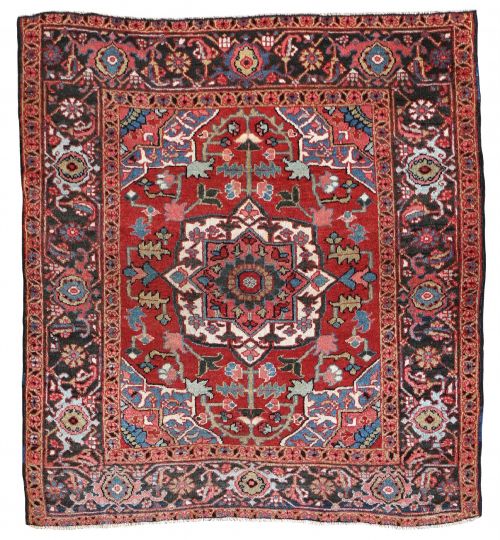


Serapi Style Persian Carpet
These serapi style persian carpet examples bring bold geometric pattern and rich Northwest Persian Heriz character to a room.
Serapi Style Persian Carpet
A serapi style persian carpet sits firmly within the broader tradition of Northwest Persian Heriz weaving, offering buyers a distinct graphic aesthetic. When searching this phrase, one encounters woven floor coverings spanning several decades from the late nineteenth century through to the early twentieth century.
The format varies from large area carpets exceeding four metres in length down to smaller scatter rugs and long hallway runners. Most pieces on show display traditional Persian layouts, often featuring balanced geometric motifs rather than fluid floral curves.
Examples date across the 1880s, 1890s, 1900s, 1910s, 1920s and 1930s, reflecting the enduring output of traditional regional workshops. Buyers frequently select these floor coverings for their architectural structure and ability to anchor a large interior space.
Materials and construction
These carpets rely on durable wool pile knotted tightly onto sturdy cotton foundations to withstand generations of daily use. The interplay of these two primary materials provides both structural stability and a heavy, flat drape upon the floor.
Weavers utilised hand-spun natural fibres that accept dye with subtle tonal variations across the field of the rug. This traditional construction method results in the resilient handle characteristic of authentic Northwest Persian workshop production.
Current listings span production dates from the 1880s through to the 1930s, utilising traditional wool and cotton materials in runner and carpet formats.
Judging quality in woven carpets
Quality rests primarily on the crispness of the geometric drawing and the intentional distribution of the all-over design or central medallion layout. Finer knots allow for sharper definition within the angular motifs and borders.
The depth and clarity of the dyed wool also separate standard examples from superior pieces, as natural colour variations impart life to the field. Preserved pile height and intact original edges further distinguish better-surviving specimens from heavily worn alternatives.
The Serapi Style Persian Carpet Glossary
- Heriz
- A region in Northwest Persia renowned for producing durable carpets with bold geometric designs and distinctive large-scale medallions. Pieces originating from this district often feature sturdy cotton foundations.
- All-over design
- A pattern arrangement where motifs repeat across the central field without a dominant central medallion. This layout distributes visual weight evenly throughout the carpet.
- Runner
- A long, narrow carpet format specifically proportioned for corridors, hallways and stairs. These pieces typically follow the same material and stylistic conventions as their larger square counterparts.
- Pile
- The upright yarn surface of a carpet formed by the cut ends of knots. The density and length of this wool layer dictate the physical feel underfoot.
- Foundation
- The underlying grid of warp and weft threads that supports the knotted pile. Cotton is the standard material used for this structural skeleton in these regional rugs.
Serapi Style Persian Carpet: Frequently Asked Questions
What defines a traditional Heriz design?
These designs rely on strong, angular geometries, large-scale central medallions, and rigid corner spandrels rather than curved floral scrolls. The aesthetic is architectural and structured.
Such layouts allow the carpets to anchor large rooms with a balanced, commanding visual presence.
How do I care for an old wool carpet?
Protect the wool pile by placing the rug in low-moisture areas and using a breathable underlay to prevent slipping. Vacuum gently without using a rotating brush bar.
Professional cleaning should happen only when strictly necessary, using specialists familiar with antique Persian textiles.
Where were these carpets originally woven?
Production centred on the town and surrounding villages of Heriz in the Northwest region of Persia. Skilled local weavers executed these durable works using generational techniques.
Materials typically combined locally sourced wool with sturdy cotton foundations for longevity.
Why choose a runner format?
Runner formats provide a durable and decorative solution for long, narrow spaces such as hallways, landings and corridors. They introduce warmth and graphic pattern where large square rugs do not fit.
These pieces maintain the exact same Northwest Persian material quality and knotting standards as full-sized carpets.