

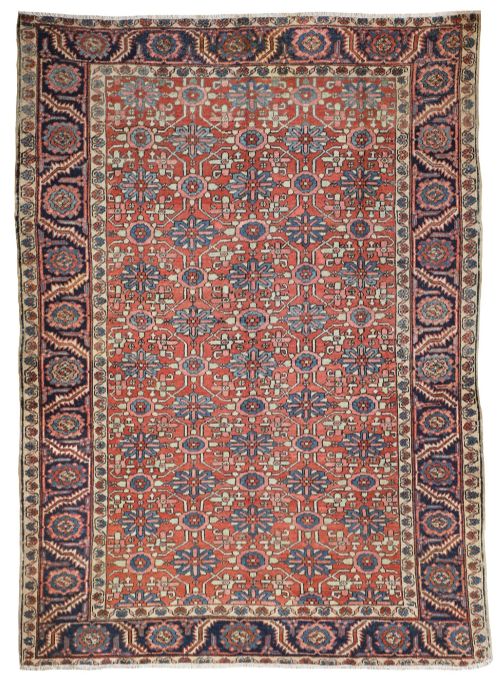

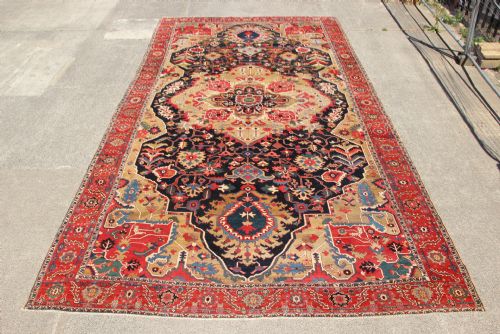
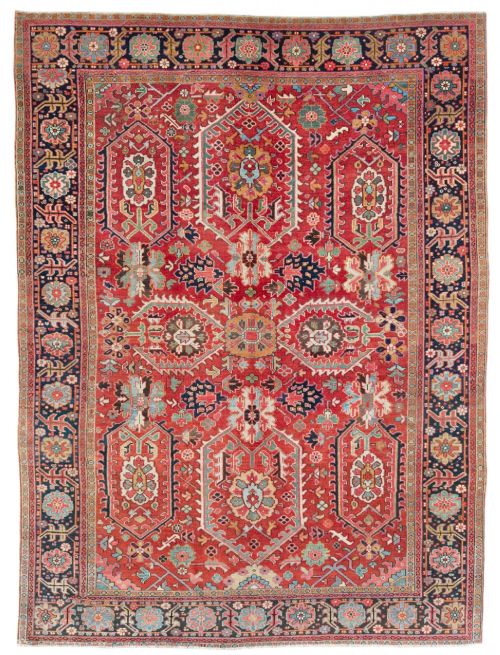
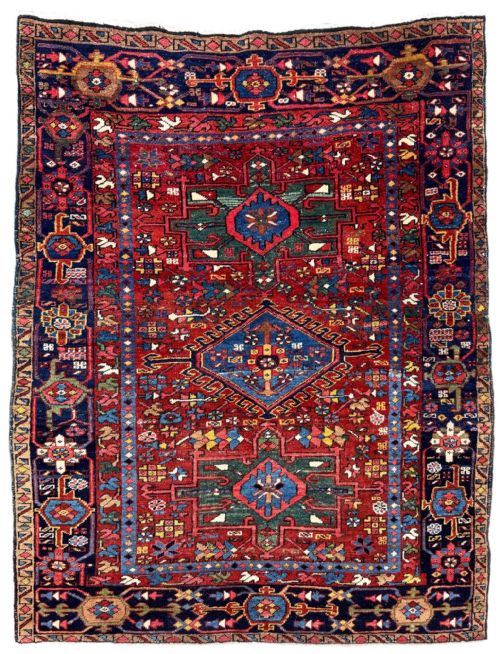


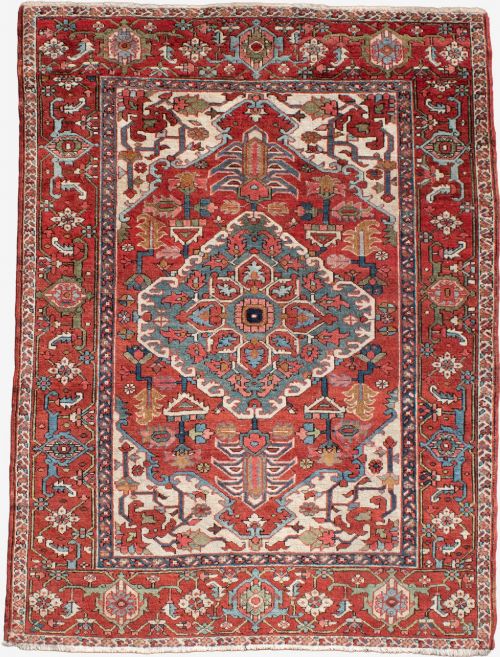

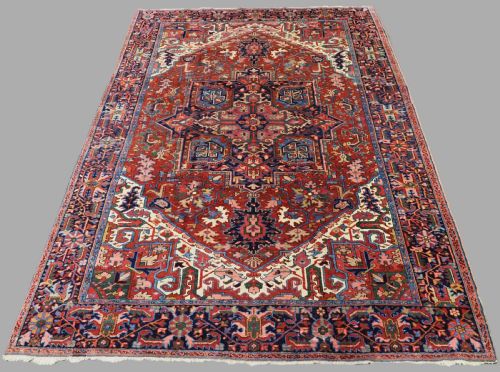


Serapi Area Rug
These heavy hand-knotted room-sized serapi area rug examples bring monumental Northwest Persian weaving to timber floors.
Serapi Area Rug
When someone searches for a serapi area rug, they encounter substantial room-sized floor coverings originating from Northwest Persia during the late nineteenth and early twentieth centuries. These large carpets belong to the broader Heriz tradition, sharing district motifs while displaying distinct design characteristics.
The versions most commonly met on this page date from the 1880s through to the 1920s, constructed as heavy area rugs or expansive carpets. They serve primarily as major floor anchors for principal rooms, displaying traditional Persian layouts through room-scaled proportions.
How they were made
These floor coverings utilise a robust foundation of cotton warps and wefts to support dense hand-knotted wool pile. The combination of sturdy cotton framing and thick wool provides the structural weight necessary for heavy room use.
Weavers knotted the pile by hand in Northwest Persian workshops, executing geometric medallion layouts and all-over field designs with durable natural materials.
Current listings span production dates from the 1860s to the 1930s, utilising wool pile woven over sturdy cotton foundations.
What varies in quality
The distinction between tiers rests upon knot density, precision of line work within the geometric medallions, and the depth of the wool pile. Finer examples maintain crisp articulation in their central motifs and border systems.
Colour saturation and balance across the wool field determine visual hierarchy, separating standard room rugs from pieces possessing exceptional chromatic harmony.
The Serapi Area Rug Glossary
- Serapi area rug
- A classification of antique Northwest Persian carpet associated with the Heriz region, noted for bold geometric designs and expansive central medallions.
- Medallion
- The central ornamental motif dominating the field of the carpet, forming the focal point of traditional Persian compositions.
- Warp
- The vertical foundation threads running lengthwise through the carpet, onto which the wool knots are tied during construction.
- Weft
- The horizontal threads passed across the warp threads between rows of knots to secure the pile in place.
- Pile
- The dense surface layer of knotted wool that forms the usable and visible fabric of the rug.
Serapi Area Rug: Frequently Asked Questions
How do I place a large serapi carpet?
Position the piece centrally within a principal room to allow the bold geometric medallion and surrounding border to function as the main visual anchor.
Ensure sufficient floor margin remains visible around the perimeter so the scale of the carpet complements the proportions of the room.
What period do these rugs come from?
The available pieces originate from the late nineteenth century and the early decades of the twentieth century, spanning the 1860s through to the 1930s.
Production during this timeframe relies on traditional Northwest Persian hand-knotting techniques executed in wool and cotton.
How do I maintain an antique wool rug?
Vacuum the pile regularly using a suction-only attachment without a rotating beater bar to protect the hand-knotted wool structure.
Rotate the carpet periodically to ensure even wear across the surface from foot traffic and exposure to natural daylight.