




Secretaire Military Chest
A secretaire military chest combines field practicality with a fitted writing drawer, offering robust storage built for travel.
Secretaire Military Chest
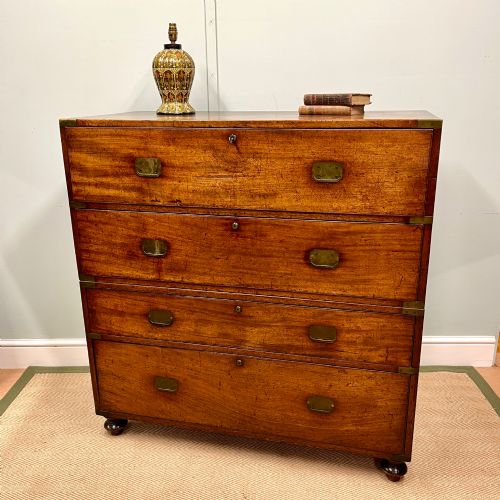
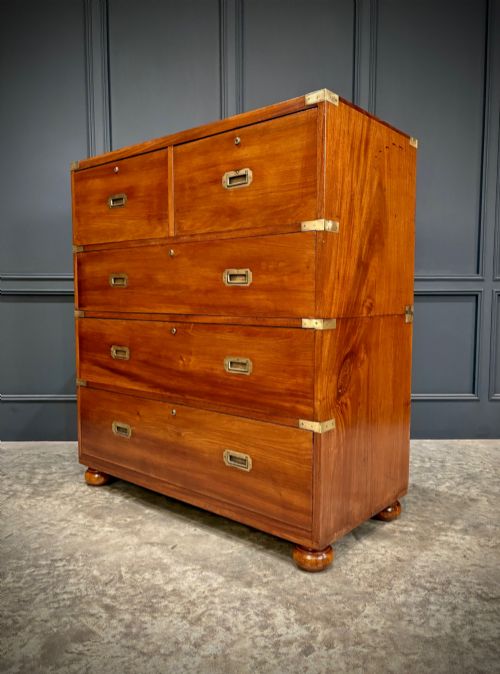
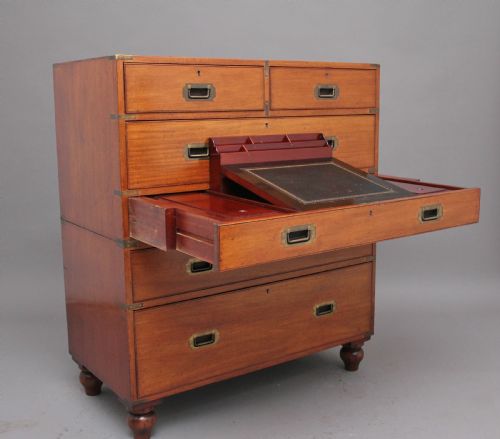
A secretaire military chest functions primarily as a chest of drawers incorporating a drop-front writing compartment fitted with small drawers and pigeonholes. The form derives from campaign furniture designed for transport during the nineteenth century, particularly within Victorian military and colonial contexts.
Most pieces seen here belong to the Victorian era, spanning dates from the 1830s through the late nineteenth century with occasional twentieth-century examples. Mahogany, camphor wood, and teak predominate as the primary timbers, frequently constructed in two separate sections for ease of movement.
Makers and regional workshops in Britain, Ireland, and British India produced these chests using dense timbers suited to travel. Examples emerge in formats ranging from standard rectangular chests to cabinet configurations resting on secretaire bases.
Materials and Technique
Cabinetmakers utilised dense hardwoods such as mahogany, teak, and camphor wood to resist warping and damage during transit. Camphor wood brought a distinct aromatic quality alongside durability, while teak and mahogany provided heavy structural strength.
Construction relies on a two-part modular format joined with flush brass corners and strapwork to protect vulnerable edges. Recessed brass carrying handles and inset drawer pulls sit flush against the timber surfaces to prevent snagging during transport.
Camphor wood chests retain their distinct herbal scent after more than a century of travel.
Construction and Materials
Quality rests upon the precision of the brass hardware integration and the stability of the timber joints under stress. Superior examples maintain tight, flush fitting of metal mounts and drawer fronts, whereas simpler pieces show wider tolerances.
The sophistication of the internal secretaire fitments distinguishes different grades of production. Elaborate pigeonhole arrangements, secret compartments, and fine leather writing surfaces indicate higher workshop standards than plain functional interiors.
Hill & Millard·H Pratt of New Bond Street·G. Kane, Dublin
The Secretaire Military Chest Glossary
- Two-Part Chest
- A chest built in separate upper and lower modular sections designed to stack together securely for travel. This division reduced weight and bulk for officers on the move.
- Campaign Furniture
- Portable furnishings constructed with folding elements, recessed hardware, and robust timbers intended for military campaigns and colonial life. It prioritised durability and modular transport.
- Secretaire Drawer
- A top drawer featuring a hinged drop-front that conceals a writing surface, small drawers, and compartments. It converted a standard storage chest into a functional desk.
- Recessed Brass Mounts
- Corner brackets and handles set flush into the wood to prevent catching and to absorb impacts during transit. These brass elements define the visual style of military pieces.
- Camphor Wood
- An aromatic timber frequently utilised in colonial chests due to its natural insect-repellent properties. It provides a distinct scent and a rich grain.
Secretaire Military Chest: Frequently Asked Questions
What is a secretaire military chest?
A secretaire military chest is a modular chest of drawers featuring a dedicated writing drawer with internal compartments.
Originally built for officers on campaign, it combined wardrobe storage and a desk into a single transportable unit.
How do I identify a Victorian campaign chest?
Victorian campaign chests typically display flush brass mounts, recessed handles, and dense hardwoods like mahogany, teak, or camphor wood.
Many examples separate horizontally across the middle and show construction methods intended to withstand moisture and rough handling.
How should I care for camphor wood?
Camphor wood requires stable indoor humidity and minimal direct sunlight to protect the natural oils and grain finish.
Avoid placing it near excessive heat sources that might dry out the dense timber.