



Scroll End Bench
A scroll end bench unites architectural presence with horizontal repose, offering a commanding anchor for a hall, bedroom, or drawing room.
Scroll End Bench
When you search for a scroll end bench, you encounter seating forms distinguished by sweeping, scrolled terminals at one or both ends, bridging the boundary between chair and bed. The pieces listed here span the nineteenth and early twentieth centuries, encompassing forms described variously as window seats, daybeds, settees, and chaise longues. These seating forms emerge in Regency, Victorian, Edwardian, and William IV periods, reflecting classical revivals and French influences across European and British cabinet making.
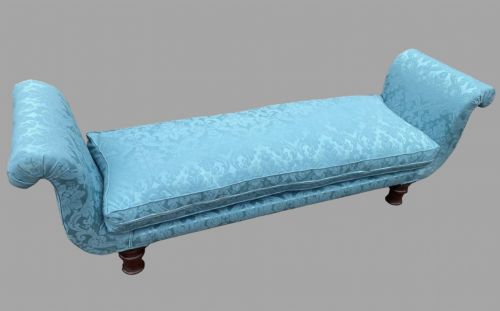
The version you are most likely to meet on this page is a mahogany-framed example drawing on Regency or Victorian design, often retaining or updated with fabric upholstery. Alongside British seating, the inventory accommodates French daybeds, Italian neoclassical pieces, and occasional variants such as Chinese hardwood kang tables. This mix shows how makers adapted the sweeping scroll motif across diverse domestic contexts, from formal entrance halls to private withdrawing rooms.
Materials and construction
Cabinet makers relied primarily on dense hardwoods such as mahogany and walnut to achieve the sweeping curves demanded by the scroll end form, occasionally turning to simulated rosewood or cast iron for structural support. Timber frames were shaped, carved, and joined to withstand the outward pressure exerted by scrolled terminals and double-ended designs. Surface finishes range from polished mahogany grains to gilded surfaces on French-influenced frames.
Upholstery formed an integral part of the construction, utilising textiles like damask, velvet, and patterned fabrics stretched over supportive foundations. Makers fixed these coverings to accommodate the complex geometry of roll-over ends and daybed backs. Structural integrity depended on the precise assembly of wooden rails, legs, and foundational webbing before final decorative textiles were applied.
Scroll End Bench Retail Price Guide 2026
Typical asking prices for scroll end bench among the pieces listed under this phrase on Sellingantiques today, from the lower quarter to the upper quarter. They describe what is for sale here now, not the wider market.
Listings feature mahogany, walnut, and cast iron structures, paired with textile surfaces including damask, velvet, and silk damask upholstery.
Measures of quality
Quality in these pieces rests upon the crispness of the timber carving and the architectural proportion of the scroll ends. Superior examples display fluid, uninterrupted lines where the scroll meets the rail, executed by skilled hands rather than mechanical replication. The choice of primary timber grain and the integrity of the frame construction further separate standard production from exceptional studio output.
The standard of upholstery and the preservation of original or sympathetic materials dictate the visual success of the piece. Top-tier specimens maintain balanced tension across curved surfaces, with fabric choices that respect the period of the frame. Subtle details, such as well-executed cabriole legs or restrained classical mounts, elevate the piece beyond utilitarian seating.
Gillows
The Scroll End Bench Glossary
- Scroll end
- A sweeping, upward-curving terminal on a seat or daybed, reminiscent of ancient klismos furniture or classical scrolls. This feature defines the profile of the piece and provides arm support.
- Daybed
- An elongated seating furniture designed for reclining during the day, combining the characteristics of a chair and a bed. These forms often feature one or two raised scrolled ends.
- Window seat
- A narrow bench designed to fit within the architectural recess of a window bay, frequently upholstered and featuring low or scrolled ends to preserve light and views.
- Chaise longue
- An upholstered sofa in the shape of a chair that is long enough to support the user's legs, frequently associated with French Empire and Regency periods.
- Mahogany
- A durable, reddish-brown tropical hardwood favoured by nineteenth-century cabinet makers for its stability and capacity for fine carving and high polish.
Scroll End Bench: Frequently Asked Questions
Where should I place a scroll end bench?
These pieces suit positions where their profile can be appreciated from multiple angles, such as the foot of a bed, an extended hallway, or beneath a large window. Their finished backs and sculptural ends allow them to sit away from walls rather than strictly against them.
In larger reception rooms, a scroll end settee or daybed acts as a room divider, breaking up expansive floor plans while offering casual seating or a place to recline.
How do I distinguish Regency from Victorian examples?
Regency pieces often display cleaner classical lines, restraint in ornament, and darker woods like mahogany or simulated rosewood inspired by ancient Greek and Roman models. The scroll ends on these pieces tend to be more architectural and tautly proportioned.
Victorian pieces generally introduce heavier proportions, more exuberant carving, and sometimes cast iron elements, reflecting a broader mix of historical revivals including Rococo and French Empire styles.
What is the difference between a daybed and a settee?
A daybed is designed primarily for reclining, featuring an elongated seat platform often accompanied by a single raised end or an asymmetric backrest tailored for lying down. They share ancestry with classical meridiennes and recamiers.
A settee provides formal seating for multiple people, maintaining a uniform back height even when fitted with dramatic double scroll ends intended for sitting upright rather than stretching out.
How do I care for antique upholstery?
Protect antique textiles by keeping the bench away from direct sunlight, which fades delicate damasks and weakens historic velvet fibres. Regular, gentle vacuuming with a soft brush attachment prevents dust accumulation within the weave.
For pieces requiring structural restoration or re-upholstery, consult conservators who utilise traditional stuffing materials and hand-stitching techniques appropriate to the period of the frame.