



Scroll Back Nursing Chair
These low-slung seats known as a scroll back nursing chair combine nineteenth-century woodwork with traditional upholstery for domestic comfort.
Scroll Back Nursing Chair
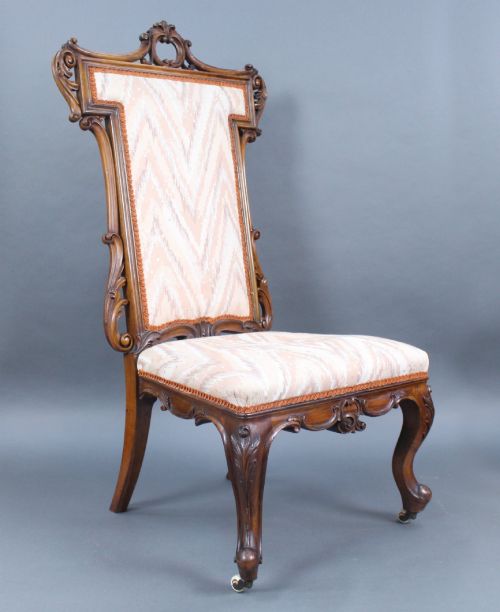
A scroll back nursing chair is a low Victorian seat designed originally to assist mothers with feeding infants, featuring a characteristic curved wooden top rail and an upholstered body. Most examples seen here date from the nineteenth century, encompassing Victorian and William IV periods alongside French Napoleon III designs.
The form often crosses over with slipper chairs, occasional chairs, and bedroom chairs due to the low seat height and compact proportions. Woods such as mahogany and rosewood frequently form the visible frames beneath fabric, velvet, tapestry, or calico upholstery.
Makers shaped these pieces with serpentine fronts, button backs, and sometimes castors for mobility across carpets. The evidence shows both standard parlour variations and rocking versions adapted for domestic resting spaces.
How they were made
Frames rely on turned and carved hardwoods like mahogany and rosewood, shaped into high scrolls and splayed back supports. Brass castors occasionally attach to the feet to aid movement across nineteenth-century floor coverings.
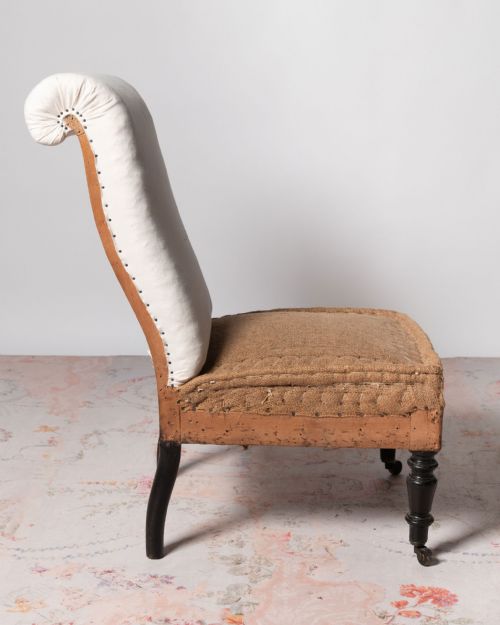
Upholstery foundations utilise traditional materials including hessian, calico, and stuffing beneath top layers of velvet, tapestry, and textile. Buttoning secures the inner padding to create the characteristic tight tufted profile seen on Victorian backs.
Scroll Back Nursing Chair Retail Price Guide 2026
Typical asking prices for scroll back nursing chair among the pieces listed under this phrase on Sellingantiques today, from the lower quarter to the upper quarter. They describe what is for sale here now, not the wider market.
Listings span Victorian, William IV, and French Napoleon III styles, utilising mahogany, rosewood, and brass alongside velvet and tapestry.
What varies in quality
The refinement of the woodwork separates standard production from superior pieces, particularly in the depth and crispness of carved scrolls on mahogany and rosewood frames. Subtleties in proportion, such as the sweep of a splayed back or the curve of a serpentine seat, dictate the visual balance of the silhouette.
Upholstery execution also distinguishes the range, where tight buttoning and appropriate fabric choices like velvet or tapestry reflect the original maker's ambition. Pieces destined for recovery demonstrate the underlying frame integrity rather than surface finish.
The Scroll Back Nursing Chair Glossary
- Scroll back
- A wooden top rail curving outward and backward like a scroll. This shape provides both decorative detail and upper back support.
- Slipper chair
- A low-set upholstered chair without arms, designed originally for ladies' bedrooms. The reduced height makes dressing and sitting close to the floor convenient.
- Button back
- An upholstery technique where indentations are formed by pulling stitches through padding to secure buttons. This creates a tufted surface that holds its shape under weight.
- Castor
- A small wheel mounted in a swivel frame attached to chair legs. These allow the heavy wooden frame to move smoothly across floor coverings.
- Serpentine
- A curved line that bends inward at the centre and outward at the ends. This shaping appears frequently on the front rails of seats.
Scroll Back Nursing Chair: Frequently Asked Questions
What is a scroll back nursing chair?
A low-seated nineteenth-century chair featuring a curved wooden top rail and upholstered padding. They were built for domestic comfort in bedrooms and parlours.
Their compact proportions and low profile distinguish them from standard armchairs of the same period.
How old are these chairs?
The pieces seen here originate predominantly from the Victorian era and the nineteenth century, including William IV and Napoleon III periods.
Stylistic details like mahogany frames and button upholstery point directly to these mid-to-late nineteenth-century dates.
What woods were used?
Mahogany and rosewood appear frequently as the primary framing materials for these nineteenth-century seats. These timbers provided the strength needed for carved scroll rails.
Brass hardware such as castors also accompanies the wooden structures on selected examples.
What fabrics cover them?
Original and replacement coverings include velvet, tapestry, and various traditional textiles. Beneath these visible surfaces lie foundational layers of hessian and calico.
Some pieces are offered specifically for recovery, exposing the bare padding and webbing.
How do they differ from slipper chairs?
While both share a low seat height suited to nineteenth-century domestic use, scroll back chairs emphasise the prominent wooden curve at the top of the frame. Slipper chairs often focus entirely on upholstered surfaces without exposed woodwork.