


Schoolhouse Wall Clock
A schoolhouse wall clock brings dependable timekeeping and clean lines into a room, offering the reliable utility that offices, stations and classrooms relied upon.
Schoolhouse Wall Clock
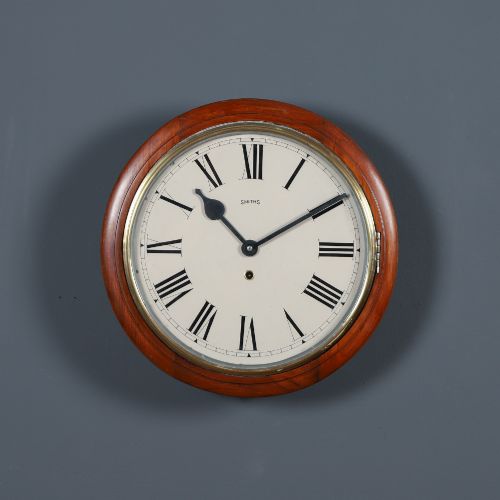
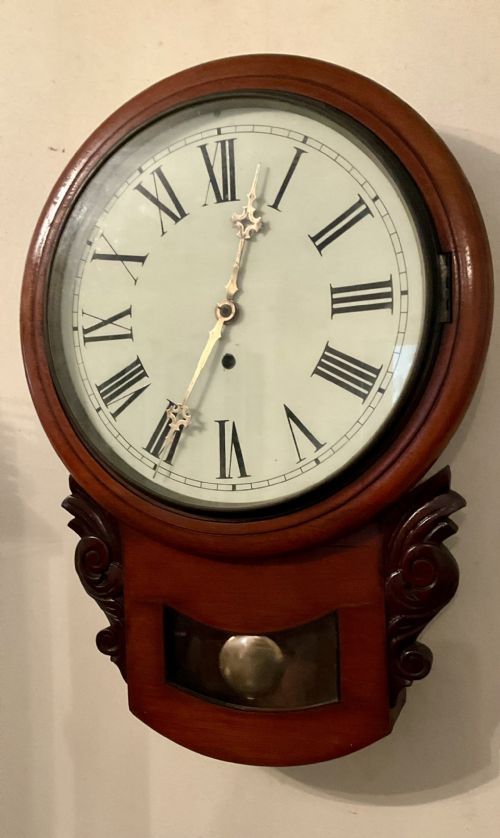
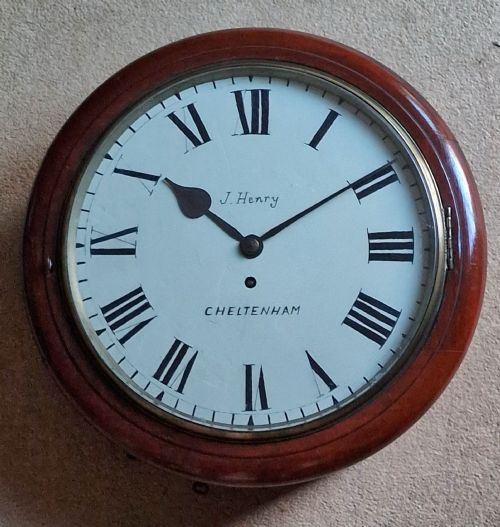
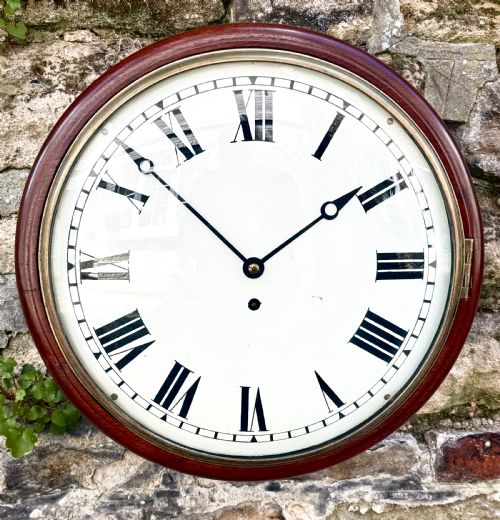
A schoolhouse wall clock is a timepiece designed for public and municipal spaces, characterised by a clear circular dial and a robust timber case. You will frequently encounter drop dial and fusee mechanism examples across this selection, spanning the Victorian era through the mid-twentieth century.
The pieces listed on this page draw from the nineteenth century, the Edwardian period and later twentieth-century production. They originate from English, American and Japanese makers, reflecting varied regional approaches to utilitarian clockmaking.
Forms range from compact eight-inch light oak cases to substantial fifteen-inch mahogany railway and station models. Institutional examples such as General Post Office and London County Council clocks appear alongside traditional domestic wall timepieces.
How they were made
Cases are constructed from hardwoods such as mahogany, oak and walnut, joined to house heavy clockwork securely. Glazed brass bezels protect the paper or painted dials from dust and damage in busy environments.
Movements rely on traditional fusee or eight-day mechanisms designed to maintain consistent tension and accurate timekeeping. Metal components work within sturdy wooden housings built to endure decades of daily use and winding.
Periods represented span from the Regency era through Victorian, Edwardian and mid-century decades.
What varies in quality
The legibility and preservation of the original dial paper or painted numerals significantly influence the character of the clock. Crisp maker signatures and uncompromised brass bezels further elevate the standing of a piece.
Smiths·Payne of Tunbridge Wells
The Schoolhouse Wall Clock Glossary
- Fusee
- A conical pulley connected to the mainspring by a chain or cord, designed to equalise the torque as the spring unwinds. This mechanism improves the timekeeping accuracy of a mechanical clock.
- Drop dial
- A clock case featuring a circular dial section at the top that extends downward into a trunk or box to accommodate the pendulum. This proportion is characteristic of many traditional wall timepieces.
- Timepiece
- A clock that indicates the time without including a striking mechanism or chiming train. These movements focus purely on keeping and displaying the hours and minutes.
- Bezel
- The metal or wooden rim that holds the glass protecting the clock face. It often opens on a hinge to allow access for setting the hands and winding the movement.
Schoolhouse Wall Clock: Frequently Asked Questions
What is a schoolhouse wall clock?
A schoolhouse wall clock is a sturdy timepiece originally built for public buildings, stations, and classrooms, featuring a clear circular face and a wooden case.
These clocks prioritize legibility and reliable mechanical movements over ornate decoration, making them practical for everyday use.
How do fusee movements work?
A fusee movement uses a conical pulley and a chain to ensure the power delivered to the gear train remains constant as the mainspring runs down.
This clever mechanical design helps the clock maintain steady accuracy throughout its running period between windings.
Where were these clocks used?
These clocks were installed in institutional settings such as railway stations, post offices, council offices, and schools where keeping accurate time for the public was essential.
Their robust construction ensured they could handle busy environments and frequent daily operations.
How do I hang a wall clock safely?
A heavy wooden wall clock requires secure fixing directly into a wall stud or the use of appropriate wall anchors rated for the weight of the timber and movement.
Ensuring the case hangs level is also vital for the pendulum to swing evenly and keep correct time.