
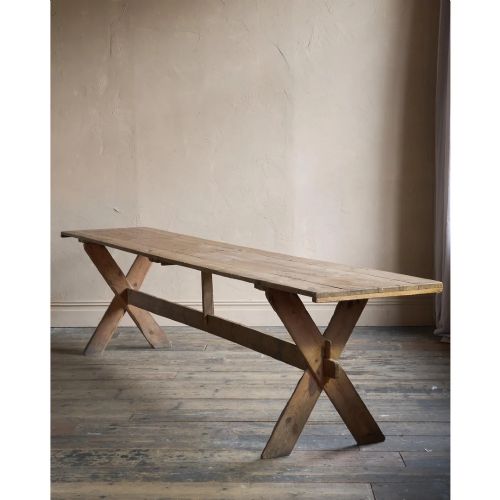
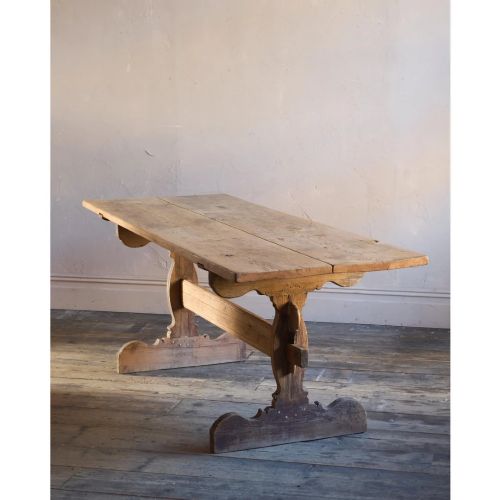


Scandinavian Country Dining Table
A scandinavian country dining table brings warmth to a room through honest pine and timber construction.
Scandinavian Country Dining Table
A scandinavian country dining table represents a robust tradition of utilitarian furniture originating from northern European farmhouses and domestic kitchens. These pieces serve as the central gathering place for everyday meals and communal work within the home.
The versions most frequently encountered on this page belong to the nineteenth century, alongside older eighteenth-century examples and mid-twentieth-century interpretations. They manifest primarily as kitchen tables, preparation tables, and trestle designs.
Stylistically, the pieces align with Swedish country and Gustavian traditions, favouring functional forms built for longevity. Their origins in northern rural workshops dictate a straightforward approach to domestic utility.
How they were made
Makers utilised available softwood, oak, and general timber, often constructing substantial trestle frames and drop-leaf mechanisms known as slagbord. These materials provided the necessary structural strength for heavy daily tasks in rural kitchens.
Surfaces frequently display applied finishes, notably paint and traditional Falu paint, which protected the underlying wood while providing colour. Joinery focuses on utility rather than ornament, reflecting the practical demands of nineteenth-century and earlier domestic life.
Listings feature eighteenth-century, nineteenth-century, and twentieth-century examples, constructed primarily from pine, oak, and softwood with painted finishes.
What varies in quality
The distinction between standard utility and finer craftsmanship lies in the proportion of the timber and the integrity of the original construction. Tables built with sturdy oak or dense pine retain their structural rigidity far better through centuries of use.
Surface treatment significantly influences character, as original layered paint finishes demonstrate superior historical integrity compared to later stripping or modern repainting. The subtlety of proportions in trestle and drop-leaf mechanisms separates basic workshop output from more thoughtful regional design.
The Scandinavian Country Dining Table Glossary
- Slagbord
- A traditional Scandinavian dropleaf dining table supported by swinging wooden gates or legs. This form allows the surface area to expand or contract according to domestic needs.
- Falu Paint
- A traditional Swedish red or dark earth paint derived from copper mine waste. It preserves softwood surfaces effectively against harsh northern climates.
- Trestle Table
- A form consisting of two or more support frames connected by a horizontal beam. This construction provides stable seating clearance along the length of the table.
- Gustavian
- The Swedish neoclassical style spanning the late eighteenth and early nineteenth centuries. It simplifies continental European motifs into lighter, restrained country forms.
Scandinavian Country Dining Table: Frequently Asked Questions
What is a scandinavian country dining table?
A scandinavian country dining table is a sturdy wooden table originating from northern European domestic and agricultural traditions. These pieces were built for daily family life and food preparation.
Most examples found here date from the nineteenth century, constructed primarily from pine and softwood. They embody practical design through trestle frames, drop leaves, and painted surfaces.
How do I use a drop leaf table?
A drop leaf table functions by raising hinged side flaps supported by swing-out wooden legs or brackets. This mechanism allows the table to save space when not in use.
In historic kitchen tables, this feature offered flexibility in smaller rooms. Raising the leaves transforms a compact board into a full dining surface.
How do I identify Falu paint?
Falu paint is a matte red or dark earth finish historically used on timber buildings and furniture in Sweden. It contains copper tailings which give the paint its characteristic dense pigment.
On tables, this finish appears as a deeply bonded coating that shows rich texture. It protects the underlying softwood while ageing with a distinctive tactile quality.
What is the difference between oak and pine tables?
Oak tables utilise a dense hardwood that provides exceptional weight and structural durability for heavy domestic use. Pine and softwood tables offer a lighter alternative favoured in regional Scandinavian workshops.
While oak survives with a harder surface texture, painted pine surfaces gain character through generations of wear. Both materials suit everyday dining environments.