
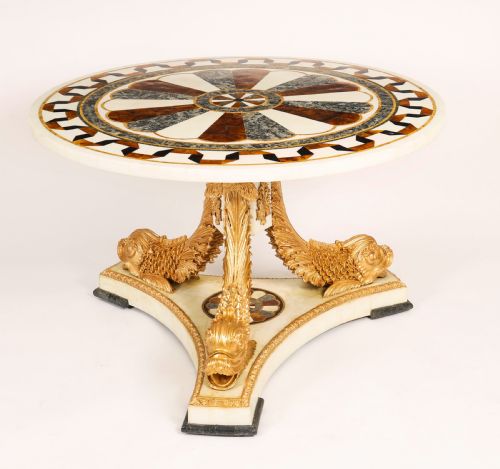
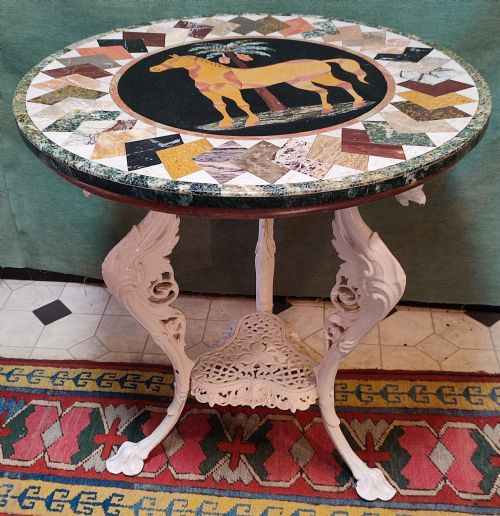


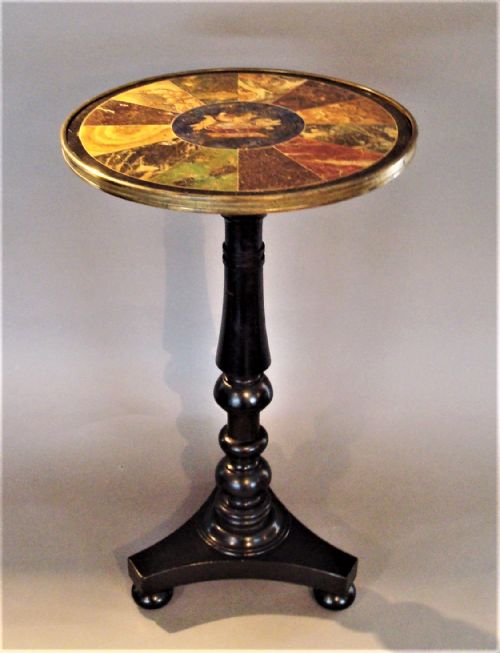
Scagliola Marble Table
A scagliola marble table brings rich Italian craftsmanship and polished stone surfaces into a room, offering both classical presence and decorative versatility.
Scagliola Marble Table
A scagliola marble table is a decorative surface that often mimics inlaid stonework through a composite plaster technique, frequently appearing in centre, console, and occasional forms. These pieces bridge centuries of European design, drawing on 18th century Italian traditions, Regency elegance, and Victorian proportions.
The versions most commonly met on this market include 19th century examples and refined Edwardian pieces, alongside earlier 18th century Italian works. They serve primarily as centre tables or console tables, anchoring a room with substantial stone or specimen marble tops paired with giltwood, mahogany, or cast iron bases.
How they were made
These tables combine plaster-based scagliola or natural specimen marble tops with structural supports in mahogany, walnut, giltwood, or cast iron. Artisans shaped composite materials and carved timber to achieve stable, ornate foundations that could bear heavy stone surfaces.
Surface decoration relies on inlaid specimen stone and intricate faux-marble finishes, requiring precise hand-polishing to secure a smooth, reflective sheen across the tabletop.
One historical table column once stood alone, proving that even table anatomy could enjoy a solitary career before meeting a top.
What varies in quality
The fineness of the scagliola inlay and the crispness of the carved giltwood or timber base separate standard production from exceptional examples. Superior pieces display meticulous colour blending and sharper definition in their faux-marble patterns.
Proportions also dictate distinction, where bold architectural scaling and harmonious pairing between the tabletop and base indicate a more deliberate workshop origin.
The Woodley family
The Scagliola Marble Table Glossary
- Scagliola
- A composite material made from pigmented gypsum, glue, and natural fibres, manipulated to imitate genuine marble and pietra dura inlay. This technique allows for complex multi-coloured designs without relying solely on carved stone.
- Specimen marble
- A tabletop composed of various fragments of different coloured marbles assembled into geometric or pictorial patterns. It showcases the diverse geological palette collected during grand tours.
- Console table
- A table designed to stand against a wall, frequently supported by carved brackets or legs rather than a full four-legged freestanding frame. They often feature elaborate giltwood or carved wooden structures.
- Centre table
- A freestanding piece meant to be viewed from all sides, placed prominently in the middle of a room. These typically feature robust bases and finished tabletops suited to central placement.
Scagliola Marble Table: Frequently Asked Questions
Where were these tables used?
Historically, these tables stood in grand reception rooms, hallways, and drawing rooms as decorative centrepieces or against walls as console furniture. Their polished surfaces displayed fine craftsmanship and artistic collections.
Today, they function similarly in domestic interiors as statement furniture that anchors a room's aesthetic.
How do I care for a scagliola top?
Scagliola and marble surfaces require gentle cleaning with a soft, dry cloth and avoidance of harsh chemical cleaners or acidic liquids. Protecting the surface from moisture and direct impact preserves the delicate plaster inlay.
Regular dusting keeps the polished finish intact without risking abrasion to the decorative layer.
How can I tell the period?
Dating relies on examining the construction methods of the base, the timber species used such as mahogany or walnut, and stylistic cues from periods like Regency, Victorian, or Edwardian. Structural joinery and the specific materials of the support offer clear chronological indicators.
Comparing the decorative motifs against established 18th and 19th century design vocabularies further clarifies the age.