




Satinwood Table with Gallery
These satinwood tables with gallery combine light timber with raised brass rails, making them an elegant choice for any room.
Satinwood Table with Gallery
A satinwood table with gallery brings together a pale timber surface bounded by a raised metal rail, often in brass, designed to keep small items from sliding off the edge. You will find these pieces spanning several distinct periods, most notably the Edwardian era and the nineteenth century, reflecting enduring tastes for refined domestic furniture.
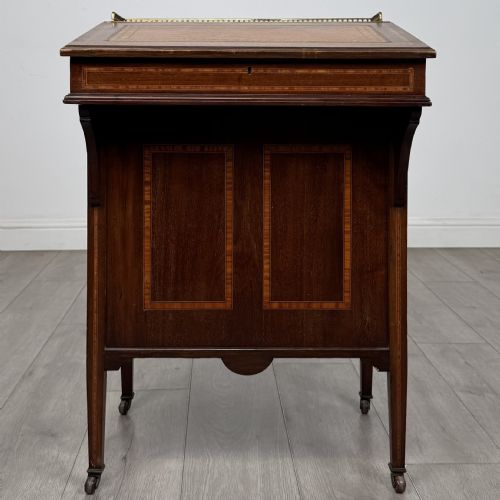
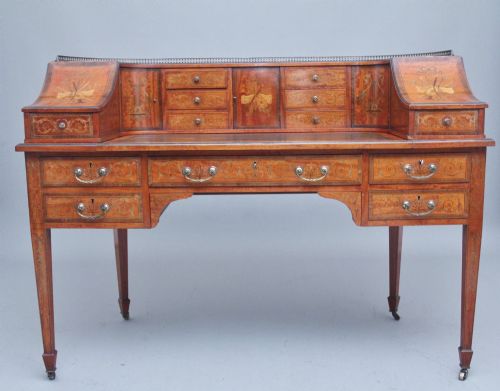
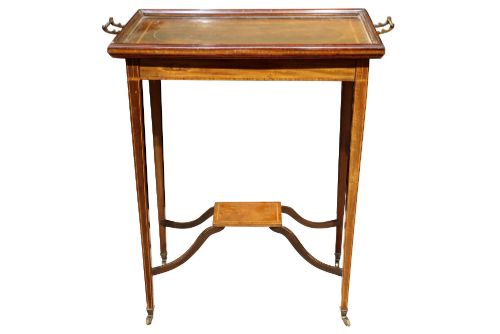
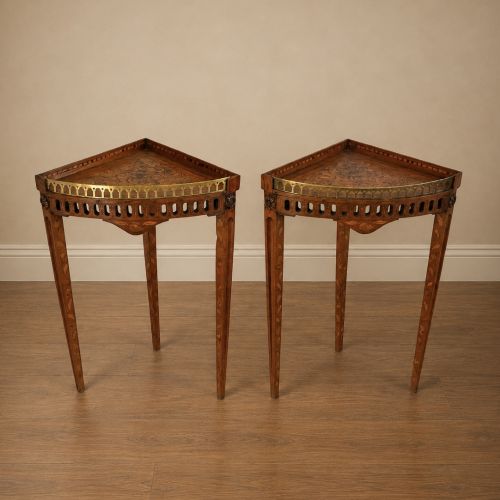
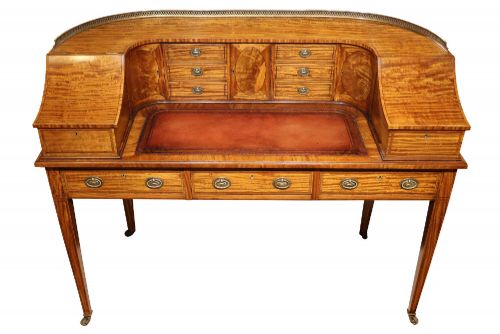
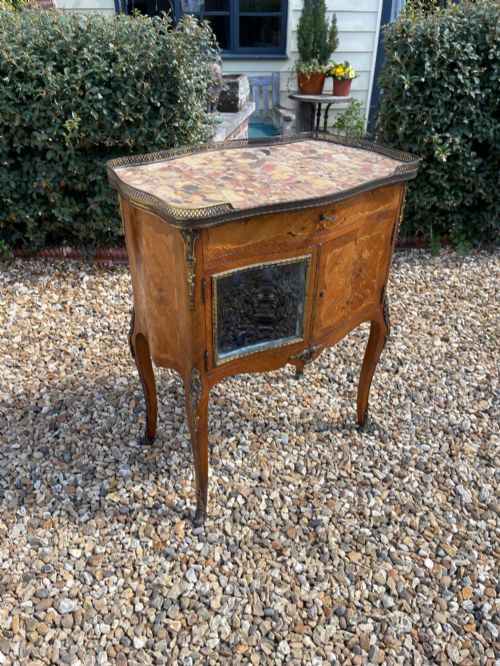
The forms on this page range widely from compact side and corner tables to elaborate writing desks, Carlton House desks, and bedside cabinets. Many examples incorporate contrasting timbers and delicate wood inlay, showing the influence of Sheraton Revival and neoclassical styles.
On this page, you are most likely to meet Edwardian and nineteenth-century pieces that utilise satinwood alongside mahogany, walnut, and kingwood. These tables serve both decorative and practical roles, whether as a lamp table in a corner or a ladies writing desk in a study.
How they were made
Cabinet makers constructed these pieces using solid and veneered timbers, laying satinwood over sturdier woods like mahogany and oak. Many examples employ crossbanding in kingwood and intricate wood inlay to create geometric and floral patterns across the surface.
The characteristic brass galleries were secured around the edges of the table tops to form a protective border. Drawers within desks and cabinets frequently feature oak linings and original brass handles, showing traditional joinery methods of the period.
Even the tiniest bedside cabinet on this page expects to hold your belongings behind a proper brass gallery.
What varies in quality
The standard of timber selection and inlay work marks the difference between standard production and finer pieces. Crisp marquetry and carefully matched grain patterns across satinwood and crossbanded borders require high skill from the cabinet maker.
The weight and finish of the brass gallery also indicate quality, with sturdier cast or pierced railings showing better execution than thin wire alternatives. Interior construction, such as the use of oak-lined drawers and original handles, further distinguishes finer examples.
Maple of London
The Satinwood Table with Gallery Glossary
- Satinwood
- A dense, lustrous timber native to tropical regions, prized for its golden sheen and smooth grain. It was widely utilised in fine cabinet making during the eighteenth and nineteenth centuries.
- Gallery
- A raised border or railing, usually made of brass, fitted around the top edge of a table, desk, or sideboard. Its primary function was to prevent small objects from rolling off the surface.
- Crossbanding
- A decorative border of veneer laid around the edge of a table top or drawer front, with the grain running perpendicular to the main panel. This technique frames the central wood and adds visual contrast.
- Marquetry
- The art of applying pieces of veneer to a structure to form decorative patterns and pictures. Makers used various coloured woods to achieve detailed floral or geometric motifs.
- Carlton House Desk
- A distinct form of writing desk featuring a curved superstructure fitted with small drawers and pigeonholes around three sides. It typically incorporates a leather-lined writing surface and a gallery.
Satinwood Table with Gallery: Frequently Asked Questions
What is a satinwood table with gallery used for?
These pieces served various domestic functions depending on their specific form. Smaller versions acted as side, lamp, or bedside tables, while larger examples functioned as writing desks and ladies writing tables.
The raised brass gallery made them particularly suitable for holding loose papers, writing implements, or decorative objects without risking them sliding onto the floor.
How do I tell Edwardian pieces from earlier ones?
Edwardian examples often display Sheraton Revival styling with light satinwood finishes, delicate inlay, and polished brass galleries. Pieces from the eighteenth century or early nineteenth century tend to show heavier proportions and different marquetry techniques.
Examining the secondary timbers inside drawers, such as oak linings, helps confirm the period of construction alongside the overall design characteristics.
Where should I place a gallery table at home?
A compact side or corner table works well beside seating or in hallways where the decorative timber top can be easily seen. Writing desks and Carlton House models suit studies or living spaces as functional writing surfaces.
Keep satinwood furniture away from direct sunlight and strong heat sources to protect the pale timber grain and prevent the veneer from drying out.
What materials are combined with satinwood?
Cabinet makers frequently combined satinwood with contrasting timbers like mahogany, walnut, and kingwood to create borders and inlaid patterns. Drawer interiors often utilised oak, while galleries and handles were made from brass.
These material combinations provided structural stability while allowing makers to achieve decorative contrast across the surface of the furniture.