


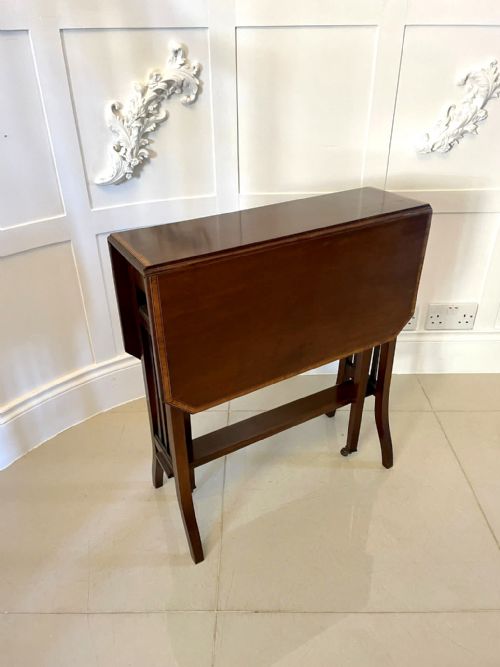


Satinwood Sutherland Table
These satinwood sutherland table pieces are folding occasional furniture offering narrow proportions when closed and wide surfaces when opened.
Satinwood Sutherland Table
A satinwood sutherland table is a narrow drop-leaf occasional table designed to take up minimal space against a wall until the hinged leaves are raised. The form relies on swinging gate-leg supports that pull outward to hold the drooping flaps level.
Most examples found here date from the Edwardian era and around nineteen hundred, alongside Victorian pieces from eighteen seventy onward. Makers utilised mahogany or burr walnut carcases overlaid or crossbanded with satinwood veneers to create contrasting top surfaces.
Forms span standard tea tables and occasional tables down to compact baby sutherland versions and unusual butterfly-shaped tops. These tables function easily as lamp tables or small coffee tables in modern rooms while retaining their folding mechanism.
How they were made
Cabinetmakers constructed these tables primarily using solid mahogany or walnut frames finished with fine satinwood veneers across the folding leaves and top panels. Boxwood and ebony stringing lines provide dark and light contrast within the borders of the woodwork.
Inlay work often incorporates satinwood banding and crossbanding around the perimeters, sometimes accompanied by painted decorative motifs. Supporting legs frequently connect through hinged gate mechanisms, utilising brass fittings and occasionally bobbin turned elements.
Satinwood Sutherland Table Retail Price Guide 2026
Typical asking prices for satinwood sutherland table among the pieces listed under this phrase on Sellingantiques today, from the lower quarter to the upper quarter. They describe what is for sale here now, not the wider market.
Some tables take the shape of a butterfly, spreading their golden wings across the room without ever learning to fly.
What varies in quality
Quality shows in the crispness of the satinwood inlay and the precision of the boxwood and ebony stringing details. Finer tables display carefully matched timber grains across the drop-leaf panels when opened flat.
The rigidity of the hinged gate supports when extended determines how stable the leaves remain under weight. Superior examples maintain smooth movement in the folding action alongside substantial timber thickness in the legs and frame.
Maple and Co
The Satinwood Sutherland Table Glossary
- Sutherland table
- A narrow drop-leaf table with hinged flaps supported by pivoting gate-legs. The design maximises floor space when folded down.
- Satinwood
- A pale, lustrous timber native to Ceylon and India, used extensively for veneering and inlay work in furniture. It provides a bright golden surface.
- Stringing
- Thin inlay lines of contrasting wood, such as boxwood or ebony, used to outline panels and borders. This linear detail defines geometric patterns on the top surface.
- Crossbanding
- A strip of veneer laid across the grain of the main panel, usually framing the outer edge of a table top. It creates a decorative border.
- Gate-leg
- A swinging leg attached to a hinged frame that pivots outward to support a drop-leaf. This allows the folding leaves to bear weight securely.
Satinwood Sutherland Table: Frequently Asked Questions
How do you fold a sutherland table?
Lift each drop-leaf upward until the surface sits level with the fixed centre top. Swing the pivoting gate-legs outward from the underframe until they lock into position beneath the extended flaps.
To close the table, swing the gate-legs back inward toward the central stretcher and lower the leaves gently to hang vertically at the sides.
What rooms suit a sutherland table?
These tables fit easily beside sofas or chairs as lamp tables or small tea tables. Their narrow folded profile allows them to rest against walls in hallways or tight spaces.
When fully opened, the larger surface area accommodates drinks or books, making them adaptable for sitting rooms where floor space is limited.
How do I identify an Edwardian sutherland table?
Edwardian examples typically feature light mahogany or satinwood timbers decorated with delicate boxwood stringing and crossbanding. The construction feels lighter and more refined than earlier Victorian pieces.
Dates cluster around nineteen hundred and the Edwardian period, often displaying inlaid oval top designs or butterfly shapes supported by slender legs.
What is a baby sutherland table?
A baby sutherland table is a smaller version of the standard drop-leaf design, built with reduced dimensions for compact spaces. These pieces retain the same working gate-leg action in miniature.
They appear with mahogany frames and satinwood inlay, functioning as small occasional or lamp tables.