
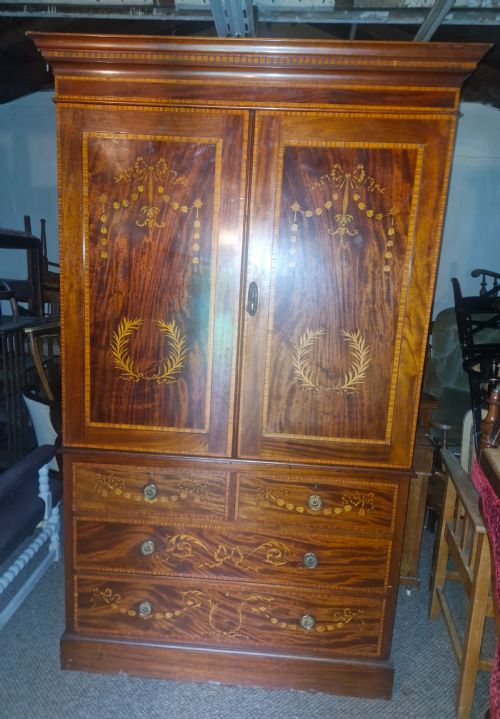


Satinwood Inlay Linen Press
These satinwood inlay linen press pieces combine generous storage with refined timber work, offering a striking centrepiece for a period bedroom.
Satinwood Inlay Linen Press
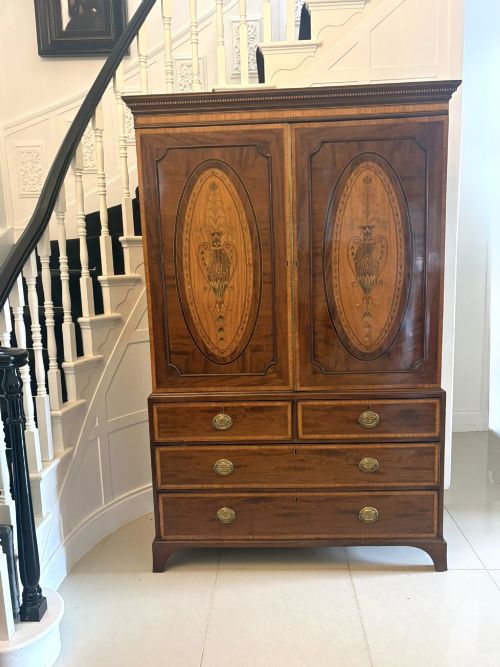
A satinwood inlay linen press is a substantial storage furniture piece designed to house linens and garments, merging upper shelving compartments with lower drawer space. These pieces span several distinct eras, appearing in Georgian, Victorian, and Edwardian interpretations, as well as the later Sheraton Revival style.
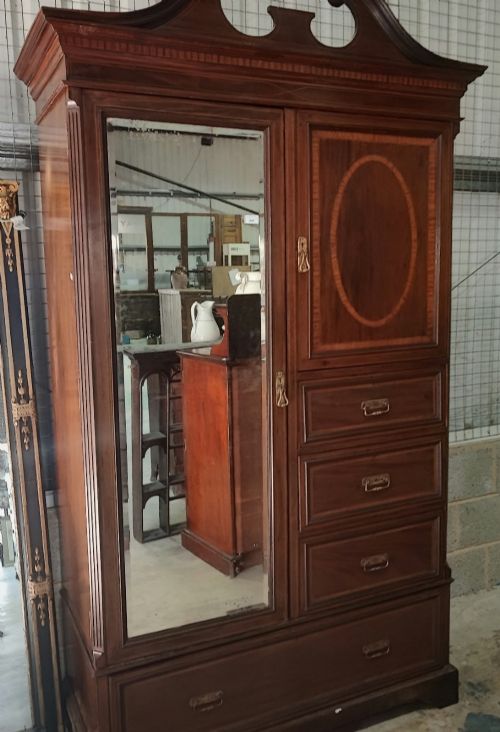
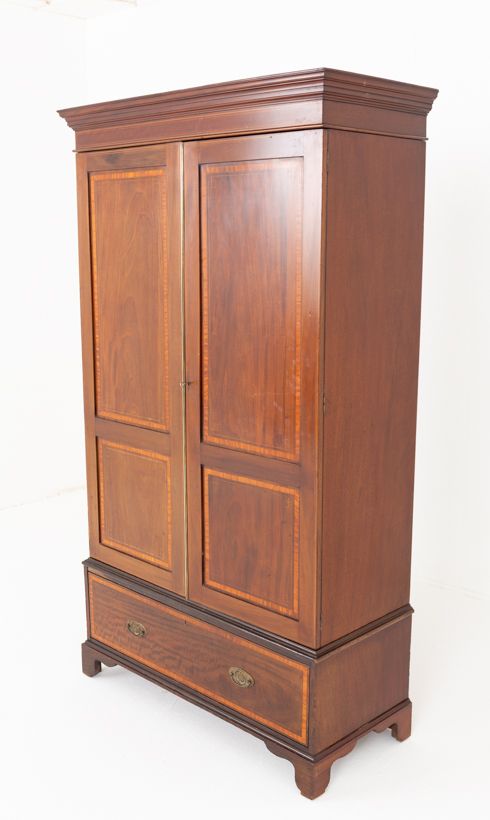
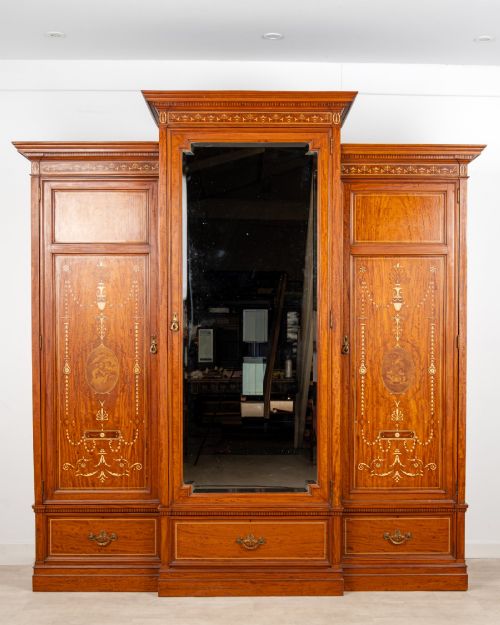
The versions most commonly met on this page range from late eighteenth century George III examples to early twentieth century Edwardian pieces. Buyers encounter both traditional housekeepers cupboards and grander multi-section wardrobes featuring elaborate crossbanding and contrasting wood details.
Construction and materials
Cabinet makers utilised mahogany as a sturdy structural timber, applying contrasting veneers and marquetry details in satinwood, boxwood, and rosewood. These intricate inlays define panels, cornices, and drawer fronts with precise geometric or floral motifs.
Functional elements such as brass hardware and mirror glass are integrated into larger multi-door wardrobes and compactum designs. Structural integrity relies on traditional joinery methods that support heavy timber framing and panelled doors.
Listings feature Edwardian, Victorian, and Georgian eras, showcasing materials such as mahogany, satinwood, rosewood, and brass hardware across multiple wardrobe formats.
Markers of distinction
The hierarchy of quality rests on the precision of the timber selection and the complexity of the contrasting bandings. Finer pieces display exceptionally crisp satinwood inlay work against richly grained mahogany bodies without awkward proportions.
Maker attribution and internal configuration also elevate a piece. Comprehensive internal fittings, original brass fittings, and well-preserved painted or polished surfaces distinguish the finest workshop output from simpler utilitarian storage.
Edwards and Roberts·Druce & Co·Waring & Gillow·Maples & Co
The Satinwood Inlay Linen Press Glossary
- Linen press
- A tall storage cabinet traditionally used for flat linens, featuring sliding trays or shelves behind upper doors above a chest of drawers.
- Satinwood
- A lustrous, fine-grained timber with a golden yellow sheen, frequently utilised for decorative inlays and banding on darker woods.
- Crossbanding
- A border technique where veneer strips are laid perpendicularly to the grain of the surrounding panel to create a framed effect.
- Compactum
- A multi-functional fitted wardrobe combining hanging space, shelves, and drawers within a single unified footprint.
- Marquetry
- The art of forming decorative patterns using fitted pieces of various coloured woods and veneers set into a surface.
Satinwood Inlay Linen Press: Frequently Asked Questions
How do I date a linen press?
Dating relies on observing the combination of timber choices, construction methods, and stylistic cues present in the cornices and feet. Pieces from the Georgian period often display cleaner architectural lines, whereas Edwardian and Sheraton Revival examples frequently incorporate more elaborate marquetry and mirrored doors.
Examining the internal drawer construction and backboards offers further clues to the manufacturing decade. Cabinet makers shifted their framing techniques gradually across the nineteenth century, moving from hand-planed timbers to more standardised industrial milling.
Where should I place a large wardrobe?
These large storage pieces require a room with adequate ceiling height and wall space to accommodate their substantial footprint and projecting cornices. Bedrooms and spacious dressing rooms suit them best, allowing the polished timber and inlay work to function as a focal point.
Ensure the chosen location avoids direct sunlight and heavy temperature fluctuations to protect the delicate satinwood veneers and polished mahogany surfaces from warping or fading over time.
Are the internal shelves adjustable?
Most traditional linen presses feature fixed internal shelving or sliding trays housed behind the upper cabinet doors. These configurations were designed specifically for folded textiles rather than modern hanging garments.
Some larger multi-section wardrobe variants incorporate hanging rails within dedicated compartments. Checking the internal layout helps determine whether a piece suits modern clothing storage or traditional linen stacking.
How do I maintain satinwood inlay?
Maintaining inlaid furniture involves keeping the timber nourished with appropriate wax polishes and avoiding excessive moisture. Gentle dusting with a soft cloth prevents surface grit from scratching the delicate contrasting veneers.
Positioning the furniture away from direct heat sources prevents the boxwood and satinwood stringing from drying out and lifting away from the primary mahogany substrate.