

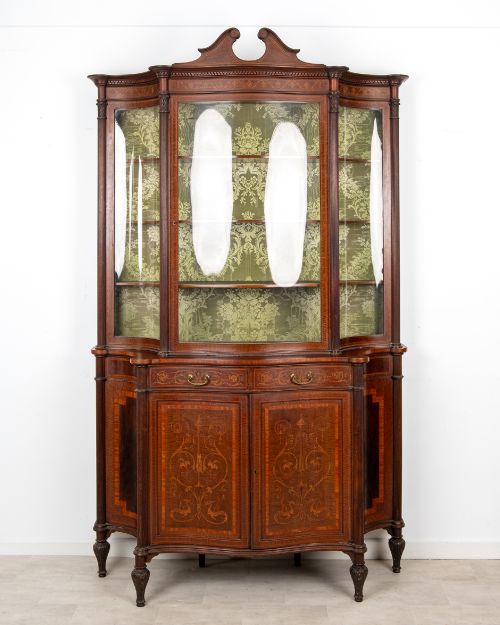
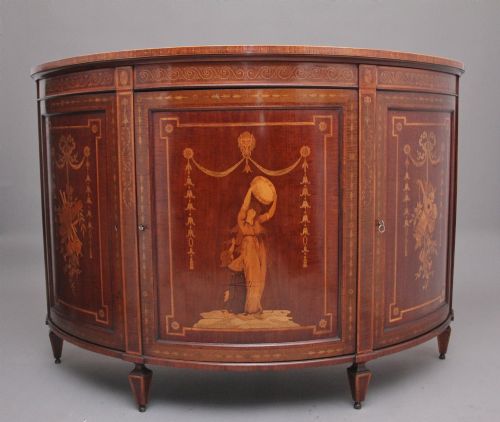
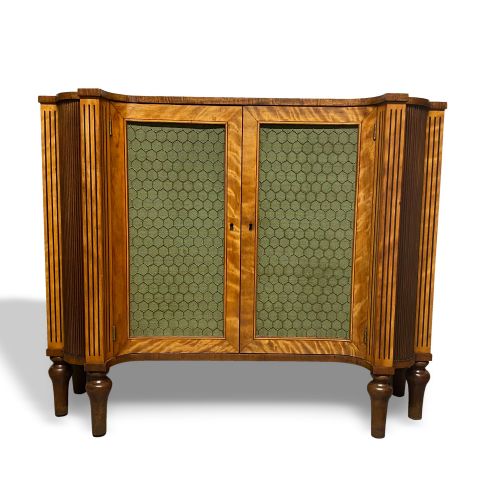
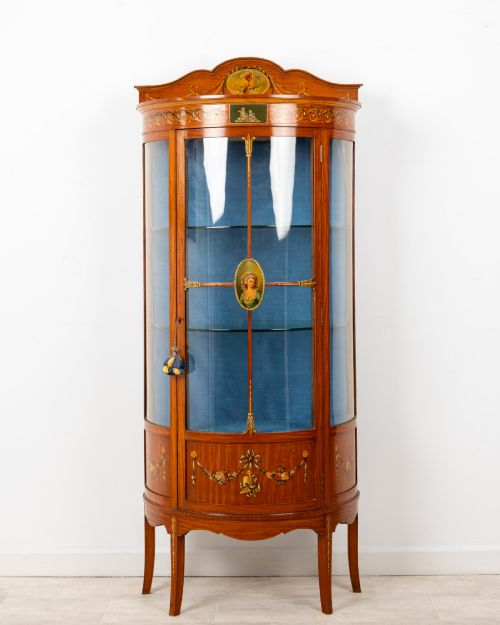
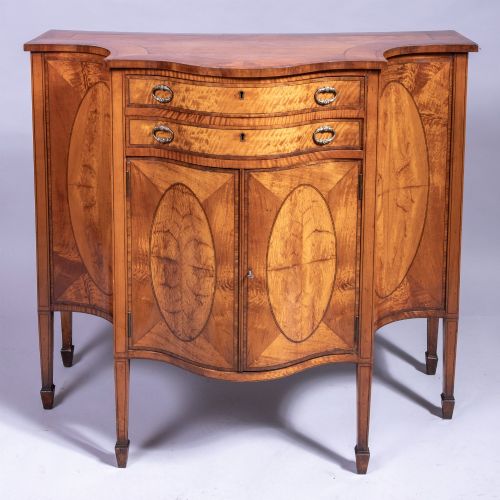
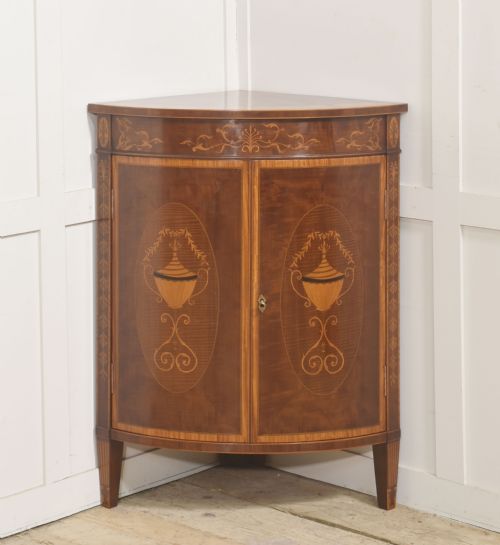


Satinwood Bowfront Cupboard
These satinwood bowfront cupboard pieces bring curved fronts and pale timber into a room, offering practical storage with cabinet doors.
Satinwood Bowfront Cupboard
A satinwood bowfront cupboard offers a curved front profile that softens the geometry of a room while providing enclosed storage behind doors. You encounter these pieces across several periods, most notably the Edwardian era, the nineteenth century, and the eighteenth century.
The selection ranges from bedside cabinets and corner cupboards to larger side cabinets and display cabinets. Many examples on this page reflect the Sheraton Revival style, incorporating painted decoration and fine inlay alongside the characteristic pale wood.
How they were made
Cabinetmakers constructed these pieces using solid timbers and veneers, frequently employing mahogany as a structural base beneath satinwood surfaces. Craftspeople shaped the curved front timbers through careful steam bending or layered construction.
Makers embellished the exteriors with intricate inlay work using ebony, rosewood, and satinwood, alongside hand-painted floral motifs. Brass hardware such as hinges, handles, and lock escutcheons completed the construction.
Satinwood Bowfront Cupboard Retail Price Guide 2026
Typical asking prices for satinwood bowfront cupboard among the pieces listed under this phrase on Sellingantiques today, from the lower quarter to the upper quarter. They describe what is for sale here now, not the wider market.
Materials recorded on this page include satinwood, mahogany, rosewood, ebony, and glass.
What varies in quality
The distinction between ordinary and exceptional pieces lies in the crispness of the inlay and the subtlety of the painted decoration. Fine examples display tight, precise marquetry where different timbers meet without visible gaps.
The choice of veneer figures heavily in the overall success of the piece, with richly grained satinwood commanding greater attention. Structural integrity in the curved doors and original brass fittings further elevate the standing of a cabinet.
Ince and Mayhew·Heal's·Edward and Roberts
The Satinwood Bowfront Cupboard Glossary
- Satinwood
- A lustrous, hard timber native to the tropics, prized for its golden colour and reflective sheen. It served as a primary veneer in high-end cabinetmaking.
- Bowfront
- A convex, outward-curving front profile common on chests, commodes, and cabinets. This curved shape softened the angles of traditional furniture.
- Marquetry
- The art of applying pieces of veneer to a structure to form decorative patterns and pictures. Craftsmen used various contrasting woods to achieve pictorial depth.
- Vitrine
- A glass-fronted cabinet designed for the display of porcelain, books, or curiosities. These pieces often feature glazed side panels to maximise light entry.
- Sheraton Revival
- A late nineteenth-century design movement that reinterpreted the light, neoclassical furniture forms of the eighteenth-century designer Thomas Sheraton. It frequently utilised satinwood, painted details, and delicate inlay.
Satinwood Bowfront Cupboard: Frequently Asked Questions
Where should I place a bowfront cabinet?
These cabinets work well in living rooms, hallways, or bedrooms where the curved front helps smooth traffic flow around corners. Their compact footprints make them suitable for spaces where a sharp-angled piece would jut out.
Position them away from direct sunlight to protect the pale satinwood veneer from fading over time. Pairing them with neutral walls allows the golden timber tones to stand out.
How do I care for satinwood surfaces?
Dust the cabinet regularly with a soft, dry cloth to prevent the buildup of particles that can scratch the polished finish. Avoid using modern silicone sprays or harsh chemical cleaners.
Apply a traditional beeswax polish sparingly once or twice a year to maintain the natural lustre of the timber. Keep the furniture away from direct heat sources such as radiators to prevent the veneer from drying out and lifting.
How do I distinguish Edwardian pieces from earlier ones?
Edwardian interpretations often display lighter structural proportions and machine-sawn internal components alongside hand-applied painted decoration. They frequently belong to the Sheraton Revival movement of around nineteen hundred.
Eighteenth-century originals show older construction methods, such as hand-cut dovetails in the drawer linings and heavier timber carcases. Examining the secondary woods inside the cabinet often clarifies the period of manufacture.