
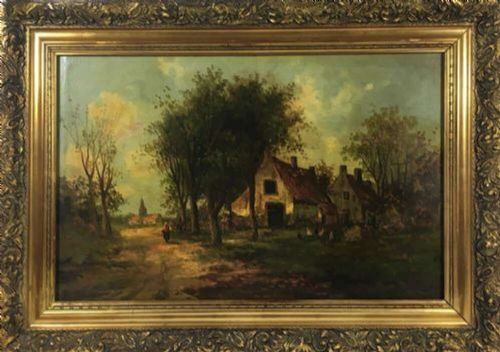


Rustic Village Scene Painting
A rustic village scene painting captures rural community life through the brush of artists working across the nineteenth and twentieth centuries.
Rustic Village Scene Painting
A rustic village scene painting portrays rural life, farmyards, and country streets through works created from the nineteenth century into the mid twentieth century. These pieces record settlements, village taverns, and local figures in oil and watercolour.
The selection here encompasses works executed in oil on canvas, panel, and paper, alongside watercolours. Artists recorded these subjects during periods including the Victorian era, the Edwardian period, and the mid twentieth century.
British and French influences dominate the selection, ranging from Barbizon School landscapes to West Country views and regional village scenes. Collectors encounter both signed works by known artists and primitive folk art examples.
Materials and methods
Artists painted these village scenes primarily using oil paint on canvas or wood panels, alongside watercolours on paper. Gold leaf often frames the finished works, while structural repairs to panels indicate the age and history of individual pieces.
Makers applied oil paint to build texture in rural street scenes, farmyards, and riverbank landscapes. Watercolours rely on fluid washes of pigment on paper to capture atmospheric light in locations such as Devon and Cornwall.
Listings feature works in oil and watercolour, created across the nineteenth and twentieth centuries by British and French artists.
Judging quality
Quality in these paintings rests on the surety of the brushwork and the artist's ability to structure a convincing rural composition. Stronger examples display careful handling of figures, animals, and village architecture.
The preservation of the paint surface and the original support material influence the standing of a piece. Works that retain their fresh pigments without excessive overpaint demonstrate superior historical survival.
Charles Vickers·David Woodlock·Robert McGregor·Walter Henry Sweet·Henry Charles Bryant·Eugene Battaille·Joseph Thors·William Greaves·John Holland Snr·John Baragwanath King
The Rustic Village Scene Painting Glossary
- Barbizon School
- A French movement of landscape painters who worked from nature, focusing on rural and forest environments. This approach influenced nineteenth-century depictions of farmyards and country villages.
- Genre painting
- The pictorial representation of scenes from everyday life, including figures working or gathering in villages. These works depict ordinary people engaged in daily activities rather than historical or mythological subjects.
- Oil on canvas
- Pigment bound in an oil medium applied to a stretched woven fabric support. This combination allowed artists to achieve rich colour depth and varied surface textures.
- Watercolour
- A painting method where water-soluble pigments are suspended in a water-based solution, typically applied to paper. It produces transparent washes that capture delicate atmospheric effects.
Rustic Village Scene Painting: Frequently Asked Questions
What periods do these paintings date from?
The works span from the nineteenth century through the Edwardian era and into the mid twentieth century. Artists produced these village scenes during distinct artistic movements including the Barbizon School and French Impressionism.
Dates on the pieces range from the early eighteen hundreds to the nineteen fifties, reflecting changing approaches to landscape and genre painting.
What mediums were used for these artworks?
Painters utilised oil paint applied to canvas, wood panels, or paper supports. Watercolours on paper also appear frequently among the village scenes.
Gold leaf frames often accompany the oil paintings, while the physical supports sometimes show historical repairs from past conservation.
Where do these village scenes typically depict?
The locations recorded in the titles include rural spots in Britain and France. Specific settings range from West Country villages in Cornwall and Devon to French farmyards and village streets.
Some pieces document named inns and fairgrounds, while others capture unlabelled rural settlements and riverbanks.
How should I care for an antique painting?
Keep oil and watercolour paintings away from direct sunlight and high humidity to protect the pigments and canvas supports. Stable indoor temperatures prevent the wood panels and canvas from warping or cracking.
Dust the surface gently with a soft, dry brush and avoid using liquid cleaners on the paint layer.