


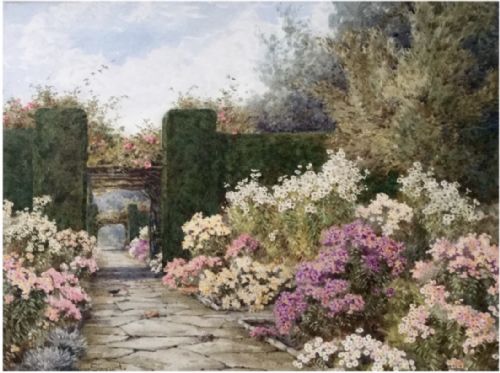


Pink Watercolour Landscape
These pink watercolour landscape works capture pastoral scenes through delicate washes on paper, offering subtle charm for any collector.
Pink Watercolour Landscape
A pink watercolour landscape presents a serene view of gardens, architecture, and countryside rendered primarily in watercolour paint on paper. These fine art watercolours date from the nineteenth century through to the 1930s, encompassing Victorian, Edwardian, and British Impressionism styles.
The paintings depict specific locales ranging from Yorkshire and Huntingdonshire to Holland and Venice. You will encounter pastoral garden scenes, old inns, and tranquil waterways framed behind glass in wood or gold leaf surrounds.
Most examples originate from established British artists working across the 1900s, 1910s, and 1920s decades. They serve as intimate windows into early twentieth-century rural and domestic life.
Materials and techniques
Artists applied watercolour pigment directly onto paper supports using traditional brushwork techniques. The water-soluble nature of the medium allowed creators to build luminous washes that defined skies, foliage, and architectural stonework.
Finished works received protection beneath glass panels to shield the delicate pigments from atmospheric moisture and dust. Wooden frames, frequently accented with gold leaf, enclosed the paper works to complete the presentation.
Listings span the nineteenth century, Victorian era, Edwardian period, and the 1900s through 1930s.
Judging quality in these watercolours
Quality rests upon the artist's handling of light and atmospheric depth across the paper surface. Superior works demonstrate confident brush control and a harmonious balance of pigment washes.
The preservation of the original paper and the integrity of the framing materials also influence the overall character of each piece. Well-maintained watercolours retain their subtle tonal gradations without excessive fading from light exposure.
Lilian Stannard·John D Walker·David Woodlock·Fred Lawson·Owen Bowen·Charles Edward Wilson·William Crouch·George Graham
The Pink Watercolour Landscape Glossary
- Watercolour paint
- A colour medium consisting of finely ground pigment suspended in a water-soluble binder. It produces transparent washes that allow the white of the paper to reflect light back through the pigment.
- Gold leaf
- Extremely thin sheets of beaten gold applied to wooden mouldings. It provides a warm, reflective border that complements the soft tones of the painting.
- Fine art
- Creative works valued primarily for their aesthetic and imaginative qualities rather than functional utility. These paintings represent traditional British and European landscape subjects.
- Victorian
- The period of British history spanning the reign of Queen Victoria. Works from this era often reflect classical or romantic sensibilities in landscape depiction.
Pink Watercolour Landscape: Frequently Asked Questions
How should I hang a watercolour painting?
Keep these works away from direct sunlight to prevent the watercolour pigments from fading over time. Stable room temperatures protect both the paper and the wooden frames.
Position the paintings at eye level in rooms with minimal humidity. Proper placement ensures the paper support remains flat within its glass enclosure.
What subjects do these landscapes feature?
The compositions record specific British and European views including walled gardens, country inns, and Yorkshire dales. Scenes also extend to continental destinations such as Dutch canals and Venetian waterways.
Artists focused on natural light falling across gardens, rural architecture, and historic townscapes. Each piece documents a distinct location observed in the nineteenth or early twentieth century.
How do I identify the period of a piece?
Examine the stylistic traits, artist signatures, and framing methods associated with the Victorian, Edwardian, or early twentieth-century decades. Records and signatures often link directly to known active years of British artists.
Stylistic shifts from nineteenth-century classical approaches towards British Impressionism help narrow the date of creation. Documentation on the reverse or within titles provides further chronological context.
What materials protect the paper?
Protective glass shields the delicate paper surface from airborne dust and physical contact. Wood mouldings, sometimes enhanced with gold leaf, secure the glass and paper together.
This traditional framing method creates a sealed environment that preserves the water-soluble pigments. Original frames also offer clues regarding the historical presentation of the artwork.