
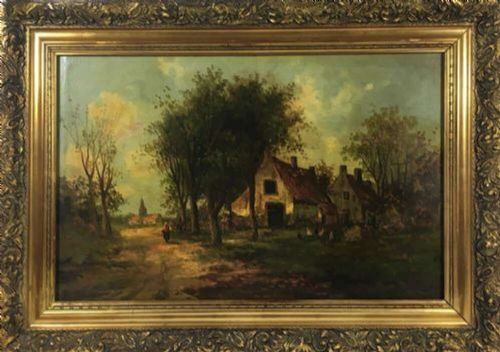


Rustic Village Painting
A rustic village painting captures rural life on canvas or paper, offering buyers a window into historic countryside settlements through oil or watercolour.
Rustic Village Painting
A rustic village painting depicts rural life, streets, inns, and farming landscapes from periods such as the nineteenth century and the Edwardian era. These artworks typically record country settlements, agricultural workers, and quiet village lanes through the eyes of academic and folk artists.
Buyers meet works executed in oil on canvas, oil on panel, and watercolour on paper, framed in wood and gold leaf. The selection ranges from French farmyard scenes and West Country watercolours to primitive folk art street scenes.
Subject matter spans from bustling village fairs and tavern exteriors to quiet paths between rural cottages. The style moves from Barbizon School realism and French Impressionism to British nineteenth-century genre painting.
Evaluating quality and execution
Quality rests upon the artist's handling of light, perspective, and atmospheric depth within the rural setting. Stronger compositions demonstrate confident brushwork and accurate proportions in figures, architecture, and animals.
The condition of the pigment and support dictates the piece's integrity, distinguishing well-preserved canvases and watercolours from those suffering heavy craquelure, foxing, or structural repairs to panels.
The listings span oil on canvas, watercolour paint, and wood, recording nineteenth-century and Edwardian village scenes across Britain, France, and Burma.
Charles Vickers·David Woodlock·Walter Henry Sweet·Fred Lawson·Henry Charles Bryant·Eugene Battaille·Joseph Thors·William Greaves·John Holland Snr·John Baragwanath King·Georgina Lara·Leopold Rivers
The Rustic Village Painting Glossary
- Barbizon School
- A French movement of landscape painters focusing on direct observation of nature. It influenced nineteenth-century depictions of rural and farmyard life.
- Genre painting
- Artwork depicting scenes from everyday life, typically involving ordinary people engaged in common activities. These works often feature children, villagers, and tavern visitors.
- Oil on canvas
- A painting technique utilising pigments suspended in drying oils applied to a stretched fabric surface. This combination provides durability and rich colour depth.
- Watercolour paint
- A water-based medium employing finely ground pigments in a binder. It creates transparent washes on paper, favoured for topographical and coastal village views.
- Folk art
- Artistic work created within a traditional culture by self-taught makers. These pieces prioritize narrative charm and direct expression over academic perspective.
Rustic Village Painting: Frequently Asked Questions
How do I date a rustic village painting?
Dating relies on stylistic clues, artist signatures, framing techniques, and the composition's clothing and architecture. Nineteenth-century works often carry distinct stretcher marks and canvas stamps.
Paper watercolours from the Edwardian period or earlier frequently exhibit period watermarks or framing inscriptions on the reverse.
What is the difference between oil and watercolour village scenes?
Oil paintings on canvas or panel offer heavier texture, deeper colour saturation, and greater resistance to light degradation. They suit grander interior walls.
Watercolours on paper deliver lighter, more luminous impressions of rural atmosphere and require protective framing behind glass.
Where should I hang a rural painting at home?
These works suit traditional dining rooms, libraries, and hallways where wooden furniture and neutral walls complement historic pastoral themes. Natural light enhances the subtle tones of nineteenth-century palettes.
Avoid placing watercolours in direct sunlight to prevent fading of the delicate pigments on paper.
Are these paintings signed by the artists?
Many pieces feature artist signatures or initials in the lower corners, while others remain attributed based on style, subject matter, and period records. Unsigned works frequently emerge from regional British or French schools.
Examine the canvas reverse or frame backing for historic inscriptions, dealer labels, and titles.