





Russian Religious Art
Russian religious art brings devotional beauty to interiors through sacred panel paintings and icons created across the eighteenth, nineteenth, and early twentieth centuries.
Russian Religious Art
Russian religious art primarily consists of panel paintings and icons that reflect the traditions of the Russian Orthodox Church. These sacred works serve as focal points for prayer and contemplation in homes and churches alike.
Buyers frequently encounter nineteenth-century pieces alongside works from the eighteenth and early twentieth centuries. Forms range from simple painted panels to detailed works featuring metal coverings known as oklads or rizas.
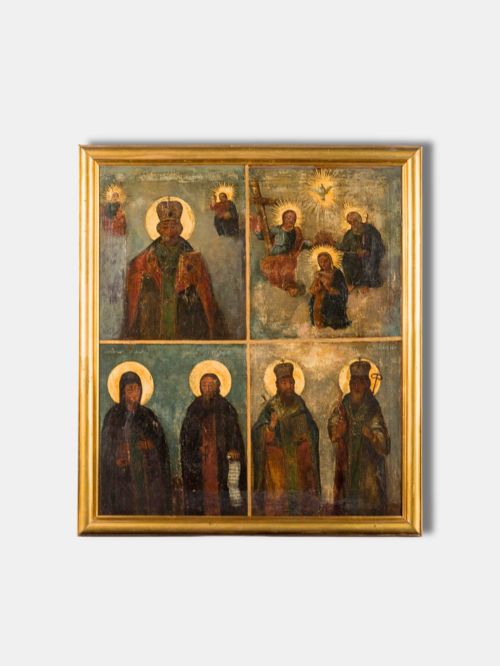
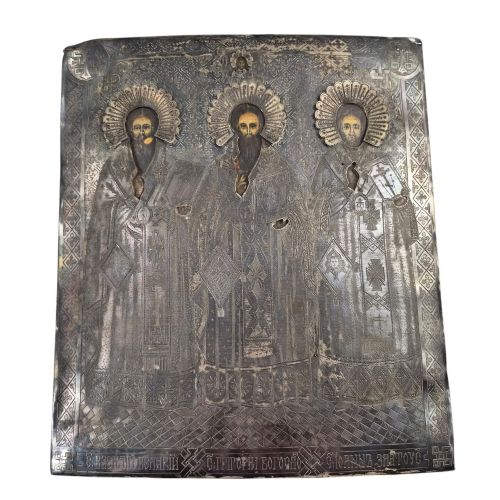
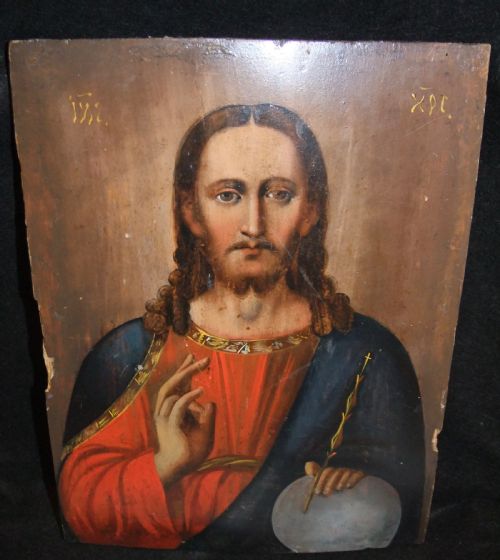
The subjects depicted include prominent holy figures, major theological scenes like the Crucifixion, and specific representations such as Christ Pantocrator or the Three Holy Hierarchs.
How they were made
Traditional creation methods involve applying tempera, egg tempera, or oil paints directly onto prepared wood panels, though canvas also appears as a base material. Artists build up the imagery using natural pigments suited to panel painting.
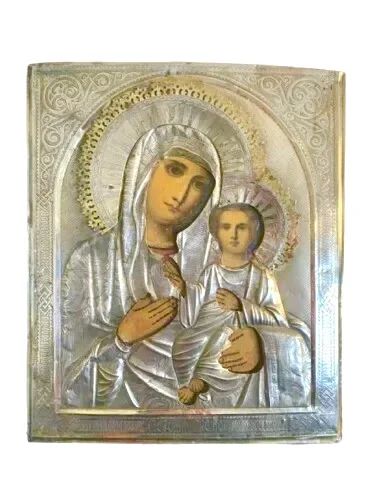
Many works incorporate precious elements such as gold leaf and silver to highlight halos, backgrounds, or vestments. Metal oklads and rizas in brass and silver are frequently fitted over the painted surfaces to protect and adorn the sacred imagery.
Angels get their own mounting instructions in the nineteenth century, proving that heavenly bodies occasionally require specialised carpentry.
What varies in quality
Quality differentiates standard workshop production from works associated with specific regional masters or documented makers. Finer examples display superior brushwork, refined facial expressions, and more intricate detailing in the painted layers.
The craftsmanship of the metalwork adds another layer of distinction, where heavily chased silver oklads reflect greater artisan skill than simpler brass coverings. The integration between the underlying panel painting and any applied metal casing determines the visual cohesion of the piece.
Heinrich Grünbaum·Volga Masters
The Russian Religious Art Glossary
- Icon
- A sacred panel painting depicting Christ, the Virgin Mary, saints, or theological narratives. These images are central to Orthodox worship and domestic prayer.
- Tempera
- A permanent, fast-drying painting medium consisting of coloured pigments mixed with a water-binder, traditionally egg yolk. This technique creates the durable matte surfaces seen on historic panels.
- Oklad
- A protective and decorative metal covering placed over an icon, leaving only the faces and hands of the figures visible. These are frequently fashioned from brass or silver.
- Riza
- An alternative term for an oklad, serving as a metallic cover that enhances the visual splendour of the holy figure beneath. It often includes repoussé and chased ornamentation.
- Christ Pantocrator
- A specific iconographic depiction of Christ as ruler of all, typically shown holding a gospel book and raising his right hand in blessing.
Russian Religious Art: Frequently Asked Questions
What is an icon?
An icon is a sacred panel painting used in Orthodox Christian prayer and worship. These works depict holy figures and biblical narratives following traditional iconography.
Created on wood panels using tempera or oil, icons are designed to act as spiritual windows connecting the viewer to the divine realm.
How do I identify periods?
Dating relies on stylistic shifts, material choices, and documentation associated with the piece. Eighteenth-century works often exhibit distinct regional painting characteristics.
Later nineteenth and early twentieth-century examples incorporate evolving framing techniques and varied applications of metal oklads over wood or canvas substrates.
How should I display them?
Displaying these works requires stable indoor environments away from direct sunlight and excessive humidity. Proper placement protects the delicate tempera and wood panels from warping.
Wall mounting or placement on dedicated shelves allows these devotional panels to become focal points within domestic spaces.