



Rural Harvest Oil Canvas
These rural harvest oil canvas works capture agricultural life across British fields, offering a timeless window into historical countryside scenes that collectors prize for their atmospheric depth.
Rural Harvest Oil Canvas
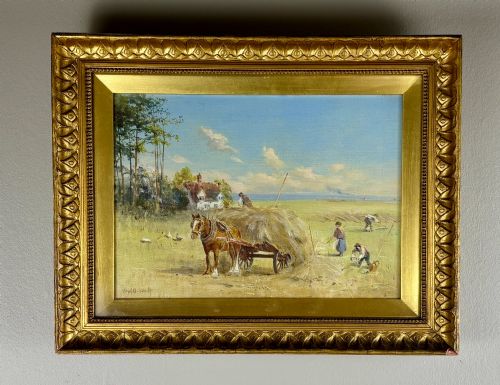
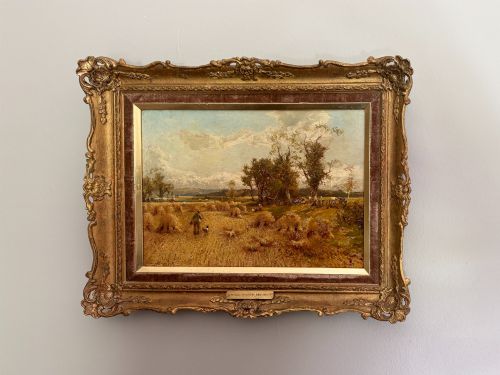
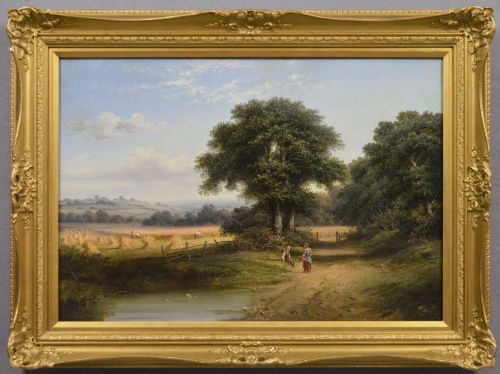
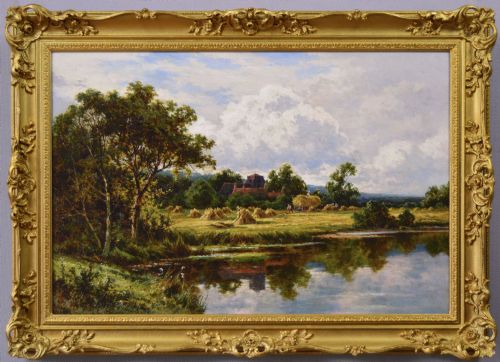
When you examine a rural harvest oil canvas, you look at historical depictions of agricultural labour, haymaking, and cornfields set across British landscapes. These works record figures gathering wheat, farmworkers with horses, and quiet pastoral moments by rivers and valleys.
The versions you most commonly meet on this page date from the nineteenth century through the mid twentieth century. They range from Victorian rural naturalism and British impressionism to twentieth-century realism and naive school interpretations on canvas.
How these paintings were produced
Artists painted these scenes using oil paint applied to woven canvas supports, often stretched over wooden frames. The medium allowed for rich texture, subtle blending of light in harvest fields at sunset, and durable preservation of pigments.
Many of these works are housed within their original giltwood frames adorned with gold leaf. The combination of oil on canvas and gilded wood reflects traditional framing techniques suited to period landscape art.
Rural Harvest Oil Canvas Retail Price Guide 2026
Typical asking prices for rural harvest oil canvas among the pieces listed under this phrase on Sellingantiques today, from the lower quarter to the upper quarter. They describe what is for sale here now, not the wider market.
Among the harvest fields and quiet rivers, ducks occasionally wander into the harvester's picnic to share the midday break.
What separates works within this range
Quality in a rural harvest oil canvas depends upon the artist's command of light, atmospheric perspective, and the naturalistic rendering of figures and animals. Superior examples capture the specific glare of a harvest sun and the convincing movement of farmworkers.
The handling of the canvas surface and brushwork also distinguishes the works. Finer paintings demonstrate confident, purposeful application of oil paint that brings depth to the cornfields and skies, whereas lesser examples rely on formulaic repetition.
Walter Heath Williams·Henry John Boddington·William Grant Murray·J.C. Grey·James William Booth·Helmut Reuter·Arthur Walker Redgate·Herbert Royle·Frederick J. Knowles·Joseph Paulman·Henry John Kinnaird·Frederick William Jackson·George Cole·William Greaves·Henry H Parker·Joseph Thors·Alfred Augustus Glendening Snr·William Kay Blacklock·John Clayton Adams
The Rural Harvest Oil Canvas Glossary
- Canvas
- A heavy woven fabric, typically linen or cotton, stretched over a wooden frame to serve as a sturdy surface for oil painting.
- Giltwood
- Wood carved and covered with a thin layer of gold leaf, frequently found on the period frames enclosing these pastoral scenes.
- Genre painting
- Artwork depicting scenes from ordinary life, including agricultural labour and farmworkers engaged in daily harvest tasks.
- Impressionism
- An art style focusing on accurate depiction of light in its changing qualities, seen here in British and Scottish regional interpretations.
- Pastoral
- A genre of art depicting the rural countryside, shepherds, and agricultural life in an idealized or naturalistic manner.
Rural Harvest Oil Canvas: Frequently Asked Questions
What periods do these harvest paintings represent?
The works span from the Victorian era through the Edwardian period and into the mid twentieth century. They reflect changing artistic interpretations of British agriculture over several decades.
Most examples date specifically from the late nineteenth century and the early decades of the twentieth century. This timeline captures the height of rural naturalism and British impressionist movements.
What subjects typically appear in these scenes?
Common subjects include figures gathering wheat, haymaking with horses, and workers resting near harvest fields. Some compositions feature specific locations such as Wharfedale, the Vale of Evesham, or the river Kennet.
Artists also incorporated animals like geese and ducks into the landscape. These genre details ground the pastoral views in recognizable British geography.
How do I care for an oil painting on canvas?
Keep the canvas away from direct sunlight and extreme fluctuations in temperature or humidity. Stable environmental conditions prevent the oil paint and wooden stretcher from warping or cracking.
Dust the surface gently with a soft, dry brush and avoid using water or chemical cleaners. Professional conservation should be sought for any deeper cleaning or canvas repairs.