


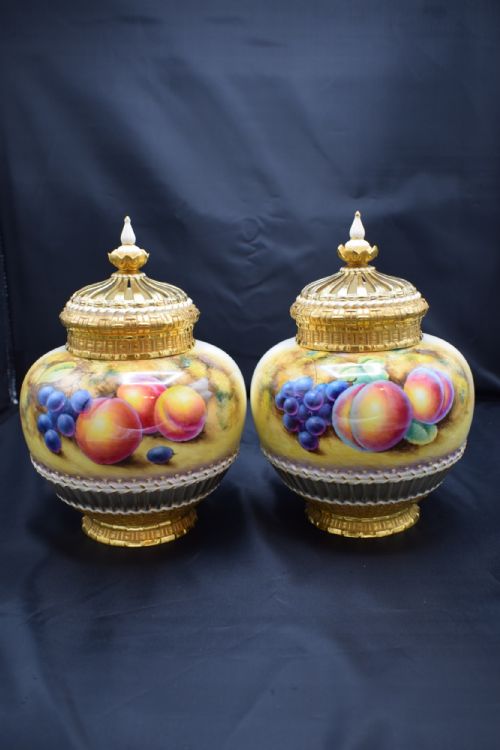


Royal Worcester Fruit Urns
Royal Worcester fruit urns are hand-painted porcelain showpieces that bring rich botanical colour and gilded elegance to any interior.
Royal Worcester Fruit Urns
Royal Worcester fruit urns represent the pinnacle of English ceramic painting, taking the form of vases, pot pourri jars, and ewers adorned with detailed studies of autumn fruits. When searching for royal worcester fruit urns, collectors encounter pieces spanning from the Victorian era through the mid-twentieth century, including the 1900s, 1910s, 1920s, 1930s, 1940s, 1950s, and 1960s.
The most common forms found on this page are lidded pot pourri vases and handled vessels, often featuring intricate crown tops or twin handles. These objects showcase traditional English craftsmanship, reflecting Edwardian and mid-century decorative tastes.
Makers and artists working within the factory developed distinct styles, ranging from intimate miniature vases to substantial rose jars and three-piece sets. Each vessel serves as a canvas for lush still-life compositions depicting peaches, grapes, berries, and apples against softly shaded backgrounds.
How they were made
These pieces begin as fine bone china or porcelain, shaped into classic urn, vase, and jar profiles before receiving an initial high-temperature kiln firing. Artisans then apply meticulous hand-painted enamel colours to build up the rich fruit studies, requiring multiple firings to fix the delicate pigments.
Gilding forms an essential part of the technique, with gold leaf and heavy gilt applied to handles, necks, and finials to frame the painted panels. This gold detailing is often burnished by hand to achieve a rich matte or polished contrast against the bright porcelain body.
Royal Worcester Fruit Urns Retail Price Guide 2026
Typical asking prices for royal worcester fruit urns among the pieces listed under this phrase on Sellingantiques today, from the lower quarter to the upper quarter. They describe what is for sale here now, not the wider market.
Painters occasionally hid stray insects amongst the painted peaches and grapes to showcase their fine brush control.
What varies in quality
The distinction between standard production and exceptional work lies primarily in the identity of the artist and the density of the painting. Pieces signed by renowned painters command greater attention due to the superior realism, depth, and brushwork evident in the fruit clusters.
The crispness of the moulding and the lavishness of the gilding further separate the tiers of quality. Heavy, pristine application of gold leaf and flawless preservation of the enamel colours elevate the status of any pot pourri jar or vase.
Chivers·Ayrton·William Hawkins·Freeman·William Ricketts·HH Price·John Smith·Richard Seabright·Kitty Blake
The Royal Worcester Fruit Urns Glossary
- Pot pourri
- A vase or jar featuring a pierced cover designed to diffuse scent from dried flowers and spices. These vessels often double as decorative fruit urns.
- Ewer
- A large jug with a wide spout and looped handle, historically used for water but produced by Royal Worcester as an ornamental showpiece.
- Gilding
- The application of gold leaf or powdered gold paint to ceramic surfaces. It highlights handles, rims, and borders with a lustrous metallic finish.
- Bone china
- A type of porcelain composed of clay mixed with bone ash. It produces a strong, translucent body ideal for fine decorative painting.
- Enamel
- Opaque glass-based paints applied over the glazed porcelain surface. These pigments are fired at lower temperatures to retain vibrant fruit hues.
Royal Worcester Fruit Urns: Frequently Asked Questions
How do I identify a signed piece?
Look closely near the base of the painted fruit panel for a handwritten artist signature, such as Ricketts or Freeman. These signatures indicate the work of a specialist painter employed by the factory.
Signatures confirm the individual artistry behind the piece, setting factory-painted items apart from standard transfer-printed wares.
Were these urns used for flowers?
Most pot pourri urns and covered vases served primarily as decorative garniture rather than practical flower holders. The pierced lids on pot pourri jars were specifically designed to release herbal scents.
Using them as dry display objects protected the delicate hand-painted enamel and heavy exterior gilding from moisture damage.
How should I clean my porcelain?
Dust these decorative pieces gently with a soft, dry brush to prevent any accumulation of dirt in the crevices of handles or crown tops. Avoid using harsh chemical cleaners or submerging the vessel in water.
Water and abrasive cloths can wear away the fragile gold leaf and enamel over time, dulling the finish of the painted fruit.
What is a ginger jar?
A ginger jar is a globular container with a high shoulder and a fitted lid, originally used in trade but adopted by English potteries for decorative storage. Royal Worcester adapted this traditional silhouette to display lush fruit paintings.
These jars provide a broad curved surface that allows artists to paint expansive panoramic fruit scenes.