




Royal Vienna Porcelain Vases
Royal vienna porcelain vases are ornate 19th-century decorative pieces combining classical painting with lavish gilding.
Royal Vienna Porcelain Vases
Royal vienna porcelain vases span the 19th century, featuring styles from Neoclassical and Empire to Rococo Revival and Victorian classical interpretations.
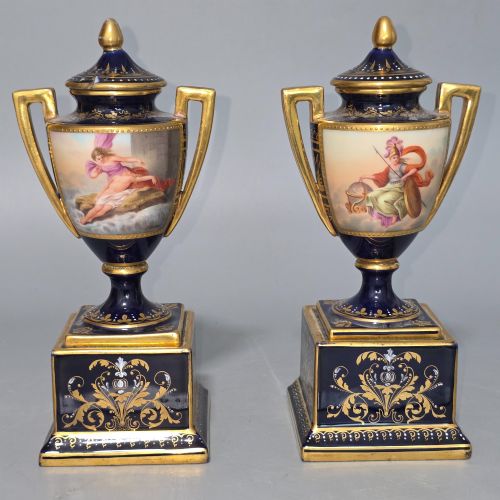
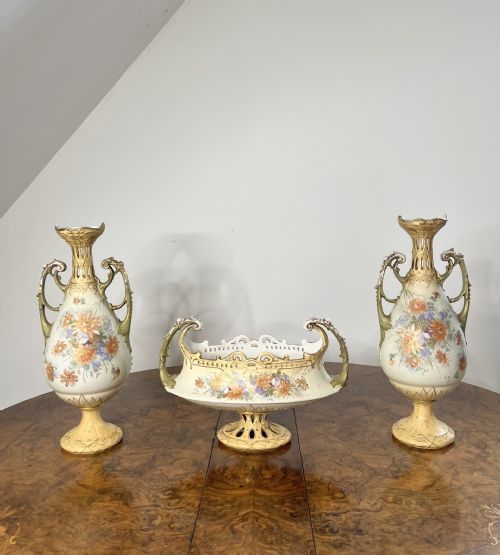
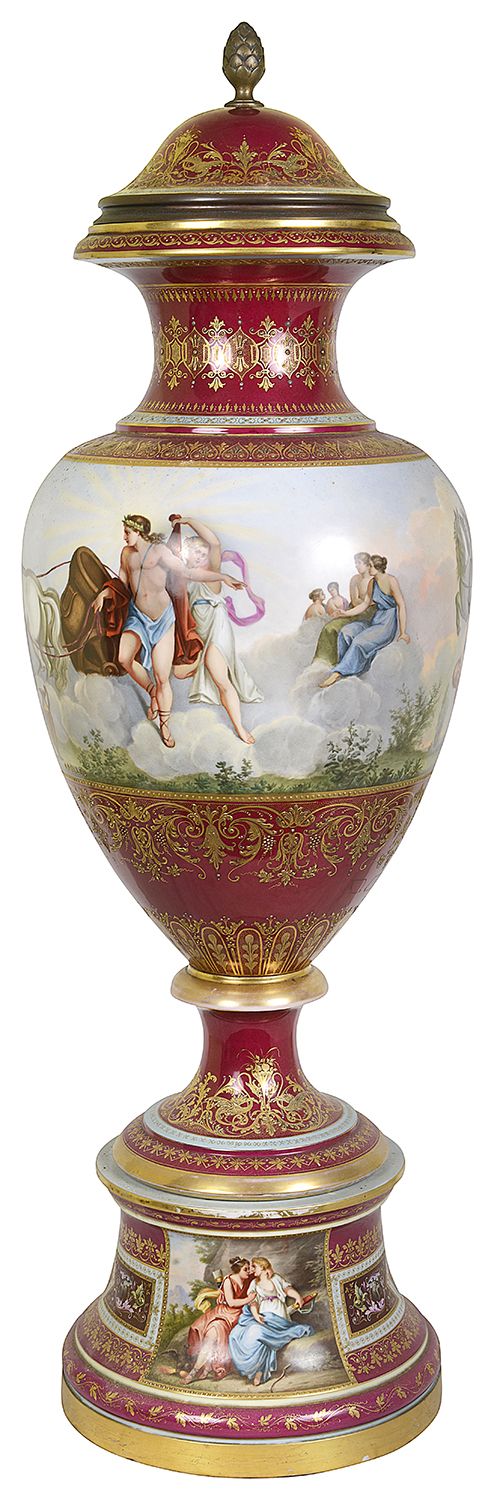
The objects appearing on this page include pairs of lidded urns, amphora vases, decorative ewers, and complete garniture sets.
Portrait vases, such as those depicting subjects like Lissette, sit alongside classical urns and hand-painted jugs.
Materials and construction
These pieces are constructed from porcelain and enhanced with hand-painted decoration, often incorporating wood stands in certain examples.
Surface ornamentation relies on enamel work alongside gold leaf, gilt, and extensive gilding applied to shape the forms.
Assessing quality and execution
Quality rests in the precision of the hand-painting, particularly on portrait and narrative pieces, compared to simpler decorative surfaces.
The application and richness of the gold leaf and gilding distinguish finer garniture sets and centrepieces from standard production.
F. Koller
The Royal Vienna Porcelain Vases Glossary
- Amphora vase
- A two-handled jar used for storage or decoration in ancient times, adopted in 19th-century Empire and Neoclassical revivals. These shapes often feature prominent handles rising from the shoulder to the neck.
- Garniture set
- A matching group of three or more vases or urns designed to be displayed together on a mantelpiece or sideboard. They typically comprise a larger centrepiece flanked by smaller matching vessels.
- Ewer
- A large jug with a wide spout and a handle, used traditionally for pouring water but rendered here as an ornamental piece. They appear frequently in late 19th-century classical revivals.
- Gilding
- The application of gold leaf or gold powder to the porcelain surface to highlight handles, rims, and pictorial borders. This technique elevates the decorative richness of the piece.
Royal Vienna Porcelain Vases: Frequently Asked Questions
What styles define royal vienna porcelain vases?
The listings show styles spanning Neoclassical, Empire, Rococo Revival, and Victorian classical adaptations. These designs draw heavily on classical antiquity and later 19th-century revivals.
Maker signatures and painted panels often accompany these revivalist forms, particularly on amphora vases and lidded urns.
How were garniture sets displayed?
Garniture sets of vases and urns were traditionally arranged symmetrically on mantelpieces, sideboards, or large tables as a unified decorative scheme. A larger central vessel was typically flanked by matching smaller pieces.
This balanced arrangement highlighted the matching enamel work and gilding across the entire set.
What materials make up these vases?
The pieces are formed from porcelain and decorated using enamel, gold leaf, and extensive gilding. Certain large examples also incorporate wooden components, such as display stands.
The combination of hand-painting and gold leaf defines the surface finish of the 19th-century output.
How do portrait vases differ from standard urns?
Portrait vases feature detailed hand-painted human subjects, such as named figures like Lissette, integrated into the porcelain body. Standard urns and amphora vases rely instead on classical scenes, floral motifs, or purely ornamental gilding.
Portrait pieces highlight the fine painterly skills employed during the 19th century.