
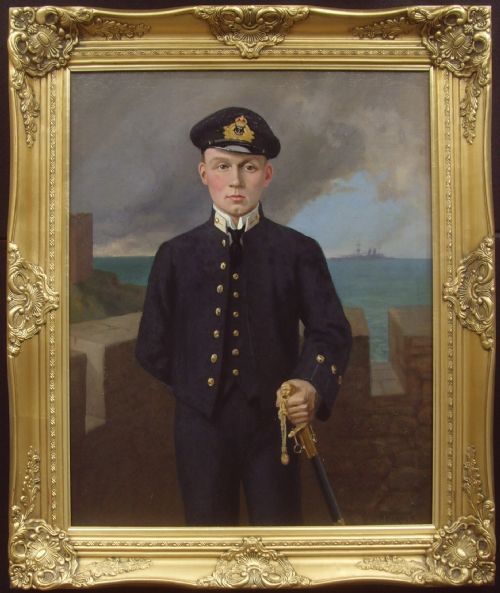


Royal Navy Portrait Painting
These royal navy portrait painting examples capture centuries of maritime leadership in oil and watercolour on canvas, paper, and wood.
Royal Navy Portrait Painting
A royal navy portrait painting records the likenesses of distinguished officers, monarchs, and notable vessels from the eighteenth century through to the mid-twentieth century. Buyers search for these works to secure historical depictions of naval command, featuring subjects such as admirals, captains, and royal figures in official uniform.
The selections available here span Georgian, Victorian, Edwardian, and mid-century periods, showcasing both formal canvas oils and intimate portrait miniatures on glass or paper. You will encounter works by named artists alongside pieces capturing specific historic ships like HMS Victory and HMS Swift.
Whether recording a decorated fleet commander or an early twentieth-century seaplane carrier, these paintings preserve the visual heritage of British maritime service. Each piece reflects the artistic conventions of its respective era, moving from eighteenth-century formal portraiture to twentieth-century realism.
Materials and technique
Artists rendering a royal navy portrait painting typically applied oil paint to stretched canvas or oil paint directly onto wood panels. Watercolour on paper also appears in maritime documentation, offering a lighter medium favoured by marine illustrators.
Framed paintings frequently utilise traditional wooden surrounds, occasionally protecting delicate surfaces behind glass. The handling of uniform details, medals, and naval regalia demonstrates the precise brushwork expected of period portraitists.
Listings feature works in oil, watercolour, and mixed media across canvas, paper, glass, and wood.
Distinctions in quality
The calibre of a royal navy portrait painting rests upon the artist's ability to render the likeness, facial expression, and psychological presence of the sitter with conviction. Superior examples display masterful handling of light across gold braid, ribbons, and naval uniforms, distinguishing them from mechanical or lesser-skilled studio output.
Provenance and attribution elevate certain works, particularly when the artist is documented or the sitter holds a significant rank such as Admiral of the Fleet. The stability of the canvas, the preservation of the original oil paint, and the integrity of the period frame further define the upper tier of these historical artworks.
Vincenzo D’Esposito·WF Mitchell·Henry L Gates·Samuel Lane·John Laviers Wheatley·William Dring·Maurice Codner·Richard Hall·Richard Livesay
The Royal Navy Portrait Painting Glossary
- Oil on canvas
- Pigments bound in a drying oil, usually linseed, applied to a woven fabric support stretched across a wooden frame. This primary medium allows for rich colour depth and layered blending.
- Portrait miniature
- A small, highly detailed painting executed on materials such as ivory, vellum, card, or paper, often housed in a protective case. These intimate works demand exceptional precision from the artist.
- Watercolour
- A painting method in which the paints consist of pigments suspended in a water-soluble vehicle, typically applied to paper. It provides transparent washes well suited to marine scenes.
- Regency
- The period in British history from 1811 to 1820, characterised by distinct shifts in fine art and portraiture styles following the Georgian era. Works from this time often exhibit neoclassical influences.
- Framed painting
- A work of art enclosed within a decorative protective border of wood or moulded material designed to hang on a wall.
Royal Navy Portrait Painting: Frequently Asked Questions
What periods do these portraits cover?
The selections span from the eighteenth century through the Victorian and Edwardian eras into the mid-twentieth century. You will find pieces dated across the 1800s, 1910, 1920, 1930, 1940, and 1950.
Each period brings distinct artistic styles, ranging from Georgian maritime portraiture to mid-century realism.
What materials were used to create them?
Artists employed oil paint on canvas, wood panels, and paper supports. Watercolours on paper and portrait miniatures under glass also feature among the recorded works.
Traditional wooden frames complete the construction of many pieces.
Who are the typical subjects depicted?
Subjects include monarchs such as King George VI, admirals, fleet commanders, naval officers, and historical vessels like HMS Victory. Many sitters are identified by name and rank.
These figures represent centuries of British naval history and service.
How should I display a canvas painting?
Hang paintings away from direct sunlight and excessive humidity to protect the oil paint and canvas substrate. Ensure the wall fixings safely support the weight of the wooden frame.
Keep pieces in stable indoor environments to preserve the materials.