


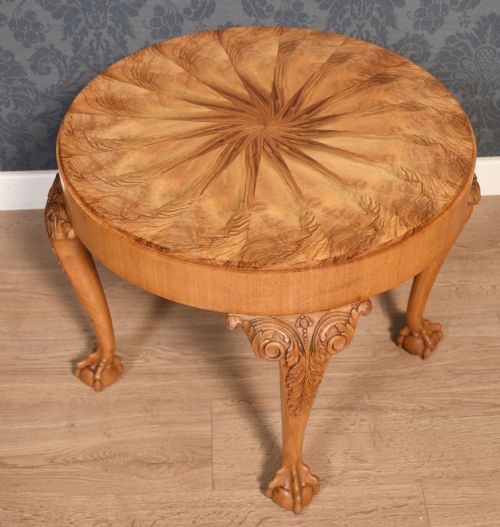


Round Walnut Cocktail Table
A round walnut cocktail table brings warmth and a strong grain to a seating area, combining low proportions with rich timber surfaces.
Round Walnut Cocktail Table
When you search for a round walnut cocktail table, you find low occasional tables designed to sit centrally before sofas and armchairs. The form appears across several decades, running from Edwardian examples down through the art deco period.
Most pieces seen here rely on circular tops supported by carved frames or straightforward pedestal bases. The timber takes many forms, shifting from plain walnut boards to highly figured burr veneers and marquetry tops.
Makers drew on various historical revivals alongside modernist lines. You encounter revival styles modelled on earlier centuries sitting alongside clean art deco designs.
How they were made
Cabinet makers utilised solid walnut alongside thin veneers to cover larger surfaces with striking grain patterns. Burr walnut veneer appears frequently, selected for its swirling knots and rich texture.
Secondary materials supplement the main timber on specific revival and decorative pieces. Giltwood, ebonised wood, and inset panels of marble or malachite introduce contrasting textures and colours to the design.
Round Walnut Cocktail Table Retail Price Guide 2026
Typical asking prices for round walnut cocktail table among the pieces listed under this phrase on Sellingantiques today, from the lower quarter to the upper quarter. They describe what is for sale here now, not the wider market.
Some tables wear pie crust edges, proving that pastry inspiration occasionally crossed over into fine cabinetry.
What varies in quality
The choice of veneer defines the visual impact of the top surface. Selected burr walnut or detailed marquetry displays greater skill and visual depth than plain timber.
Carving and edge detail separate standard production from finer work. Pie crust edges and shaped carved frames require careful hand labour, whereas simpler turned legs keep the construction straightforward.
The Round Walnut Cocktail Table Glossary
- Burr walnut
- A veneer taken from the warted growths of walnut trees. It yields complex, swirling grain patterns highly valued for decorative table tops.
- Pie crust edge
- A raised, scalloped rim carved around the circumference of a circular table top. This decorative border is typical of certain revival pieces.
- Marquetry
- The art of applying small pieces of veneer to a structure to form decorative patterns. It requires precision in cutting and fitting different woods.
- Ebonised wood
- Timber treated to resemble ebony through staining or painting dark. It provides a sharp contrast against lighter walnut sections.
Round Walnut Cocktail Table: Frequently Asked Questions
What periods do these tables come from?
The pieces span the early decades of the twentieth century. Examples range from Edwardian pieces made around nineteen ten through to art deco designs from nineteen thirty.
Production methods shifted slightly across these decades, moving from revival styles towards cleaner modernist lines while retaining walnut as the primary material.
How do I care for a walnut surface?
Walnut benefits from gentle cleaning with a soft cloth and occasional application of appropriate furniture wax. Avoid placing hot items or liquids directly onto the wood.
Keeping the table away from direct sunlight and strong heat sources protects the veneer from drying out or splitting over time.
What is a pie crust edge?
A pie crust edge is a decoratively carved, raised border running around the perimeter of a circular table top. It creates a shaped profile reminiscent of pastry crusts on traditional pies.
This detail appears on revival pieces and adds texture and visual interest to the silhouette.