
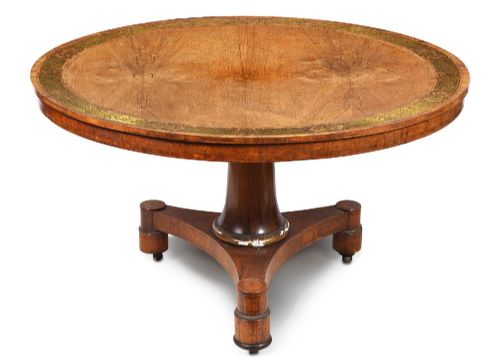
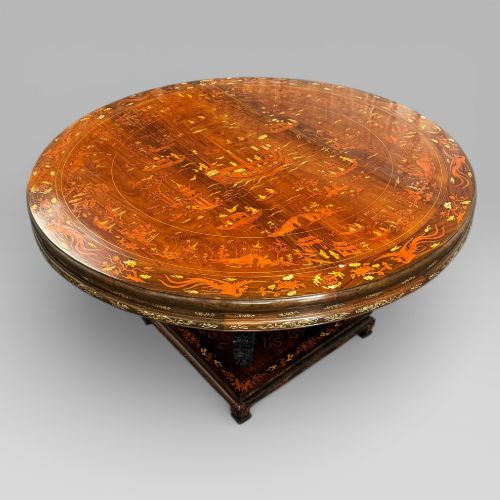
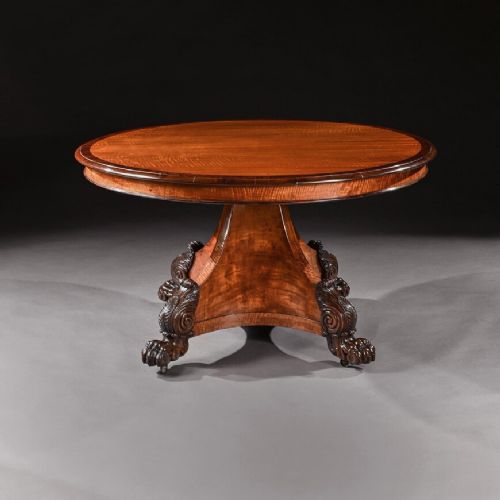
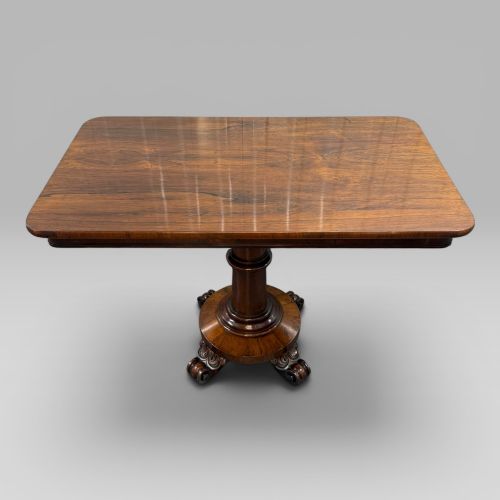

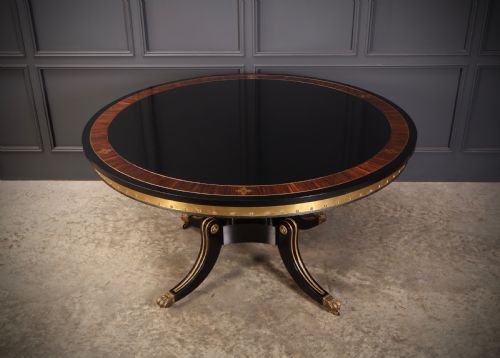


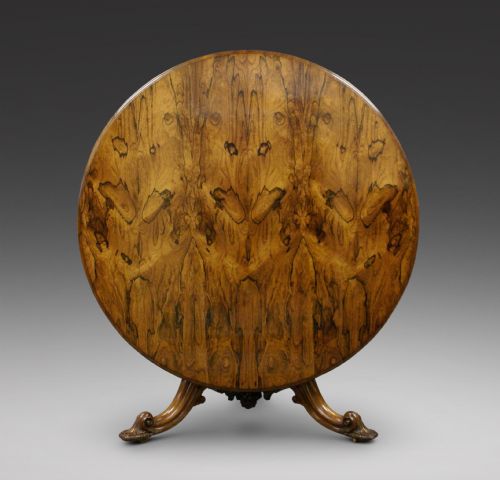
Round Rosewood Foyer Table
A round rosewood foyer table commands the centre of a grand entrance, bringing rich grain and heavy timber to your hallway.
Round Rosewood Foyer Table
When you search for a round rosewood foyer table, you are looking at substantial centre tables built to anchor large entrance halls and reception rooms. The pieces appearing here span the nineteenth century, including Georgian, Regency, William IV, and Victorian iterations.
Most examples function as freestanding centre tables, occasional tables, or tilt-top breakfast tables designed to sit centrally in a space rather than against a wall. These tables arrive in diverse cultural interpretations, ranging from British cabinetmaker productions to Chinese Export and Anglo Indian workshops.
How they were made
Cabinetmakers constructed these tables primarily from solid rosewood and wood veneers, frequently applying ebonised wood for darker contrasts. Structural elements often rely on mahogany or fruitwood as secondary timbers.
Decoration required intricate hand skills, incorporating brass inlay, satinwood detailing, mother of pearl accents, and elaborate fruitwood inlay or marquetry. Certain variations employ heavy marble tops set onto the timber framework.
Some tables tilt their faces away when resting, hiding elaborate marquetry like shy courtiers at a grand ball.
What varies in quality
Quality rests upon the ambition of the design and the precision of the cabinetmaking, distinguishing standard workshop production from marked pieces by known makers. The intricacy and preservation of brass inlay or marquetry shift an example from simple utility to high decorative art.
Proportion and scale dictate the visual weight of the timber, where substantial tilt-top mechanisms or heavily carved pedestals demand superior engineering. The depth of the rosewood grain and the crispness of the fruitwood or satinwood contrast directly influence the standing of the piece.
Edwards & Roberts·Peters of Genoa·James Winter of Wardour Street
The Round Rosewood Foyer Table Glossary
- Centre table
- A freestanding table finished on all sides to stand in the middle of a room rather than against a wall. These forms provide access from every angle and often feature heavy pedestals.
- Tilt-top table
- A table equipped with a hinged mechanism allowing the circular top to tip vertically when not in use. This clever design saved floor space in grand nineteenth-century houses.
- Marquetry
- The art of forming decorative patterns by fitting together small pieces of wood veneer, shell, or ivory. Craftsmen used contrasting timbers like satinwood and fruitwood to create elaborate surface designs.
- Ebonised wood
- Timber treated with chemical stains or dark finishes to imitate expensive ebony. This dark surface provided a stark background for brass inlay and lighter woods.
Round Rosewood Foyer Table: Frequently Asked Questions
Where should a round rosewood foyer table go?
These tables are designed to anchor spacious entrance halls, grand foyers, and large reception rooms as freestanding centrepieces.
Because they are finished on all sides and meant to be viewed from any angle, they work best when given adequate clearance in the middle of a space.
How do I identify a William IV table?
William IV examples typically feature heavy proportions, robust pedestals, and rich rosewood veneers dating from the 1830s.
They often incorporate architectural carving and substantial plinth bases that give them a heavy, grounded appearance.
What is a tilt-top mechanism used for?
The hinged mechanism allows the circular top to lock into a vertical position for convenient storage against a wall.
In period homes, this practical feature cleared the floor space when the room needed to serve another purpose.
How do I care for rosewood furniture?
Protect the timber by keeping it away from direct sunlight and maintaining stable room humidity to prevent veneer splitting.
Regular dusting with a soft, dry cloth preserves the natural lustre of the polished wood and inlaid details.