




Round Marble Lamp Tables
Round marble lamp tables bring circular stone surfaces and timber frames together to hold lamps beside seating.
Round Marble Lamp Tables
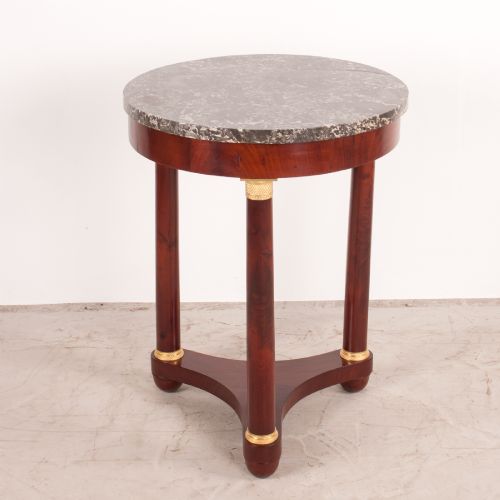
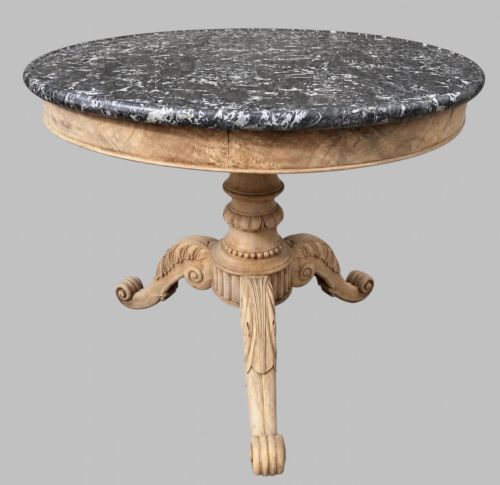
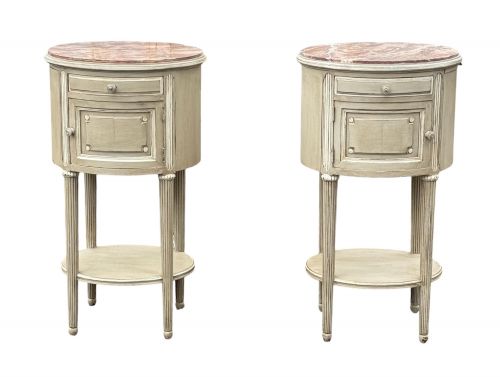
Round marble lamp tables appear mostly as French gueridon and occasional tables originating from the nineteenth century, alongside later twentieth-century interpretations. These circular pieces serve as compact surfaces for illumination and display within a room.
Makers constructed these tables using a variety of woods including mahogany, walnut, burr elm, kingwood, and satin birch, frequently pairing them with white marble or onyx tops. Styles draw heavily upon French Empire, Louis XVI, Regency, and Art Deco traditions.
The selection ranges from small wine tables and two-tier occasional stands to more substantial centre tables featuring giltwood, ormolu, or bronze ornaments. Buyers typically encounter pieces dating from the Victorian era up to the nineteen-thirties.
Materials and construction
Craftsmen shaped dense stones such as marble and onyx into circular slabs, setting them into timber frames built from mahogany, walnut, kingwood, and satin birch. Woodwork often incorporated ebonising, giltwood, or canework details.
Metal mounts in brass, ormolu, and bronze provided structural or decorative accents, securing columns, capitals, and leg supports. Joinery methods matched the cabinetry standards of nineteenth and early twentieth-century workshops.
Round Marble Lamp Tables Retail Price Guide 2026
Typical asking prices for round marble lamp tables among the pieces listed under this phrase on Sellingantiques today, from the lower quarter to the upper quarter. They describe what is for sale here now, not the wider market.
Rams heads occasionally peer out from nineteenth-century Empire frames to watch over your evening reading.
Assessing quality
Quality rests upon the selection of timber veneers and the figuration found in woods like burr elm and walnut, paired with the purity and veining of the marble top. Finer examples display crisper carving on giltwood elements or more intricate bronze and ormolu mounts.
Structural integrity depends on the stability of the central column or leg assembly and the precise fit of the stone insert within its wooden gallery.
The Round Marble Lamp Tables Glossary
- Gueridon
- A small circular table on a central pillar or multiple legs, originating in seventeenth-century France. These pieces function as occasional tables or stands for lamps and decorative objects.
- Bouillotte table
- A small neoclassical circular card or occasional table with a raised gallery around the marble top to prevent counters from rolling off. They frequently incorporate candlesticks or lighting brackets.
- Ormolu
- Gilded bronze mounted onto furniture as decorative ornamentation. The technique involves applying a mercury and gold amalgam to bronze before firing.
- Specimen marble
- A tabletop composed of various coloured marbles fitted together in geometric or pictorial patterns. This lapidary work showcases mineral diversity.
- Giltwood
- Timber that has been coated with a thin layer of gold leaf or gesso and gilding size. It provides a reflective surface on decorative frames and mounts.
Round Marble Lamp Tables: Frequently Asked Questions
What is a gueridon table?
A gueridon is a circular table supported by a central pillar or legs, designed for occasional use.
These pieces originally served as torchieres or small stands before evolving into general-purpose lamp and wine tables.
How do I date a marble lamp table?
Dating relies on identifying stylistic markers from periods like the Regency, French Empire, or Art Deco.
Wood types, construction methods, and mount designs also provide clues to the decade of manufacture.
Are these tables sturdy enough for daily use?
Most designs balance heavy stone tops on central columns or three-legged bases.
While functional for lamps and drinks, their stability depends on the weight distribution of the specific frame.
Where should I place a round marble table?
These compact pieces fit easily beside sofas, armchairs, or in narrow hallways.
The circular shape prevents sharp corners in tight spaces while offering a durable stone surface.