


Round Marble Foyer Table
A round marble foyer table brings immediate presence to an entrance hall, combining stone tops with timber frames across nineteenth-century forms.
Round Marble Foyer Table
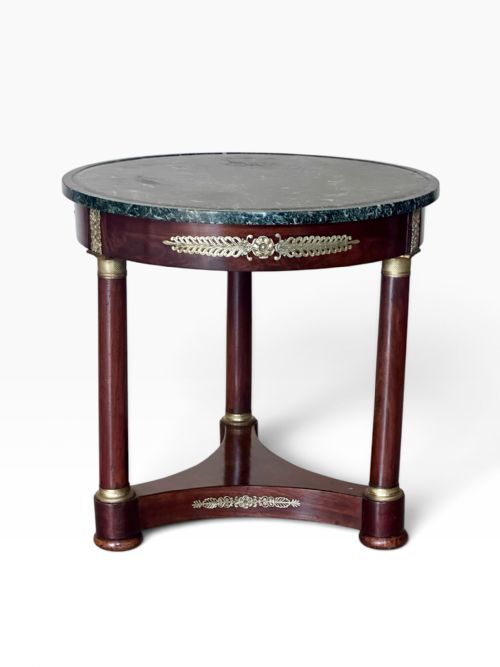
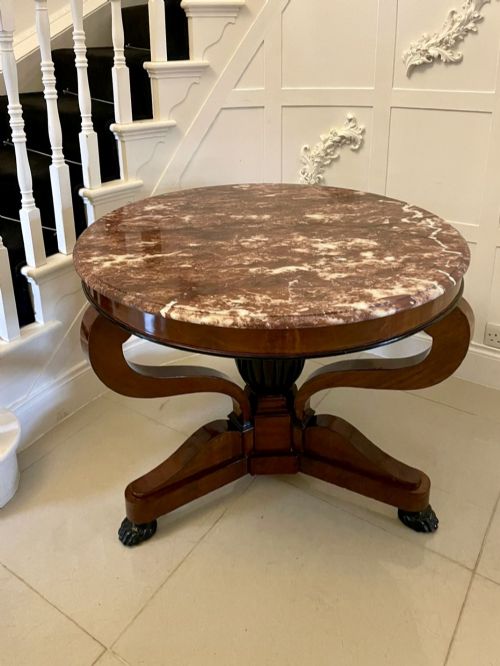
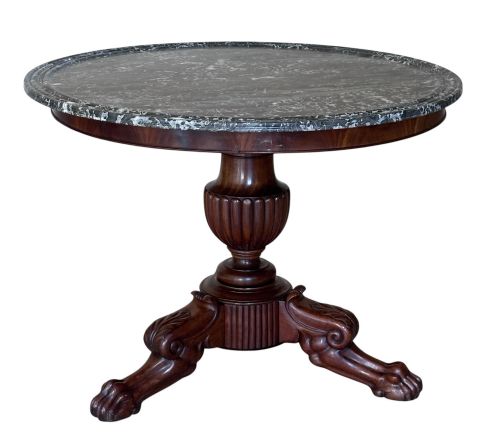
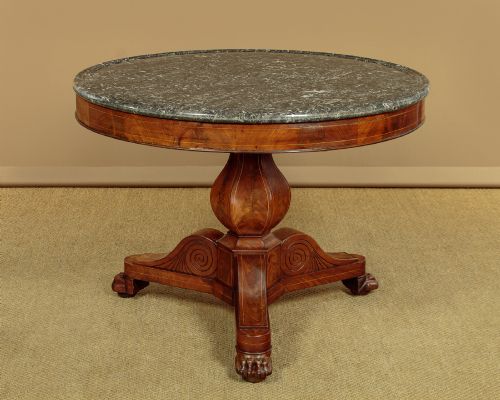
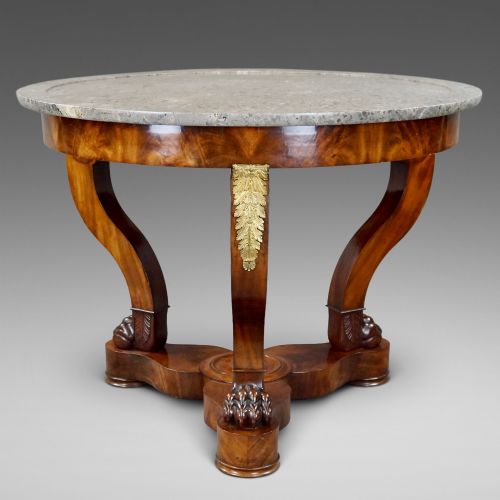
When searching for a round marble foyer table, you are looking primarily at French gueridons and centre tables dating from the nineteenth century. These circular pieces were designed to stand central to a room or hall, carrying heavy stone tops supported by timber pedestals or pillar frames.
The versions most commonly met on this page span the Regency, Empire, Louis Philippe, and Charles X periods, often taking the form of a freestanding guéridon. Mahogany and burr elm dominate the structural woodwork, frequently paired with white or grey marble inserts.
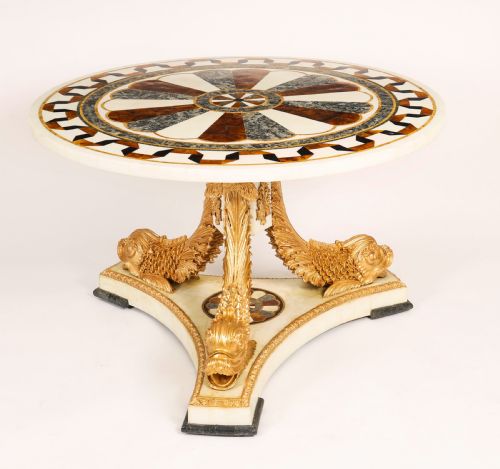
Object types on offer stretch from standard occasional tables and breakfast tables to grander centre tables featuring bronze ornaments, brass mounts, or carved wooden details such as dolphins, swans, and rams' heads.
How they were made
Cabinetmakers constructed the main framework using solid and veneered timbers such as mahogany, walnut, and burr elm, shaped into sturdy central columns or multi-legged pedestals. Ormolu, giltwood, and brass mounts were frequently applied to enrich the structural timber.
The defining stone surface consists of heavy marble, sometimes featuring specialised specimen marble or porphyry varieties. These slabs were cut and polished to fit precisely within the wooden framing of the table top.
The periods represented stretch from early nineteenth-century Regency and Empire eras through to later revival styles.
What varies in quality
The distinction between standard examples and the finest pieces lies in the crispness of the carving upon timber elements like swan or dolphin supports, alongside the weight and grade of the marble top. Richer figuring in the mahogany veneer and finer cast bronze or orrmolu ornaments elevate an example above simpler vernacular pieces.
Proportion and structural integrity dictate the upper tiers of quality, where heavier pillar supports meet precisely fitted stone without timber warping or excessive surface repair.
The Round Marble Foyer Table Glossary
- Guéridon
- A small French round table, typically supported by a single central pillar, commonly topped with marble during the nineteenth century.
- Ormolu
- Gilded bronze used for decorative mounts and ornaments on furniture frames.
- Specimen marble
- A polished stone top composed of various geometric or pictorial segments of different coloured marbles, seen on Regency period examples.
- Porphyry
- A very hard igneous rock with crystal inclusions, used for luxury marble-style tabletops.
- Giltwood
- Timber carved and coated with a thin layer of gold leaf.
Round Marble Foyer Table: Frequently Asked Questions
Where should a round marble foyer table go?
These pieces suit entrance halls and large landings where their circular footprint allows movement around all sides.
They function well beneath central chandeliers, providing an immediate focal point upon entering a home.
How do I clean the marble top?
Use a soft, damp cloth with mild soap and dry immediately to protect the polished stone surface from staining.
Avoid acidic cleaning products that can etch or dull the marble finish over time.
Are these tables heavy?
The combination of solid timber frames and thick marble slabs makes these pieces substantial and weighty to move.
Most rely on their own mass to remain stable as freestanding centre tables without needing floor fixings.
What is the difference between an Empire and a Regency table?
Empire pieces originate from French workshops, frequently incorporating heavy mahogany, gilt brass mounts, and classical motifs like swans and rams' heads.
Regency examples belong to the British period running concurrently, often showing distinct regional cabinetmaking techniques and local timber choices.