




Round Art Deco Side Table
A round art deco side table brings geometric warmth and clean utility to a room through rich figured timber and compact tiers.
Round Art Deco Side Table
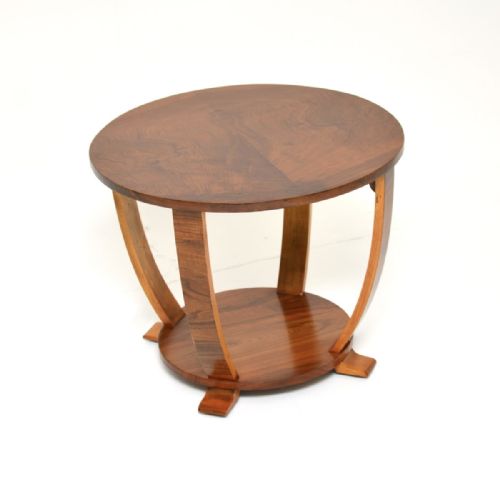
A round art deco side table brings the characteristic geometry of the interwar decades into domestic spaces as coffee tables, lamp surfaces, or multi-tiered occasional furniture. Buyers seek these pieces for their compact footprint and strong circular profiles, which break up linear room layouts.
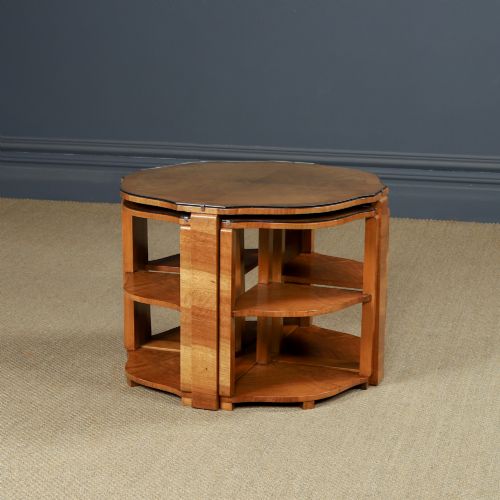
The selections on this page span the nineteen-twenties and nineteen-thirties, originating from English, French, Italian, and Scandinavian workshops. Alongside standard side tables, the listings include nests of tables, drum-shaped bedside cabinets, and metamorphic card tables sharing the same circular design language.
Materials and construction
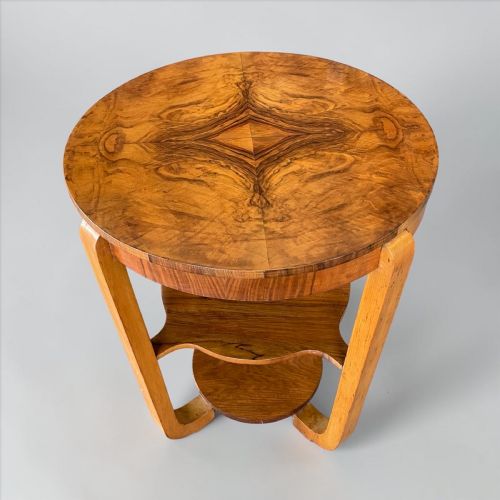
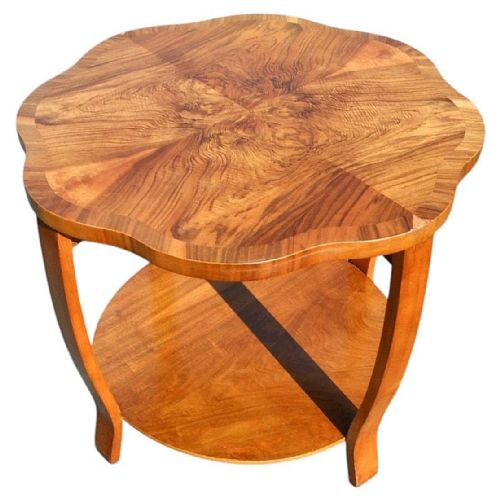
Cabinet makers utilised walnut, burr walnut veneer, oak, maple, birch, and rosewood over solid timber frames to achieve dramatic grain patterns across circular table tops. Artisans arranged veneers symmetrically to create striking visual movement, often combining contrasting timbers like ebony or maple within a single piece.
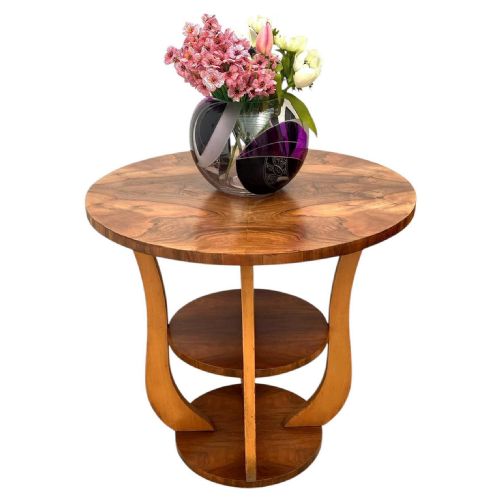
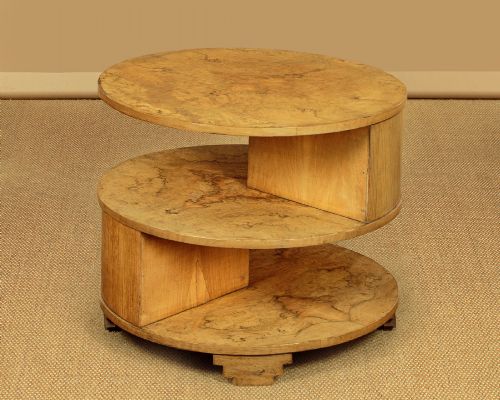
Structural variety comes from the addition of chrome supports, glass inserts, marble tops, and brass accents that define the modernist aesthetic of the period. Multi-tiered designs utilise turned columns or stepped central pedestals to support secondary shelves without cluttering the floor space.
Among the round surfaces sits an illuminated top sofa table designed to cast a subtle glow upwards through its glass.
Distinctions in quality
Quality rests in the selection of the veneer and the precision of its book-matching across a circular surface, where superior examples display seamless grain continuation. The complexity of the frame, such as multi-tiered constructions or integrated illumination, separates standard occasional tables from higher-tier workshop output.
The choice of secondary materials also dictates grade, with heavy chrome plating, thick polished plate glass, and solid marble inserts indicating higher manufacturing ambition than plain timber builds. French and Scandinavian pieces often demonstrate more intricate timber combinations and refined edge profiles.
The Round Art Deco Side Table Glossary
- Veneer
- A thin layer of figured wood applied over a stable timber base to display decorative grain patterns. This technique allowed makers to utilise expensive woods economically.
- Book-matching
- A method of arranging veneer slices so that adjoining surfaces mirror each other, creating symmetrical patterns across a table top. This technique requires skilled cutting and jointing.
- Tiered table
- A piece featuring multiple stacked surfaces supported by columns or pedestals. These designs maximise display space while maintaining a small floor footprint.
- Quintetto
- A nest of five tables designed to fit together compactly under a main round surface. This configuration provides flexible hosting arrangements within a single footprint.
Round Art Deco Side Table: Frequently Asked Questions
What rooms suit a round art deco side table?
These tables fit easily beside low seating in living rooms or function as bedside surfaces in bedrooms due to their compact circular shape.
Their multi-tiered and nest configurations also provide flexible surface area for lamps or drinks without dominating small spaces.
How do I identify a nineteen-thirties piece?
Look for characteristic timber selections like burr walnut and birds eye maple combined with geometric shapes, chrome framing, or stepped tiers.
English and continental workshops from this decade favoured clean circular silhouettes over ornate historical revivalism.
What is a quintetto table?
A quintetto is a nesting set typically comprising four or five smaller tables that fit neatly beneath a larger central round top.
This form offers practical versatility for entertaining while storing away as a single compact unit.
Are these tables solid wood or veneer?
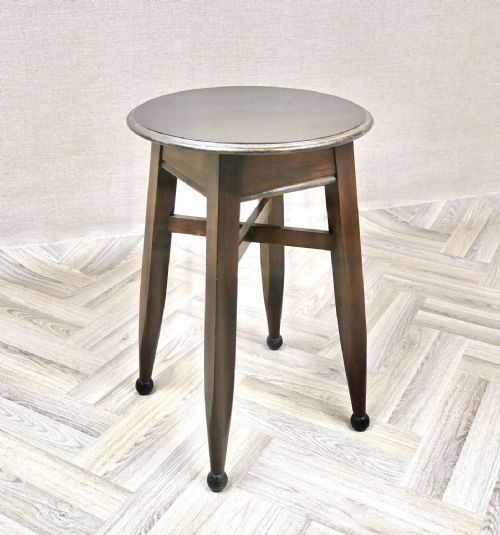
Most examples utilise decorative wood veneers applied over a solid timber or secondary wood substrate to showcase elaborate grain patterns.
Some pieces incorporate solid oak, maple, or metal and glass frames alongside the veneered surfaces.