



Rosewood Slope Front Desk
A rosewood slope front desk brings warm timber and clever internal compartments together for serious correspondence.
Rosewood Slope Front Desk
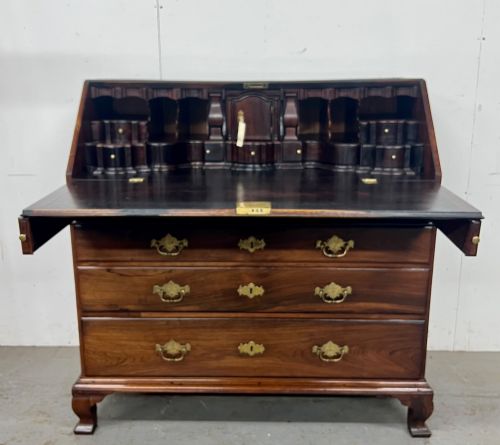
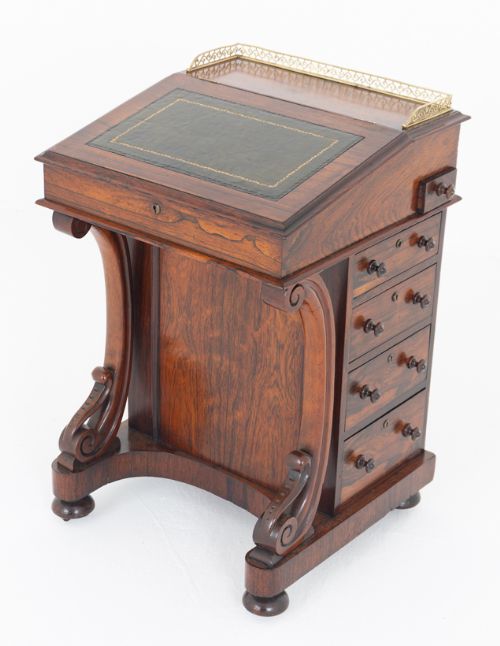
A rosewood slope front desk is primarily represented here by compact Davenport desks, bureau bookcases, and ladies writing desks from the eighteenth and nineteenth centuries. These pieces combine a slanted writing surface with built-in storage, drawers, and pigeonholes.
The pieces on offer span the Regency, Victorian, and William IV periods, alongside continental examples including eighteenth-century Iberian work and Louis XV revival pieces. Buyers encounter various forms, from the classic Davenport with side drawers to grand bureau bookcases.
How they were made
Cabinet makers utilised dense rosewood timber as the primary surface, often enhanced with contrasting boxwood inlay or delicate marquetry. Many examples incorporate fitted leather writing surfaces set into the slope.
Structural enrichment relies on cast brass fittings and glass panels where upper bookcase sections apply. Joinery techniques from the Georgian era through to the late nineteenth century ensure robust framing for heavy timber lids and sliding mechanisms.
Rosewood Slope Front Desk Retail Price Guide 2026
Typical asking prices for rosewood slope front desk among the pieces listed under this phrase on Sellingantiques today, from the lower quarter to the upper quarter. They describe what is for sale here now, not the wider market.
Current listings span the eighteenth century, Regency, William IV, and Victorian eras, alongside Louis XV revival and French chateau styles.
What varies in quality
The distinction between standard production and exceptional work rests on the precision of the boxwood inlay and the intricacy of the internal fittings. Superior desks display harmonious grain matching across the rosewood surfaces rather than arbitrary veneer placement.
The execution of brass hardware and the smoothness of sliding tops or integrated drawer mechanisms indicate the original maker's skill. Finer examples maintain structural integrity in the slope hinge and internal stationery compartments over centuries of use.
The Rosewood Slope Front Desk Glossary
- Slope front
- A slanted writing lid that opens to reveal internal compartments and drawers. This angled surface provides a comfortable platform for handwriting.
- Davenport
- A compact small desk featuring a sloping top and a bank of drawers to one side. This form became popular during the Regency and Victorian periods for domestic correspondence.
- Bureau bookcase
- A tall two-part cabinet combining a desk base with a glazed upper bookcase section. It offers substantial storage for both books and writing materials.
- Bureau de Dame
- A small ladies writing desk, often French in origin. These delicate pieces frequently feature curved lines and refined decorative inlays.
- Boxwood inlay
- Contrasting pale wood inserted into the darker rosewood surface to create geometric or floral patterns. This decorative technique highlights the borders and panels of the desk.
Rosewood Slope Front Desk: Frequently Asked Questions
What is a Davenport desk?
A Davenport is a compact writing desk featuring a sloping lid on top and a pedestal of drawers opening to the side. It was designed to occupy minimal space while providing comprehensive storage for stationery.
Most examples date from the Regency and Victorian periods, often incorporating rosewood timber and brass detailing.
How do I use a slope front desk?
The angled lid opens downward or lifts to provide a slanted surface for writing letters and documents. Inside, small drawers and pigeonholes organise inkwells, paper, and envelopes.
Many modern owners utilise the enclosed space to house laptops or tablets when not writing by hand.
How do I date a rosewood desk?
Dating relies on architectural styles, hardware design, and construction methods. Regency pieces often feature bold classical lines, whilst Victorian examples frequently showcase inlaid decoration and fitted side drawers.
Rosewood was heavily utilised across the eighteenth and nineteenth centuries before restrictions changed furniture manufacturing.
How do I care for rosewood furniture?
Rosewood benefits from stable room temperatures away from direct sunlight and strong heat sources. Regular dusting with a soft, dry cloth preserves the natural lustre of the polished timber.
Avoid chemical sprays and excessive moisture, which can damage antique French polish and delicate boxwood inlay.