
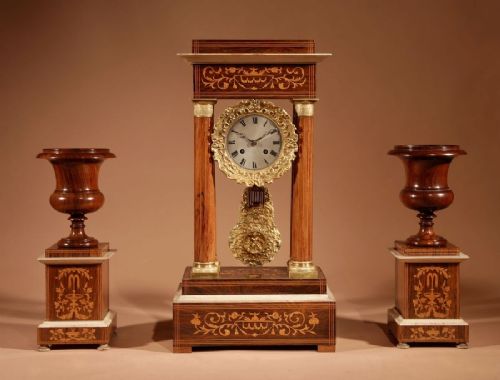
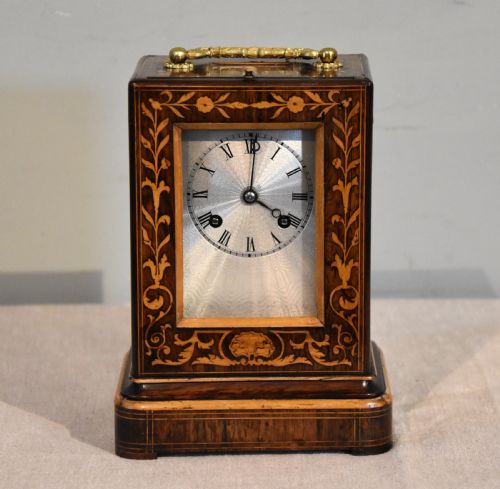


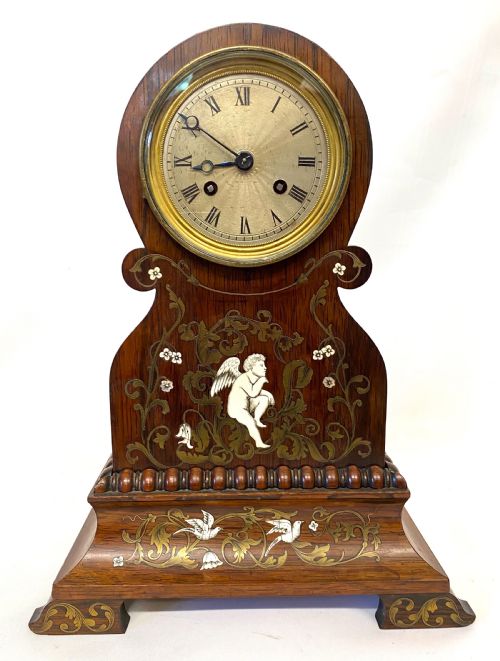


Rosewood Shelf Clock
A rosewood shelf clock is a timpiece defined by rich timber and intricate brass inlay, offering a centrepiece of functional historical design.
Rosewood Shelf Clock
A rosewood shelf clock brings together dense tropical hardwood cases with precise mechanical movements across several distinct periods. Buyers searching for a rosewood shelf clock will find examples spanning the nineteenth century, including Regency, Victorian, and Louis Philippe eras.
The selection encompasses mantel clocks, bracket clocks, and wall clocks housed in rosewood. Many pieces originate from French workshops or English makers, featuring inlaid marquetry, brass decoration, and glass panels.
Mantel and bracket forms dominate the selection, often taking shaped, dome-topped, or portico configurations. These timepieces served both practical domestic functions and decorative roles in nineteenth-century interiors.
What varies in quality
Quality rests upon the crispness of the rosewood grain and the precision of the brass or boxwood inlay work. Finer examples display meticulous marquetry and well-proportioned case architecture rather than simple geometric veneer.
The sophistication of the internal movement and the reputation of the maker distinguish superior pieces from standard production. Signed dials and complex striking mechanisms elevate the standing of a clock within the historical record.
The inventory records mantel clocks, bracket clocks, and wall clocks spanning the Regency, Victorian, and Louis Philippe periods.
Seller of Reading·Henry Marc·Paul Garnier·Walker and Hall·Savory and Fils·Dumont·Malecot of Paris
The Rosewood Shelf Clock Glossary
- Bracket clock
- A portable timekeeper originally designed to sit upon a dedicated wall bracket or furniture shelf. These domestic clocks often feature architectural wooden cases and carrying handles.
- Marquetry
- Decorative veneer work forming pictorial or geometric patterns using various coloured woods. Artisans meticulously fit pieces of rosewood, boxwood, and other timbers into the case surface.
- Portico clock
- A monumental mantel clock style mimicking classical portico architecture with pillars supporting a central pediment. French makers frequently produced these balanced designs during the nineteenth century.
- Ormolu
- Gilt-bronze decorative mounts applied to clock cases to highlight corners, bezels, and feet. This technique provides metallic contrast against dark rosewood surfaces.
- Double barrel movement
- A mechanical system utilising two spring barrels to power the timekeeping and striking trains independently. This setup ensures more consistent power delivery to the gear train.
Rosewood Shelf Clock: Frequently Asked Questions
How do I wind an antique clock?
Most nineteenth-century movements require a key to tension the springs via winding arbours on the dial face. Care must be taken not to over-wind the mechanism.
Consulting a professional horologist for initial setup ensures the escapement and pendulum remain properly balanced.
Where should I place my clock?
Select a stable, level mantelpiece or shelf away from direct sunlight and fluctuating heat sources. Wood and veneer cases react to extreme humidity changes.
Placing the piece on a solid surface prevents vibrations from interfering with the pendulum swing.
How can I identify the period?
Examine the case style, dial materials, and internal movement signatures for stylistic clues. Regency and Victorian designs often incorporate distinct decorative motifs.
Maker signatures on the dial or movement backplate provide definitive clues to the manufacturing decade.
What maintenance do these clocks need?
Periodic professional cleaning and oiling keep the brass gears operating smoothly without excessive wear. Dust accumulation inside the case should be managed carefully.
Avoiding amateur repairs preserves the original integrity of the movement components.