


Rosewood Floral Side Table
A rosewood floral side table brings rich timber and intricate marquetry into a room, offering a functional surface shaped by nineteenth-century tastes.
Rosewood Floral Side Table
A rosewood floral side table is primarily a nineteenth-century form, encompassing occasional tables, centre tables, and bedside cabinets fashioned during the Victorian, Edwardian, and earlier periods. These pieces serve as compact display or writing surfaces, often incorporating drop leaves or tiers to maximise utility in domestic spaces.
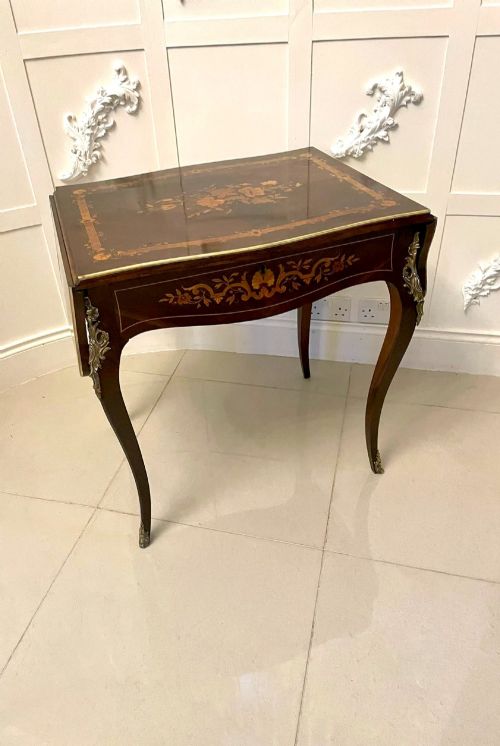
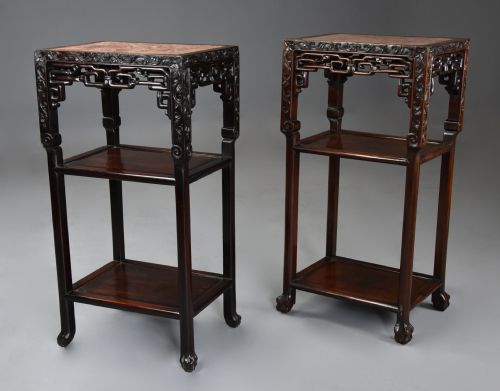
The most common iterations on this page display French revival styling, particularly Louis XV and Louis XVI tastes, alongside Anglo-Indian and Chinese export variants. Marquetry inlay depicting floral motifs dominates the tops, frequently paired with contrasting timbers like satinwood and kingwood.
Makers ranged from notable London retailers and workshops such as Edwards & Roberts and Liberty & Co to continental cabinet makers and eastern artisans. Buyers encounter everything from small bedside stands to freestanding centre tables and graduated quartetto sets.
Materials and Construction Techniques
Construction relies heavily on a dense tropical hardwood carcass faced with rosewood veneer, augmented by decorative marquetry panels cut from satinwood, fruitwood, and kingwood. These timbers provide the natural contrast required to render floral sprays and scrolling foliage across the tabletop.
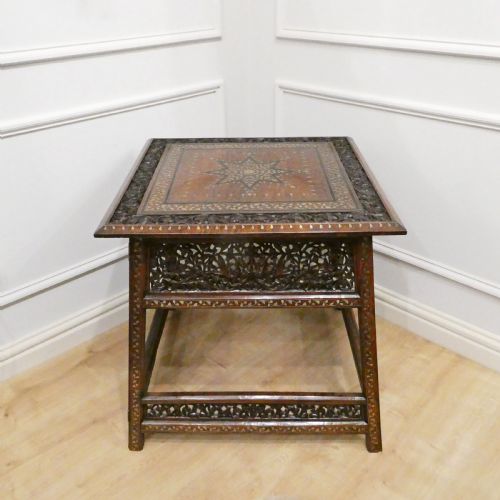
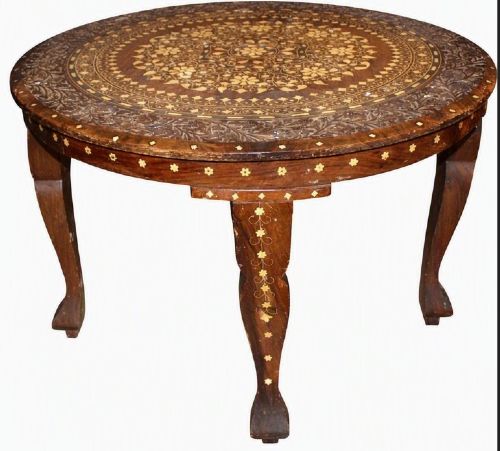
Metal mounts in brass and cast ormolu secure corners, edges, and cabriole legs, while bone inlay and intricate hand-carving appear on Anglo-Indian and Chinese hardwood pieces. Joinery follows traditional nineteenth-century cabinet-making practices, accommodating the movement of dense hardwoods over time.
Some tables double as opium coffee tables, proving that nineteenth-century relaxation took many international forms.
Distinctions in Quality
Quality rests upon the precision of the marquetry cut and the botanical accuracy of the floral inlay, where crisp shading and tight joints distinguish superior work from simpler production. The choice of secondary timbers and the weight of the cast ormolu mounts further separate standard utility pieces from exhibition-grade furniture.
The integrity of the rosewood surface and the subtlety of any hand-carved detailing indicate the original maker's skill. Retained maker marks or stamps from established firms elevate an item's documentary interest, whereas plain construction points to more commercial workshop origins.
Liberty & Co·Edwards & Roberts·Ince & Mayhew
The Rosewood Floral Side Table Glossary
- Marquetry
- Decorative veneer work arranged in pictorial patterns such as floral sprays. Artisans cut thin slices of contrasting coloured woods to fit precisely into a prepared ground.
- Ormolu
- Gilt bronze mounts applied to furniture edges and legs for ornamentation. This cast metalwork adds structural emphasis and decorative sheen to French revival tables.
- Etagere
- A set of open tiered shelves used for display. These multi-level tables allow ornaments or books to be arranged across several stacked surfaces.
- Poudreuse
- A multi-compartment dressing or work table equipped with mirrors and wells. These vanity tables often feature folding tops and fitted interiors for personal items.
- Quartetto
- A set of four graduated tables designed to slide neatly beneath one another. This nested arrangement saves floor space when the smaller surfaces are not in use.
Rosewood Floral Side Table: Frequently Asked Questions
Where should I place a side table?
These compact surfaces fit beside a sofa or armchair to hold lamps and small items. Freestanding centre tables also anchor the middle of a drawing room or hallway.
Smaller plant stands and bedside cabinets suit corners or narrow walls where surface space is needed without blocking traffic flow.
How do I care for rosewood furniture?
Keep these pieces away from direct sunlight and radiators to prevent the rosewood veneer and marquetry from drying out or splitting. Consistent indoor humidity protects the underlying timber.
Dust gently with a dry or slightly damp cloth, avoiding harsh chemical polishes that can degrade nineteenth-century French polish and wax finishes.
How can I tell French styles apart?
Louis XV revival pieces tend to feature flowing asymmetrical curves, cabriole legs, and elaborate ormolu mounts. Floral marquetry on these tables often mimics naturalistic rococo asymmetry.
Louis XVI style leans towards stricter symmetry, straight tapered legs, and neoclassical proportions. Marquetry here frequently incorporates geometric banding alongside floral urns.
What is an Anglo-Indian table?
Anglo-Indian tables combine British furniture forms with traditional Indian craftsmanship, often featuring dense hand-carving and bone inlay. These pieces were produced during the colonial period for export or local European residents.
They stand out for motifs like elephants, intricate foliage, and contrasting dark hardwoods that differ from standard European revival designs.