


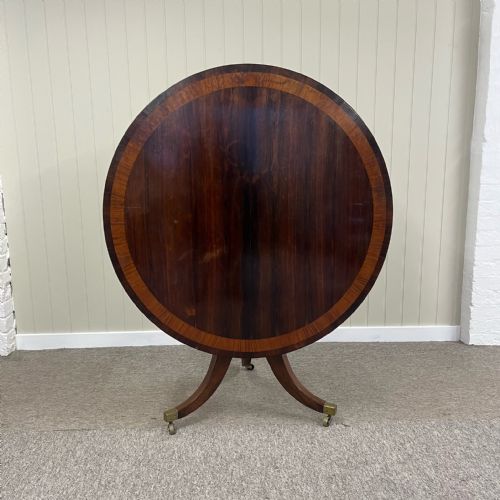

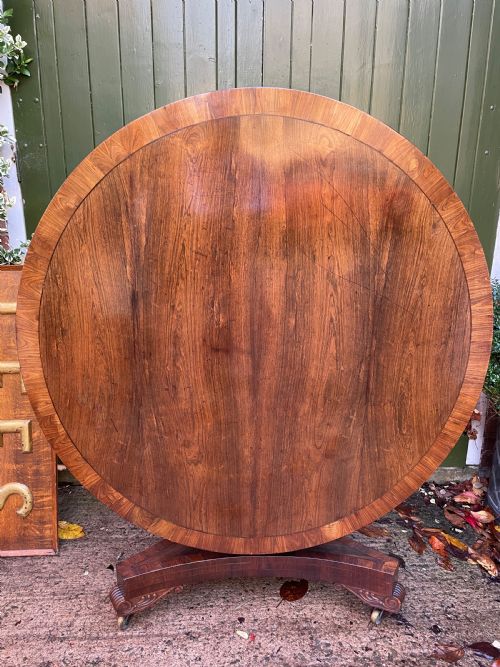


Rosewood Crossbanded Table Top
A rosewood crossbanded table top brings striking grain contrast and classic proportions into a room, offering both practical surface space and fine cabinet-making.
Rosewood Crossbanded Table Top
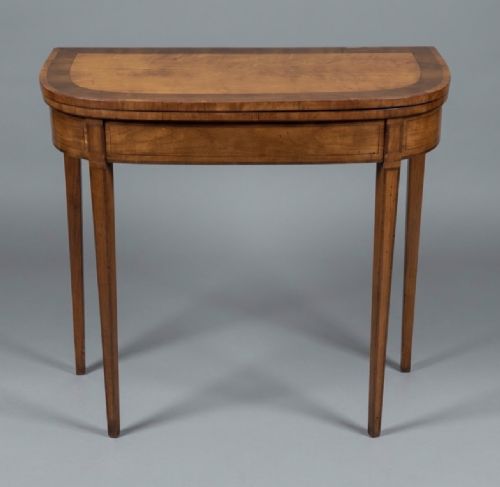
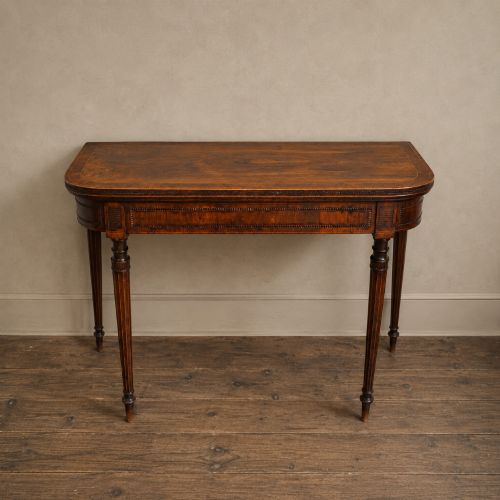
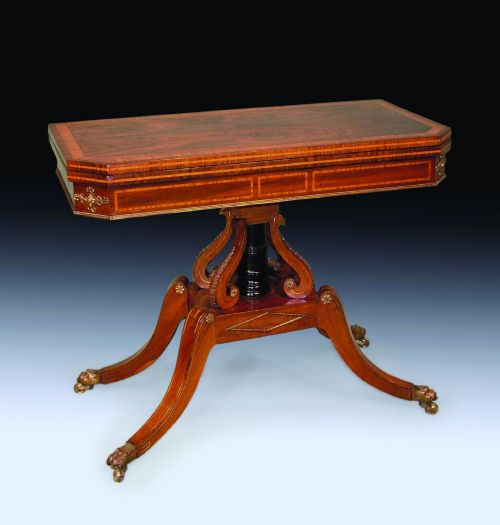
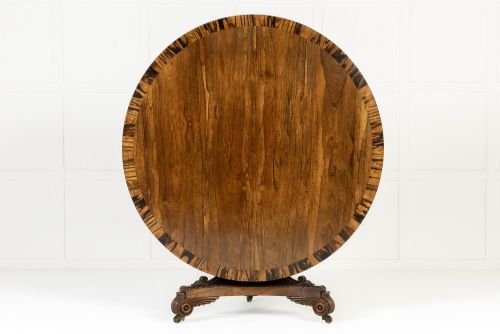
When you search for a rosewood crossbanded table top, you encounter a refined group of antique furnishings predominantly dating from the Regency and early nineteenth-century periods. These pieces include circular centre tables, fold-over card tables, and occasional gaming surfaces designed for drawing rooms and parlours.
The defining characteristic of these items is the distinctive perimeter border, where the timber grain runs perpendicular to the main centre panel. You are most likely to meet circular centre tables and fold-over card tables displaying this decorative technique across the listings.
Originating largely from English workshops of the Georgian and Regency eras, these tables often incorporate supporting pedestals, scroll bases, or pillar columns. The combination of dark rosewood with lighter contrasting borders creates a sophisticated visual focal point suited to traditional interiors.
Materials and construction methods
Cabinet-makers constructed these table tops by applying carefully selected veneers over stable secondary timbers such as mahogany or deal. The primary surface utilises rich rosewood, chosen for its deep colour and pronounced grain patterns.
Crossbanding involves laying narrow strips of veneer around the perimeter so that the grain runs at right angles to the central panel. Craftsmen frequently separated the contrasting timbers with fine stringing lines of boxwood or satinwood to accentuate the geometric precision of the border.
The underlying structure often combines solid timber framing with veneered surfaces to prevent warping while displaying decorative wood selections. Workshops utilised brass mounts, inlay, and robust pedestals to support the substantial weight of the timber tops.
Rosewood Crossbanded Table Top Retail Price Guide 2026
Typical asking prices for rosewood crossbanded table top among the pieces listed under this phrase on Sellingantiques today, from the lower quarter to the upper quarter. They describe what is for sale here now, not the wider market.
Listings for this phrase feature pieces primarily from the Regency and nineteenth-century periods, utilising rosewood, satinwood, and mahogany.
Distinguishing quality in period tables
The standard of a rosewood crossbanded table top depends heavily on the selection and matching of the timber veneers. Superior examples display symmetrical grain patterns across the central panel and neat, tight joints along the crossbanded borders.
The crispness of the inlay work and the subtlety of the contrasting stringing lines indicate the skill of the original workshop. Higher grade pieces maintain harmonious colour tones between the primary rosewood and the lighter satinwood or boxwood elements.
Structural integrity also separates standard items from exceptional ones, particularly in the stability of the pedestal base and the smoothness of any fold-over or pivoting mechanisms. Fine cabinet-work ensures the timber moves naturally with changes in atmosphere without separating the delicate edge veneers.
Peters of Genoa
The Rosewood Crossbanded Table Top Glossary
- Crossbanding
- A decorative technique where a border of veneer is applied around the edge of a table top with the grain running perpendicular to the central panel.
- Rosewood
- A dense, dark timber prized for its rich purplish-brown colouring and dramatic black grain figuring, commonly used in high-status nineteenth-century furniture.
- Card Table
- A specialised folding table featuring a hinged top that opens to reveal a baize-lined surface for playing cards or board games.
- Centre Table
- A freestanding table designed to be viewed from all sides, traditionally placed in the middle of a room rather than against a wall.
- Satinwood
- A lustrous, hard timber native to India and Sri Lanka with a golden-yellow sheen, frequently used for contrasting stringing and inlay details.
- Stringing
- Thin lines of contrasting light or dark wood inlaid into the surface of furniture to outline panels and geometric borders.
Rosewood Crossbanded Table Top: Frequently Asked Questions
How do I identify a Regency table?
Regency tables typically date from the early nineteenth century and often incorporate classical architectural motifs, such as pedestal pillar bases, brass paw feet, and scroll supports. The timbers used lean heavily towards dark mahogany and rosewood.
Look for clean geometric lines, contrasting satinwood stringing, and balanced proportions characteristic of English design from that era.
Where were these tables placed originally?
These tables served multiple functions in the principal rooms of grand homes, particularly drawing rooms, libraries, and parlours. Centre tables stood freestanding in the middle of a space to display decorative objects or lamps.
Fold-over card tables remained folded against a wall until needed for evening entertainment, when they were opened out to provide a stable gaming surface.
How should I care for rosewood furniture?
Rosewood surfaces respond best to stable indoor environments away from direct sunlight and sudden temperature shifts, which can dry out the timber and cause veneer lifting. Dust regularly with a soft, dry cloth rather than applying heavy silicone polishes.
Applying a light coat of appropriate wax periodically helps maintain the natural lustre of the polished wood without building up residue.