
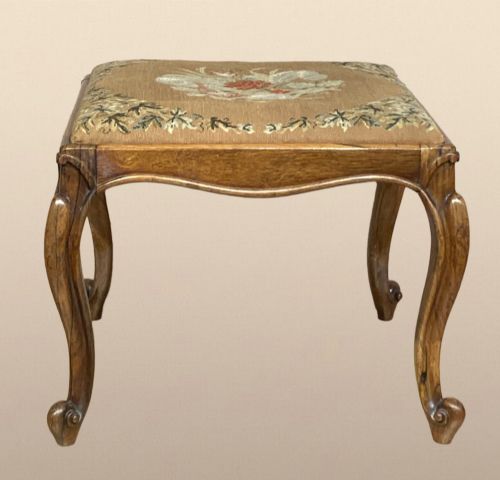
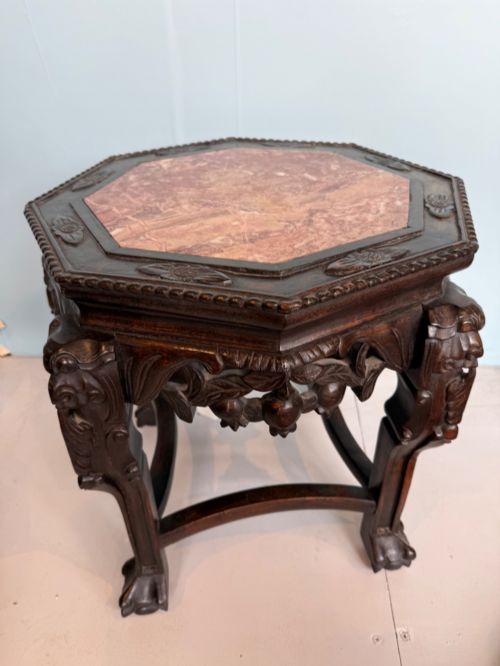

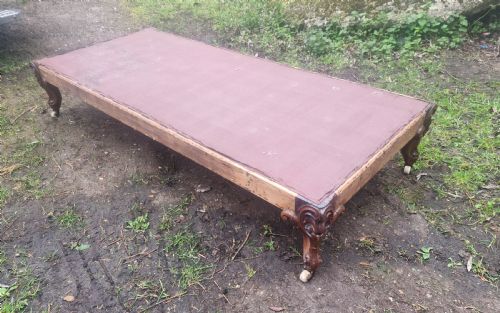
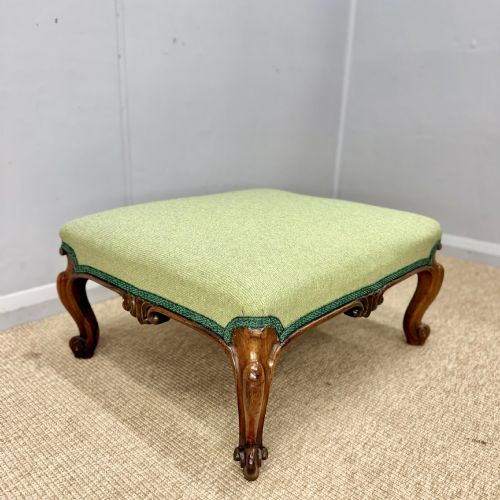


Rosewood Cabriole Leg Stool
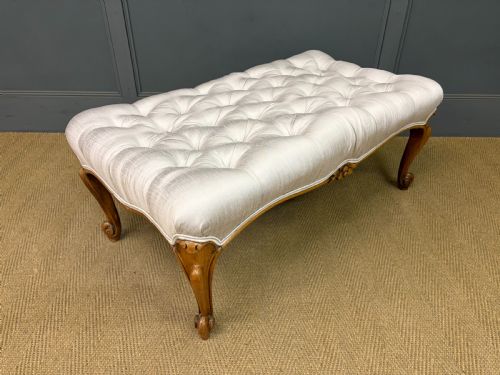
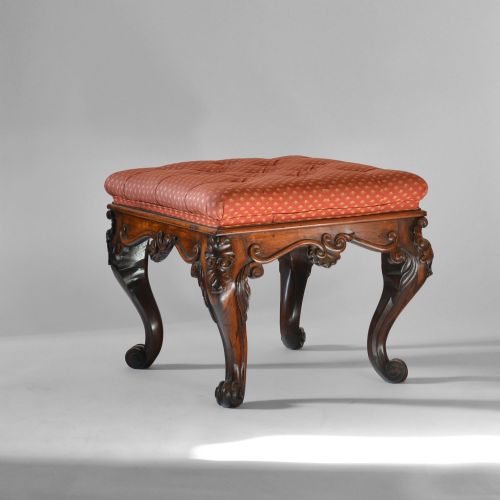
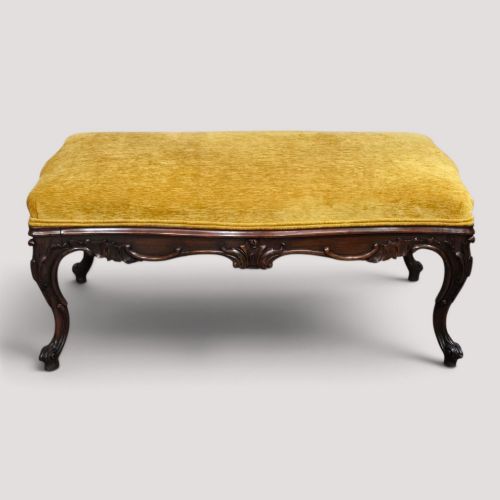
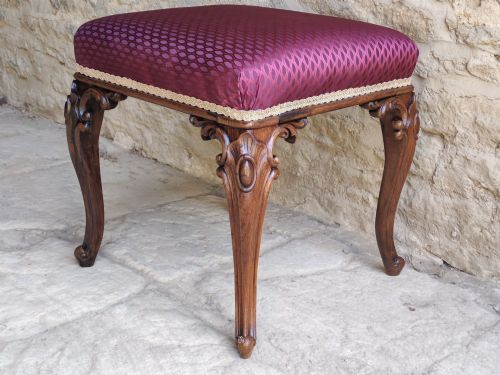
These rosewood cabriole leg stool examples bring dense timber and curved supports together in nineteenth-century forms.
Rosewood Cabriole Leg Stool
A rosewood cabriole leg stool is typically a nineteenth-century seating form featuring curved wooden supports and dense dark timber. Most examples on this page date from the Victorian period, spanning decades from eighteen fifty to eighteen eighty.
Makers produced these forms as footstools, dressing stools, and centre stools with upholstered tops in fabric, wool, or hide. Larger oblong shapes and occasional window seats also appear among the records.
How they were made
Craftsmen shaped dense rosewood and hardwood into undulating cabriole legs, frequently adding carved detail to the knees and frames. Upholstery techniques incorporated wool, textile, and buttoned coverings fixed over webbed or liftout seat frames.
Brass castors and fittings occasionally supplemented the timber bases, while structural joinery relied on traditional tenon methods to support heavy daily weight.
Victorians rested tired feet on these carved wooden curves after long days standing in heavy boots.
What varies in quality
Quality rests upon the depth of the timber carving and the crispness of the cabriole curves rather than simple scale. Heavier carving on nineteenth-century frames marks out the upper tier of execution.
The integrity of the underlying rosewood frame and the appropriateness of the textile upholstery dictate the standing of an individual stool.
The Rosewood Cabriole Leg Stool Glossary
- Cabriole leg
- A furniture support that curves outward at the knee and tapers inward toward the foot, mimicking animal limbs. This form is characteristic of mid-nineteenth-century seating.
- Rosewood
- A heavy, dense tropical timber prized for its dark grain and polished finish. It served as the primary material for high-end Victorian stools.
- Centre stool
- A large freestanding stool designed to sit in the middle of a room rather than against a wall. These pieces often feature elaborate carving on all four sides.
- Liftout seat
- A drop-in upholstery frame that is removable from the main wooden structure. This design facilitates reupholstering without dismantling the stool.
- Ottoman
- A larger upholstered seat or footstool, sometimes fitted with internal storage or extra length. Nineteenth-century examples often match larger armchair suites.
Rosewood Cabriole Leg Stool: Frequently Asked Questions
What periods do these stools date from?
Most examples originate in the nineteenth century, with a strong concentration in the Victorian era from eighteen fifty to eighteen eighty. Earlier pieces stretch back into the Regency period.
Specific dates are often identified by stylistic details like the depth of the rosewood carving and the profile of the cabriole legs.
How were these stools used originally?
They served primarily as footstools before armchairs, dressing stools in bedrooms, or freestanding centre stools in larger reception rooms. Some functioned as window seats.
Their substantial timber frames allowed them to handle frequent daily sitting and resting of feet.
Are the fabrics original?
Very few pieces retain their original textile or wool coverings due to centuries of wear. Many listings feature newly upholstered surfaces using period-appropriate fabrics or hide.
The underlying rosewood frames remain antique while the top upholstery is frequently renewed.
What is an Anglo-Indian stool?
Anglo-Indian pieces reflect nineteenth-century design exchange, combining traditional British furniture forms with intricate indigenous carving styles. They utilise the same dense rosewood timber.
These variants display distinctive decorative motifs carved directly into the hardwood frames.