
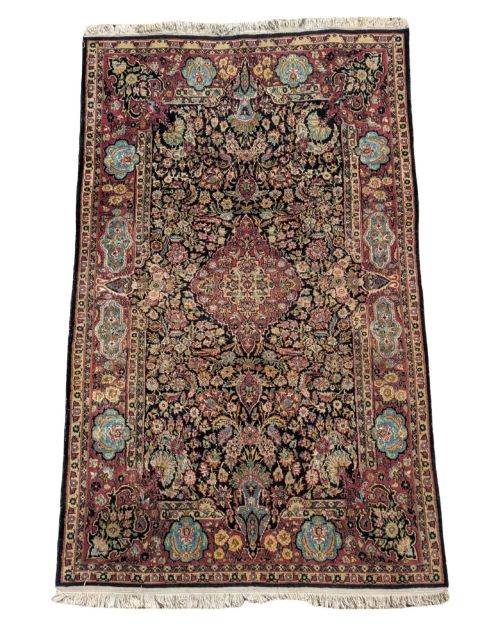


Rose Medallion Rug
These rose medallion rug alternatives span diverse regional workshops, offering tactile wool, cotton, and silk floor coverings for traditional interiors.
Rose Medallion Rug
Buyers seeking a rose medallion rug encounter an assortment of floor coverings originating from distinct historical periods, including the nineteenth century and the early decades of the twentieth century. These textiles include specific regional types such as Bessarabian kilims, Hamadan rugs, and French Aubusson square carpets.
The objects take the form of rugs, area rugs, kilims, and larger carpets designed for domestic settings. Origins stretch across Persian, Ottoman, Bessarabian, and French design traditions.
Most examples rely on traditional room-scale dimensions or smaller formats, utilising wool, cotton, and silk structures to deliver patterned surface decoration.
Materials and construction methods
Makers constructed these pieces using foundational warps and wefts of cotton or wool, overlaid with knotted pile or flatweave techniques. Silk highlights appear in specific carpets to accentuate particular design elements.
Weavers employed regional wool qualities, sometimes combining them with cotton foundations to ensure structural stability across large formats like the Meshed carpet or Ishfahan carpet.
Some rugs wear their centuries lightly, sporting deliberate distress that whispers of generations of muddy boots and royal footsteps.
Assessing quality and craftsmanship
Distinction across the range rests on the fineness of the weave, the integrity of the material fibres such as silk highlights, and the preservation of the original format over time. Distressed surfaces reflect the physical history of an item rather than standard manufacture.
The sophistication of regional pattern work, from French Rococo interpretations to traditional Persian and Bessarabian motifs, determines the aesthetic standing of each textile.
The Rose Medallion Rug Glossary
- Kilim
- A flatwoven carpet or rug produced without a pile, commonly associated with Bessarabian traditions. These textiles rely on tightly packed interlocked weft threads to form flat geometric or floral designs.
- Pile
- The upright yarn loops or cut ends that form the soft surface of a carpet. This layer is knotted onto the underlying foundation warp and weft.
- Medallion
- A central ornamental motif positioned in the middle of a rug field. It typically serves as the primary focal point of the textile design.
- Warp
- The stationary vertical threads stretched onto a loom before weaving begins. All subsequent weft threads and knots interlace with this foundational skeleton.
Rose Medallion Rug: Frequently Asked Questions
What periods do these rugs come from?
The available stock spans the nineteenth century through the early decades of the twentieth century, specifically including items dated across the 1870s, 1890s, 1900s, 1910s, 1920s, and 1930s.
These dates reflect the period of production assigned to each individual carpet or kilim by the inventory records.
What materials were used to make them?
Makers utilised natural materials including wool, cotton, and silk. Certain carpets incorporate silk highlights to enhance specific areas of the design.
The combination of these fibres varies according to the regional workshop and the specific weaving tradition.
How do I identify different styles?
Styles include Persian, Bessarabian, Ottoman or Turkish, and French Rococo designs. Each tradition employs distinct visual motifs and structural techniques.
Examining the border patterns, weave type, and overall colour palette helps distinguish between regional origins like Hamadan, Kashan, or Aubusson.
Where were these textiles made?
The pieces originate from various international centres of production, including Persian workshops, Turkish regions such as Istanbul and Bandirma, Bessarabia, and France.
Each region developed specific methods for constructing floor coverings using local materials and aesthetic conventions.