

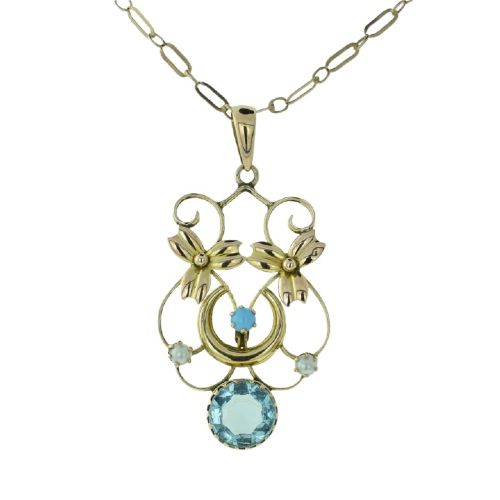


Rose Gold Floral Pendant
These rose gold floral pendant examples bring warm hues and botanical charm straight from the Victorian and Edwardian eras to your collarbone.
Rose Gold Floral Pendant
A rose gold floral pendant captures botanical motifs in warm metallic tones, often taking the form of stamped wreaths, daisies, or clustered flower heads. These pieces range from compact Victorian heart puffs to larger French medals and convertible brooch fittings.
You will most frequently encounter Victorian and Edwardian iterations on this page, alongside French Belle Epoque and mid-century interpretations. The selection frequently merges pink-hued gold with silver settings designed to catch the light around central gemstones.
Materials and construction
Goldsmiths utilised varied purities, combining 9ct, 15ct, and 18ct rose gold alongside yellow gold and silver-topped settings. This dual-metal approach allowed jewellers to mount diamonds securely in white silver while retaining warm gold backs.
Construction relies heavily on hand-cut gemstones such as rose-cut diamonds, alongside turquoise cabochons, garnets, pearls, and blue topaz. Artisans also employed guilloche enamel and pietra dura inlay to add permanent colour and texture to the floral subjects.
Rose Gold Floral Pendant Retail Price Guide 2026
Typical asking prices for rose gold floral pendant among the pieces listed under this phrase on Sellingantiques today, from the lower quarter to the upper quarter. They describe what is for sale here now, not the wider market.
Some Victorian hearts puff out like tiny lockets without the hinges.
Assessing quality and craftsmanship
Quality rests in the delicacy of the botanical carving and the precision of the stone setting. Finer examples display meticulous hand-engraving on petals and leaves, ensuring the metal mimics natural flora rather than appearing stiff or mass-produced.
The integration of materials also defines the upper tier, particularly where old-cut diamonds are grain-set into silver overlays atop solid gold bodies. Better pieces maintain structural integrity in convertible mounts like pendant-brooches without loose hinges or worn loops.
The Rose Gold Floral Pendant Glossary
- Rose gold
- A copper-alloyed gold that yields a distinct pinkish or reddish warm hue. It gained immense popularity during the Victorian and Edwardian periods for romantic jewellery.
- Rose-cut diamond
- An antique diamond cut featuring a flat base and a faceted dome that resembles an opening rosebud. This style produces a soft, understated gleam rather than modern brilliance.
- Pietra dura
- A pictorial technique using inlaid cut and fitted irregularly shaped coloured stones. Artisans utilise this method to create permanent floral mosaics within a solid gold frame.
- Guilloche enamel
- Decorative engine-turned metalwork covered with a transparent translucent enamel layer. This technique creates geometric background patterns beneath coloured glass surfaces.
- Silver-topped gold
- A technique where jewellers soldered a thin layer of silver to the front of a gold piece. This allowed white metal prongs to hold diamonds securely without altering the warm gold tone at the reverse.
Rose Gold Floral Pendant: Frequently Asked Questions
How do I wear a convertible pendant brooch?
Many Victorian floral pieces feature a removable pin and a hidden loop at the back. You can thread a fine chain through the bail to wear it as a pendant or secure it to a lapel as a brooch.
Ensure the safety catch functions properly before wearing it on fabric to prevent loss.
How do I date a floral pendant?
Dating relies on the gold purity marks, the gemstone cuts, and the manufacturing style. Victorian pieces often utilise 15ct gold and rose-cut stones, while later Edwardian designs lean towards platinum or lighter gold alloys.
French pieces frequently bear specific control marks like eagle heads on the jump rings or edges.
Can I wear my antique pendant daily?
These pieces survived over a century because previous owners treated them with care. Everyday wear is possible if you remove the item before sleeping, swimming, or handling harsh chemicals.
Softer materials like turquoise, pearls, and enamel require particular attention to avoid scratching.
What does silver-topped gold mean?
In the nineteenth century, platinum was not yet utilised for fine jewellery settings. Artisans soldered silver onto the front of gold pieces so white prongs would complement the sparkle of diamonds.
The solid gold back keeps the piece sturdy against the skin while the front mimics a brighter metal.