
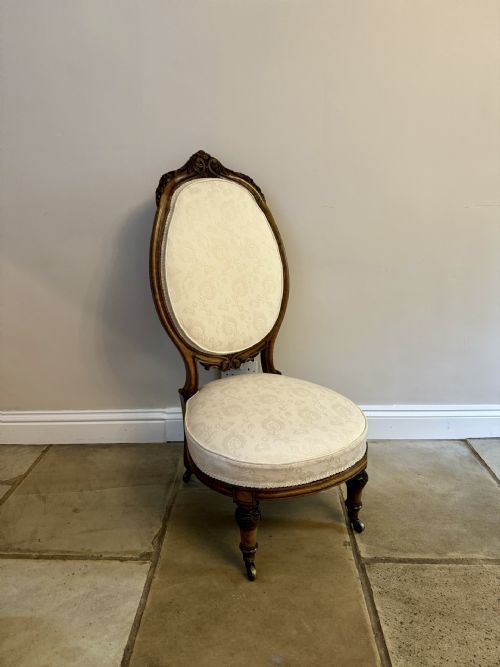


Rococo Revival Low Chair
These rococo revival low chair examples offer low seats and carved frames, bringing curved nineteenth-century lines into a modern room.
Rococo Revival Low Chair
A rococo revival low chair typically presents as a Victorian ladies chair, nursing chair, or salon chair designed for domestic comfort. These pieces emerge in formats like the spoon back or balloon back, sitting low to the floor for period dressing rooms and parlours.
The selection here includes occasional chairs, side chairs, and stools drawing on nineteenth-century design. Walnut, rosewood, and mahogany form the primary wooden frames, paired with various upholstered seats.
Materials and construction
Cabinetmakers shaped dense hardwoods such as walnut and rosewood into flowing, organic curves, often adding intricate carved details. Ebonised finishes and painted silver gilt surfaces also appear across the selection.
Upholstery techniques involve buttoning and tensioned fabric over low-slung frames, supported on cabriole legs. Brass fittings and ceramic castors occasionally finish the construction.
Some nineteenth-century sitters required exceptionally low seats simply to manage voluminous skirts.
Judging the work
Quality rests in the depth and crispness of the carved woodwork, where sharper leaf scrolls and fluent curves distinguish finer seating. The choice of timber grain, from rich walnut to figured rosewood, alters the visual weight.
Frame rigidity and the proportional grace of the cabriole legs separate standard production from superior pieces. Upholstery finish and the execution of buttoned backs further define the standard of the item.
The Rococo Revival Low Chair Glossary
- Cabriole leg
- A furniture leg that bends outward in a convex curve and tapers inward in a concave arc, ending in a simple foot.
- Spoon back
- An upholstered chair back shaped to resemble the bowl of a spoon, providing ergonomic support for the spine.
- Balloon back
- A rounded, oval-shaped chair back popular during the Victorian era.
- Nursing chair
- A low-seated chair designed for comfort, traditionally used by women when nursing infants or dressing.
Rococo Revival Low Chair: Frequently Asked Questions
What is a low chair used for?
These low seats served nineteenth-century domestic spaces like dressing rooms, bedrooms, and parlours where relaxed posture and ease of movement mattered.
Today, they function well as accent seating in living rooms or studies, offering a compact footprint alongside period character.
How do I identify Victorian pieces?
Look for characteristic nineteenth-century timber choices like walnut, rosewood, and mahogany combined with florid carved ornamentation.
Construction methods, such as traditional joinery and button-tufted upholstery styles, help confirm the period alongside the listed dates.
Are these chairs comfortable?
The low seating position and supportive curved backs were specifically engineered for extended periods of sitting and dressing.
Modern comfort depends on the internal padding and springing used during any reupholstery work while maintaining the original frame geometry.
How do I style a low chair?
Their compact scale allows them to sit comfortably in corners, beside low tables, or paired with larger armchairs in a reception room.
The ornate carved woodwork works well against plain walls, letting the silhouette and fabric texture stand out.