
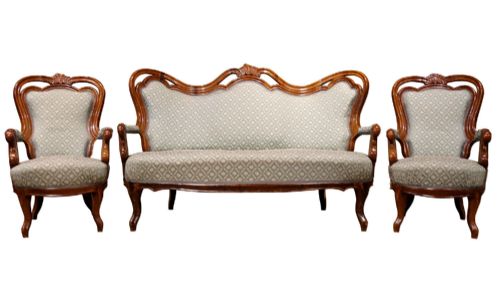


Rococo Revival Canape
A rococo revival canape brings exuberant curved lines and lavish nineteenth-century seating into a modern interior.
Rococo Revival Canape
A rococo revival canape is a decorative nineteenth-century settee or sofa modelled on earlier French court furniture. These pieces appear as multi-piece salon suites, carved open arm sofas, or smaller two-seater couches designed for formal entertaining.
Most examples found here date from the nineteenth century, including Victorian periods, with origins spanning French, German, and Continental workshops. Buyers meet variations ranging from giltwood salon settees to carved walnut open arm sofas and mahogany frames.
Forms include large salon settees and compact two-seater settees described variously as sofas, couches, or salon suites. The overarching style follows French Rococo Revival, Louis XV Revival, and the broader Rococo taste.
Materials and construction
Frames are constructed from solid timbers including walnut, mahogany, and rosewood, alongside gilded or gold-painted wood. Carvers worked these materials by hand to create the characteristic flowing contours and organic motifs of the style.
Upholstery relies on traditional textiles such as velvet, damask, and patterned fabric fitted to the carved wooden structures. Brass components occasionally supplement the structural joinery and decorative elements.
Assessing quality
Quality separates pieces by the crispness and depth of the hand-carved woodwork along the crest rails and cabriole legs. Finer frames exhibit fluid, deeply undercut foliage and scrolls rather than shallow or mechanical shaping.
The choice of primary wood and the integrity of the original gilt or polished finish dictate the visual hierarchy. Comprehensive salon suites and matched pairs demonstrate higher ambition than isolated seating pieces.
The Rococo Revival Canape Glossary
- Canape
- An upholstered settee or sofa featuring an exposed wooden frame and decorative carved details. These seats originated in France and gained renewed popularity during the nineteenth century.
- Louis XV Style
- A design aesthetic characterised by asymmetrical curves, C-scrolls, and naturalistic plant motifs. Nineteenth-century makers drew heavily upon this eighteenth-century French source.
- Salon Suite
- A matched set of seating furniture comprising a larger settee and accompanying armchairs. These ensembles were intended for formal reception rooms.
- Giltwood
- Timber treated with a thin layer of gold leaf or gold paint over a prepared surface. This finish accentuates the elaborate carving typical of revival furniture.
- Cabriole Leg
- A furniture leg that curves outward and then tapers inward with a pad or scroll foot. It is a defining structural element of rococo design.
Rococo Revival Canape: Frequently Asked Questions
How were these sofas used originally?
These settees served as formal seating in nineteenth-century drawing rooms and reception parlours. They provided comfortable yet impressive seating for entertaining guests and displaying social standing.
Owners placed them against panelled walls or within large salon arrangements. Their decorative backs were intended to be admired from multiple angles within the room.
How do I style a canape today?
A rococo revival canape works well as a focal point in a contemporary living room or bedroom. Pairing the ornate carved wood with simpler modern surroundings highlights its sculptural qualities.
Buyers often place them in entrance halls or large dressing rooms. Their curved silhouettes soften linear architectural spaces.
How do I tell nineteenth-century pieces apart?
Distinguishing nineteenth-century pieces involves examining the depth of the woodcarving and the timber species used. Walnut and mahogany frame construction points towards specific regional workshops and decades within the Victorian era. Nomenclature in listings also helps differentiate individual sofas from complete salon suites. Stylistic labels like Louis XV Revival indicate the specific design source.