



Revival Oak Desk
A revival oak desk brings substantial nineteenth and twentieth-century character to a study through heavy timber construction and historical stylistic references.
Revival Oak Desk
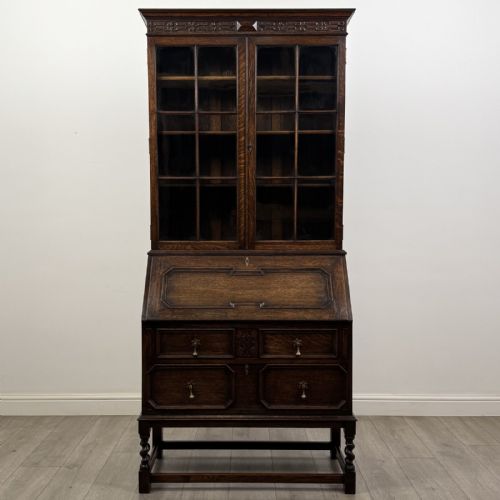
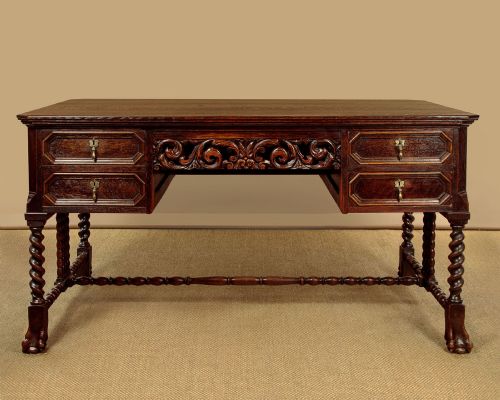
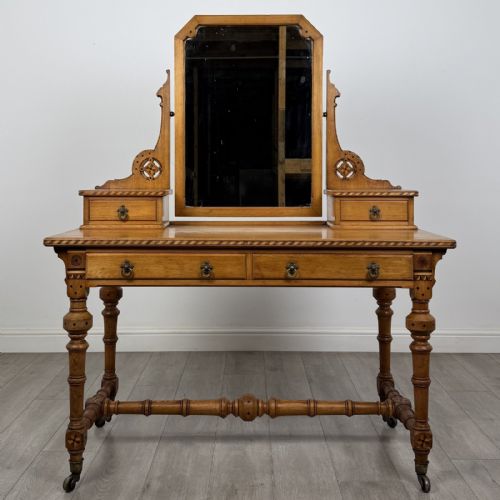
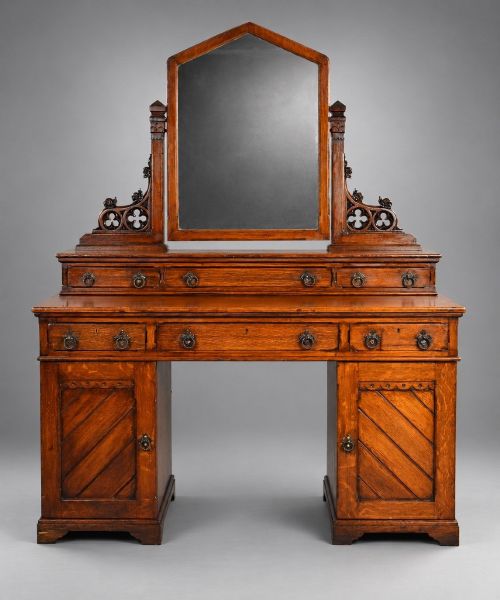
A revival oak desk unites sturdy domestic timber with historical decorative motifs drawn from Gothic, Jacobean, and Renaissance traditions. Buyers searching for a revival oak desk encounter robust nineteenth-century library tables, Victorian pedestal writing pieces, and compact Edwardian bureaux featuring fitted interiors.
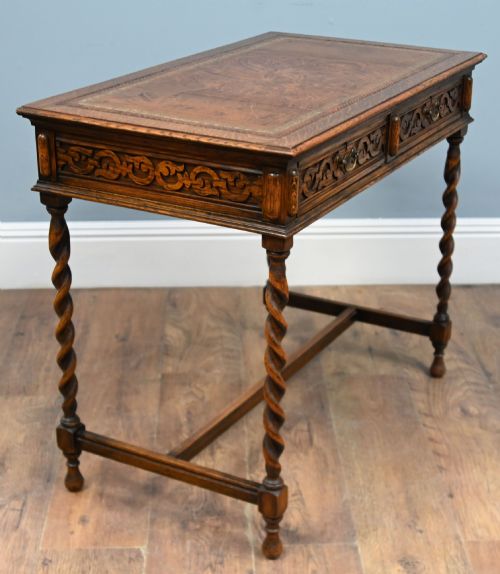
The material vocabulary centres on solid oak augmented by brass hardware, leather writing surfaces, and occasional carved detailing. Surviving forms range from heavy partners tables resting on barley twist legs to smaller writing desks equipped with raised galleries and linenfold panelling.
How they were made
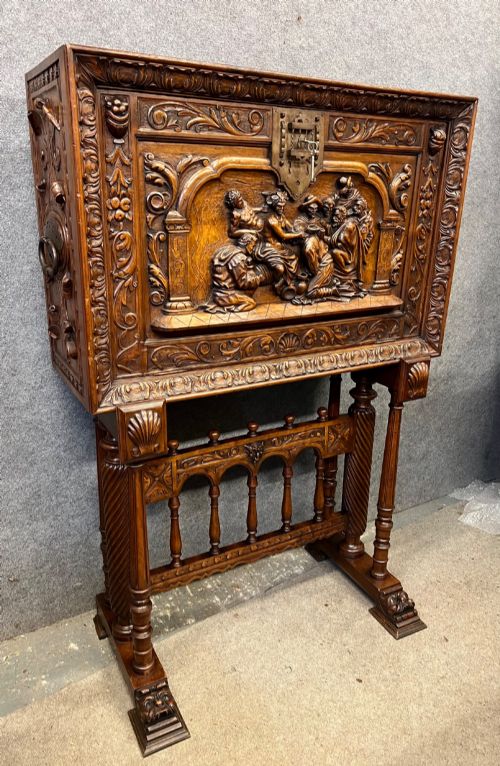
Cabinet makers utilised dense oak timber, selecting boards for visible grain patterns and quarter-sawn figuring before shaping structural frames by hand. Surface ornamentation relied upon deep chisel carving, applied mouldings, and turned elements such as barley twist supports.
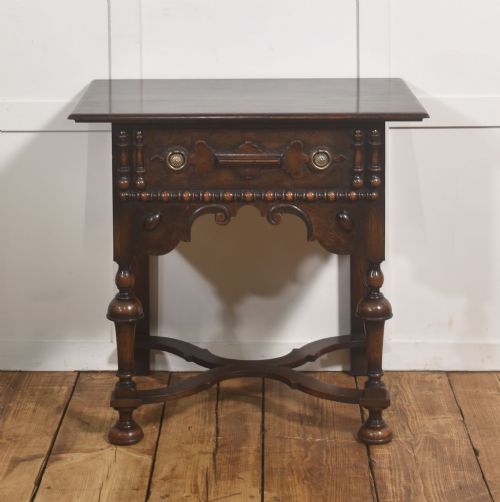
Writing surfaces were frequently inset with tooled leather panels, while drawers utilised traditional dovetail joinery and brass drawer pulls. Secondary materials like iron and glass appear in structural brackets, clock dials, and protective desk components.
Revival Oak Desk Retail Price Guide 2026
Typical asking prices for revival oak desk among the pieces listed under this phrase on Sellingantiques today, from the lower quarter to the upper quarter. They describe what is for sale here now, not the wider market.
Listings feature solid oak combined with leather, brass, and iron across Victorian and Edwardian periods.
What varies in quality
The standard of a revival oak desk depends on the crispness of the hand carving and the selection of the timber. Dense, figured oak with tight growth rings indicates a superior choice of raw material compared to plain, utility-grade boards.
Construction methods dictate longevity, distinguishing pieces assembled with tight dovetails and heavy timber framing from lighter, factory-produced alternatives. The integration of period-appropriate brass hardware and carefully fitted interior compartments further separates standard examples from exceptional ones.
Gillows·Bruce James Talbert·Winterhalder
The Revival Oak Desk Glossary
- Partners table
- A large double-sided writing desk designed for two people to work opposite each other, featuring drawers on both flanks. These are commonly found in nineteenth-century library settings.
- Bureau
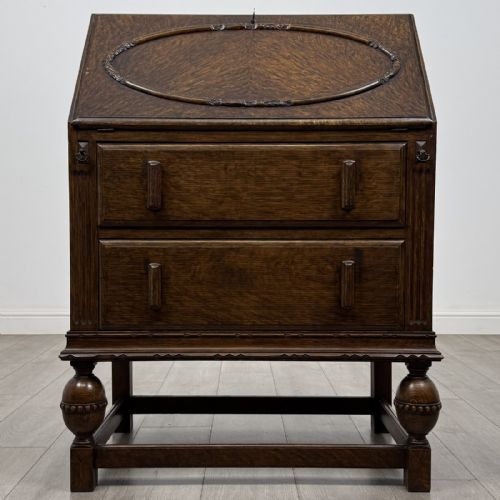
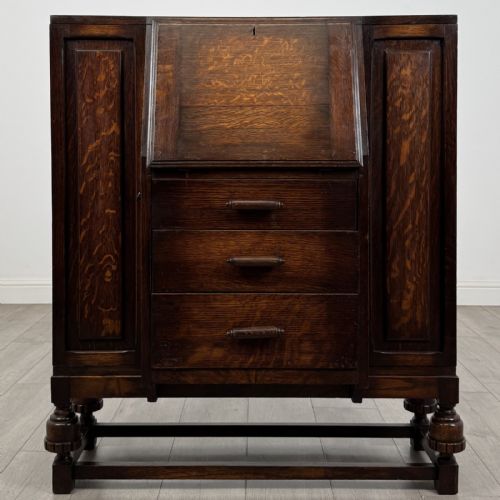
- A desk featuring a sloping hinged writing flap that opens to reveal internal pigeonholes and small drawers. Edwardian examples often incorporate linenfold panels or fitted stationery compartments.
- Barley twist
- A turned decorative furniture leg resembling a spiral rope or twisted column. This turned detail is particularly characteristic of seventeenth-century revival pieces made during the Victorian and Edwardian eras.
- Gothic Revival
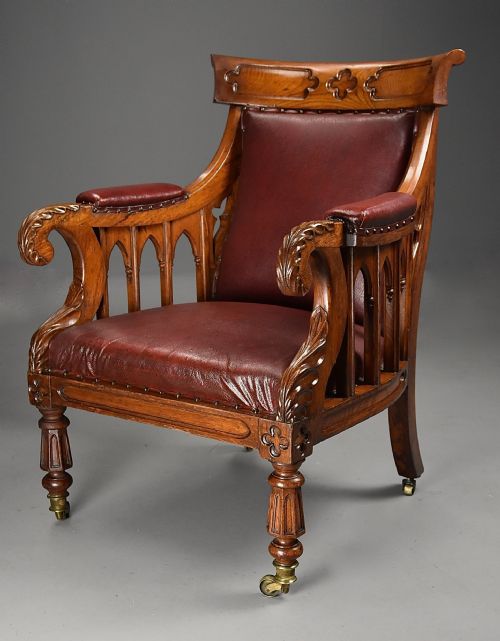
- An architectural and decorative style inspired by medieval forms, marked by pointed arches, trefoil details, and heavy carved tracery. It appears frequently on nineteenth-century oak furniture.
- Linenfold
- A style of wood carving that imitates folded parchment or linen cloth, frequently used on panelled cabinet doors and desk fronts. This technique adds texture to Edwardian oak surfaces.
Revival Oak Desk: Frequently Asked Questions
What periods do these desks cover?
The pieces span from the mid-nineteenth century through the Edwardian era and into the early twentieth century. These objects reflect successive waves of historical revivalism.
Craftsmen drew inspiration from Gothic, Jacobean, and Renaissance styles while adapting forms for contemporary nineteenth and twentieth-century domestic use.
Are writing surfaces usually leather?
Many library tables and writing desks feature inset leather writing panels. These surfaces provided a smooth, durable plane for ink and paper.
Not all forms include leather, as many Edwardian and Victorian bureaux rely entirely on polished solid oak writing flaps.
How do I identify a bureau?
A bureau is distinguished by its sloping front flap that drops down to create a writing surface. This hinged lid conceals a fitted interior of small drawers and pigeonholes.
They appear in compact Edwardian versions as well as larger variations supported by barley twist legs.
What is linenfold decoration?
Linenfold is a form of relief carving designed to resemble vertical folds of cloth or parchment. It is commonly found on panels surrounding Edwardian desk doors and galleries.
This technique adds depth and historical texture to plain oak surfaces without requiring figurative carving.