


Retro Globe Desk Lamp
A retro globe desk lamp brings character and functional task lighting to a room through period materials and striking sculptural forms.
Retro Globe Desk Lamp
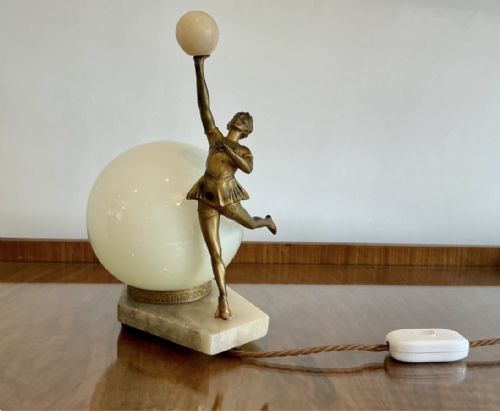
When you search for a retro globe desk lamp, you are looking at task and decorative lighting produced primarily during the early to mid-twentieth century. The selection spans the Edwardian era through the nineteen-forties, capturing distinct shifts in domestic design. You will encounter pieces defined by structural metalwork, decorative figures, and spherical or cylindrical diffusers.
The versions you are most likely to meet on this page lean heavily into the Art Deco style, alongside Machine Age modernist designs and Edwardian adaptations. These objects function as practical desk or table lighting while serving as sculptural centrepieces for a room. Their forms range from figurative statuary holding light sources to sleek industrial chrome structures.
Origins vary across British and continental workshops, with several notable French pieces appearing in the lineup. Materials such as opaline glass, brass, chrome, and marble dominate the construction, often paired with spelter or bronze figures. This combination of heavy stone bases and gleaming metal gives each example a substantial physical presence on a desk.
How they were made
The construction relies on contrasting heavy mineral bases with polished metals and delicate glass. Marble and alabaster provide stable foundations, while brass and chrome form the structural arms and lamp bodies. Spelter and bronze frequently appear in figurative components, cast into human and animal shapes.
Diffusers and shades utilise opaline glass to soften the light output effectively. Metal components involve period casting and plating techniques characteristic of the nineteen-twenties and nineteen-thirties. Many surviving pieces also show evidence of historical conversion from earlier oil-burning configurations to electricity.
The listings on this page span the Edwardian era through the nineteen-forties, featuring materials such as opaline glass, chrome, and marble.
What varies in quality
Quality in these desk lamps is dictated by the integrity of the materials and the crispness of the casting. Superior examples feature dense marble bases and heavy gauge brass or chrome rather than lightweight plated alloys. The weight and balance of the piece generally indicate the standard of its manufacture.
The Retro Globe Desk Lamp Glossary
- Opaline glass
- A milky, semi-translucent glass used widely for lamp shades to diffuse light evenly. It diffuses glare while maintaining a bright, clean illumination.
- Spelter
- An alloy of zinc used as a cost-effective substitute for bronze in decorative figures. It is softer than bronze and typically painted or electroplated.
- Machine Age
- A design aesthetic from the nineteen-thirties celebrating industry, technology, and streamlining. It favours smooth chrome, Bakelite, and unadorned geometric lines.
- Pricket lamp
- A style of lamp featuring a sharp spike or central stem to support a candle or shade component. They often utilise heavy brass or bronze shafts.
- Bakelite
- An early form of synthetic plastic prized for its durability and rich dark lustre. It appears frequently in switches, bases, and electrical fittings of the period.
Retro Globe Desk Lamp: Frequently Asked Questions
What periods do these desk lamps come from?
The pieces span the Edwardian period through the nineteen-forties, with a strong concentration from the nineteen-twenties and nineteen-thirties.
Design influences range from traditional Edwardian brass work to geometric Art Deco and industrial Machine Age modernism.
How were these lamps originally used?
They served primarily as task lighting for desks, reading tables, and writing bureaus in homes and offices.
Many also functioned as decorative accent pieces, combining ambient illumination with sculptural metalwork or figural art.
Are these lamps wired for modern use?
Many surviving examples have been adapted or rewired over time to meet contemporary electrical standards.
Some Edwardian pieces even show historical conversions from original oil-burning mechanisms to standard electrical fittings.
How do I identify Art Deco lighting?
Art Deco pieces typically display clean geometric lines, zig-zag motifs, and smooth metallic finishes like chrome.
They often incorporate contrasting materials such as polished brass, Bakelite, and heavy marble bases.
What materials are most common?
Brass, chrome, marble, and opaline glass appear most frequently across the listed selection.
Secondary materials include bronze, spelter, and alabaster, which add weight and decorative detail to the bases and figures.