






Ecclesiastical Brass Lamp
An ecclesiastical brass lamp brings solemn architectural weight and warm metalwork into a room, drawn directly from church altars into domestic spaces.
Ecclesiastical Brass Lamp
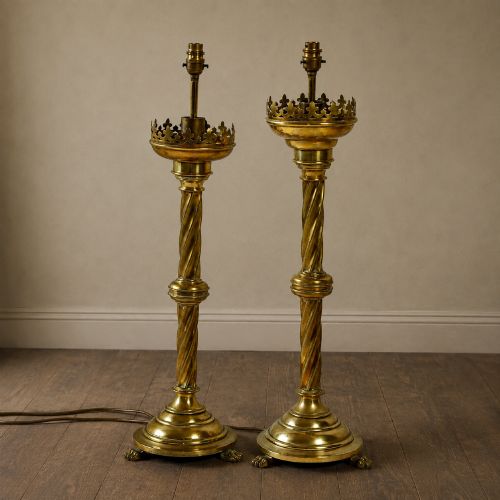
When you search for an ecclesiastical brass lamp, you are looking at metalwork originally cast for church altars, chapels and monastic spaces, repurposed over time into functional domestic lighting. These pieces carry the heavy ritual aesthetic of nineteenth-century worship, shifting from liturgical service to interior decoration.
You are most likely to meet nineteenth-century table lamps and converted altar candlesticks on this page, often appearing as matched pairs or imposing single pricket standards. They frequently display the distinctive architectural vocabulary of the Gothic Revival or French ecclesiastical traditions.
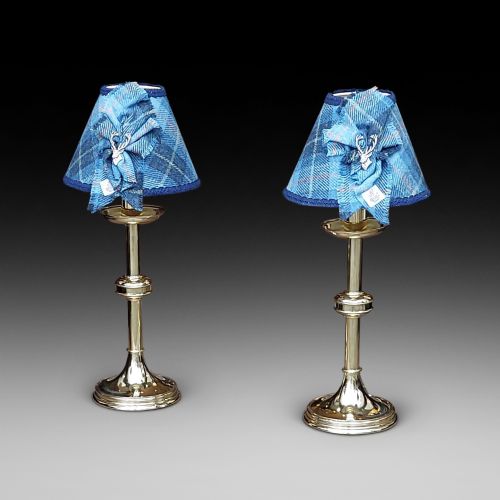
The form usually begins as a heavy brass or gilt bronze candlestick or candelabra, later adapted with electrical fittings for domestic use. Some examples retain traces of their original function through pricket spikes or wide drip pans, while others integrate opaline glass or fabric shades.
Materials and construction
These lamps rely on substantial brass, ormolu and gilt bronze, cast in heavy sections to support tall shafts without tipping. Foundries used robust metalworking techniques to build structural rigidity, ensuring the pieces could hold candles securely on altars before later conversion to electricity.
Surface treatment ranges from polished brass to rich fire gilding, sometimes paired with contrasting materials like opaline glass. Later conversions introduced fabric, damask and silk fringe shades, often finished with glass beads, sitting atop the metal bases.
Several heavy brass altar candlesticks survived centuries of church liturgy only to spend their retirement holding up silk fringe shades.
Assessing quality and proportion
Quality rests in the weight of the casting and the crispness of the architectural detail, where sharper moulding and heavier gauge metal distinguish better workshops. Pieces showing refined Gothic Revival tracery or delicate French Rococo Revival cast ornament stand apart from simpler utilitarian foundry work.
The integrity of the conversion also defines the standard, particularly how cleanly electrical wiring is integrated without compromising the original brass structure. Surviving matched pairs command greater presence than single standards, maintaining symmetry in scale and decorative program.
The Ecclesiastical Brass Lamp Glossary
- Pricket lamp
- A candlestick or lamp featuring an upright metal spike designed to hold a candle, adapted into a table lamp base.
- Gothic Revival
- A nineteenth-century architectural and decorative style drawing inspiration from medieval pointed arches, trefoils and heavy ecclesiastical forms.
- Ormolu
- Finely chased and gilt bronze ornament applied to decorative objects and metalwork, originating in French luxury workshops.
- Candelabra
- A branched lighting fixture holding multiple light sources, frequently converted from church altar furnishings.
- Opaline glass
- A translucent, milky white glass popular in nineteenth-century lighting and decorative objects, often paired with brass bases.
Ecclesiastical Brass Lamp: Frequently Asked Questions
What is an ecclesiastical brass lamp?
An ecclesiastical brass lamp is a piece of metalwork originally cast for use in churches, such as altar candlesticks or pricket standards, which has subsequently been converted into a table lamp for domestic interiors.
These pieces retain the solemn architectural forms of their liturgical origins, offering substantial weight and distinct period styling ranging from Gothic Revival to French nineteenth-century design.
How do I identify a Gothic Revival piece?
Gothic Revival pieces display architectural motifs borrowed from medieval buildings, including pointed arches, quatrefoils, heavy knops and triangular bases.
On this page, these characteristics appear most frequently in nineteenth-century altar candlesticks and table lamps produced during the Victorian era.
Are these lamps sold as pairs?
Many ecclesiastical lamps listed here appear as matched pairs, particularly those converted from altar candlesticks used to flank church tabernacles or altars.
Single table lamps also occur, often representing larger pricket standards or individual sanctuary pieces.
How are altar candlesticks converted into lamps?
Conversion typically involves running an electrical cord through the central shaft of the heavy brass candlestick and mounting a bulb holder near the top.
Many examples retain their original pricket spikes, drip pans and weighted bases beneath the added electrical hardware.
What materials accompany the brass?
While solid brass forms the primary structure, these lamps frequently incorporate ormolu, gilt bronze and opaline glass components.
Shades added during conversion often utilise damask fabric, silk fringe and glass beads to complement the heavy metal bases.