
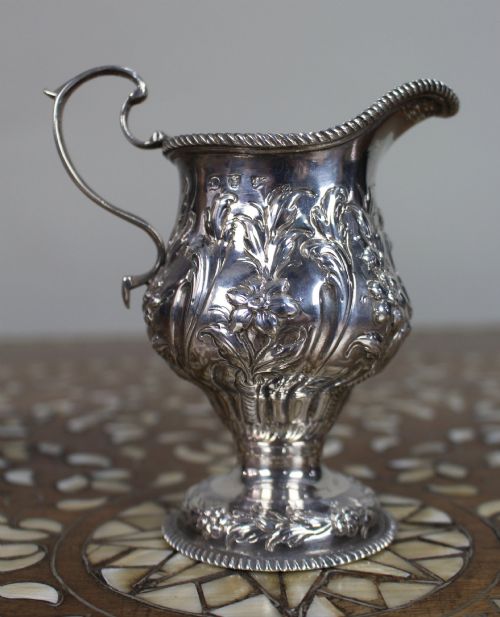
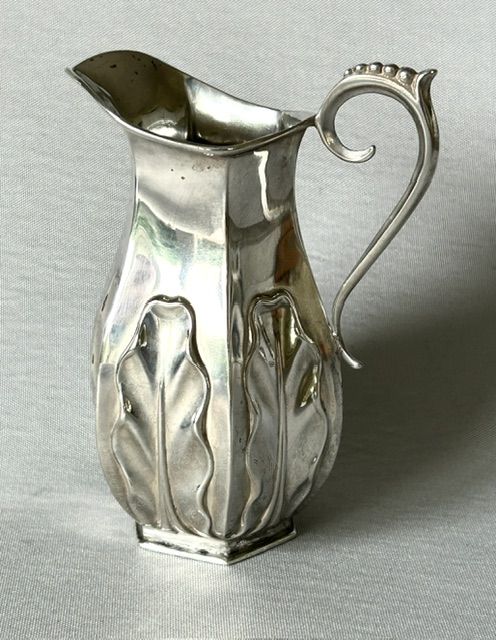


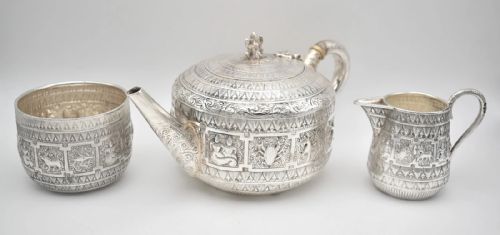

Repousse Silver Cream Jug
A repousse silver cream jug brings tactile weight and chased relief to the tea table, ranging from Georgian restraint to Victorian naturalist exuberance.
Repousse Silver Cream Jug
When you search for a repousse silver cream jug, you encounter holloware designed to pour milk or cream, shaped by hammering from the reverse to create raised ornamental patterns on the surface. These pieces span Georgian, Victorian, and Edwardian periods, appearing alongside later twentieth-century iterations and Chinese export examples.
The version you most frequently meet on this page is the Victorian sterling silver cream jug, often dated across the nineteenth century from eighteen-forty-nine to eighteen-ninety-four. Alongside these standard vessels, you also find paired jug and sugar bowl sets, multi-piece tea services, and occasional silver-plated or electroplated nickel silver alternatives.
Materials and construction
Makers formed a repousse silver cream jug primarily from sterling silver, shaping the metal body while hammering intricate designs from the inside out to achieve three-dimensional floral, animal, or scroll relief. Some iterations incorporate internal gilt washes, while other pieces utilise silver plate or electroplated nickel silver over a base metal foundation.
Handles and spouts required careful soldering to the chased body, frequently featuring organic forms such as bamboo or naturalistic branches. Hallmarks stamped directly into the metal record the assay office, standard of silver, and date of manufacture for many British examples.
Some Victorian silversmiths went entirely wild, wrapping small cream jugs in raised bamboo handles and chasing pandas or dragons into the metal.
Judgement of quality
Quality in a repousse silver cream jug rests upon the depth, crispness, and control of the chased relief across the surface of the metal. Superior examples exhibit sharp botanical or figural detail where the hammer work remains distinct from the interior, rather than softened or flattened through excessive polishing over generations.
The weight of the silver gauge and the proportional balance between the body, handle, and spout distinguish finer workshop production from simpler commercial output. Maker marks and clear hallmarks also elevate a piece by providing verifiable evidence of its origin and silver standard.
Luen Hing·George Fox
The Repousse Silver Cream Jug Glossary
- Repousse
- Metalworking technique where the artisan hammers the design from the reverse side of the object to create a raised pattern in relief. This method produces tactile ornamentation across the exterior of tea and tableware.
- Sterling silver
- Alloy consisting of ninety-two point five percent silver by mass, with the remainder usually copper. This standard defines the primary metal used for most antique British cream jugs.
- Gilt
- A thin layer of gold applied to the interior surface of a silver vessel. This treatment protects the silver from tarnishing when exposed to acidic dairy products.
- Hallmark
- Official stamp applied to precious metals by an assay office to guarantee the purity of the metal. These marks often include maker initials, date letters, and city symbols.
- Holloware
- Tableware category that includes vessels with volume, such as cream jugs, pitchers, teapots, and sugar bowls. These pieces are typically formed by raising, spinning, or assembling sheet metal.
Repousse Silver Cream Jug: Frequently Asked Questions
What is a repousse silver cream jug?
It is a small pouring vessel for dairy created by hammering metal from the reverse to raise decorative motifs in relief.
These pieces were made in sterling silver or plate to accompany tea services across the Georgian and Victorian eras.
How do I date an old cream jug?
Examine the stamped hallmarks on the base or rim, which typically indicate the assay office, silver standard, and exact year of production.
Stylistic indicators such as Rococo revival scrolls or naturalist floral motifs also help assign pieces to specific nineteenth or eighteenth-century periods.
Why is the inside gold colored?
That golden layer is a gilt wash applied to protect the silver from reacting with milk or cream.
This interior gilding was a common practice in quality dining silver to prevent tarnishing and preserve the metal.
What is the difference between sterling and plate?
Sterling silver consists of solid metal meeting strict purity standards throughout its entire thickness.
Silver plate and electroplated nickel silver feature a thin coating of silver bonded over a base metal core.