

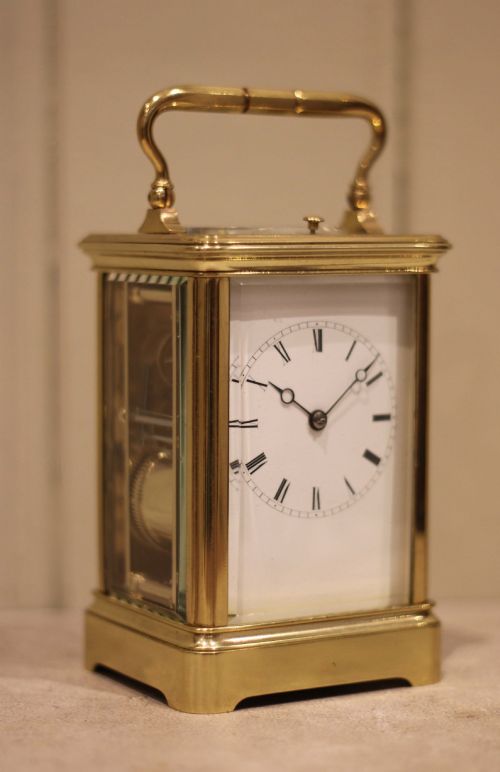


Repeater Mantel Clock
A repeater mantel clock brings mechanical precision and heavy brass proportion into a room, sounding the hours on demand through a button press.
Repeater Mantel Clock
A repeater mantel clock typically takes the form of a French carriage clock designed to sit firmly on a shelf or desk. These portable timepieces date mainly from the Victorian era and the late nineteenth century.
The selection here centres on traditional French workshops producing brass and gilt bronze cases housing complex striking movements. Examples range from plain gorge cases to grander pieces featuring enamel panels and alarm functions.
How they were made
Clockmakers constructed these heavy frames from brass, gilt brass, and silver gilt, housing steel internal components behind bevelled glass panels. Cases often follow the gorge design with distinctive stepped mouldings.
Dials employ white enamel with detailed markings, sometimes decorated with hand-painted floral motifs or enamel paintings. Movement plates demand careful hand-finishing to coordinate the striking, chiming, and repeating mechanisms.
Repeater Mantel Clock Retail Price Guide 2026
Typical asking prices for repeater mantel clock among the pieces listed under this phrase on Sellingantiques today, from the lower quarter to the upper quarter. They describe what is for sale here now, not the wider market.
One exceptional piece carries race horse interest, proving that even Victorian timekeeping occasionally kept pace with the turf.
What varies in quality
Quality depends upon the complexity of the internal train, distinguishing standard striking clocks from those featuring five-minute repeaters, grand-sonnerie strikes, or added alarm mechanisms. Maker attribution also separates standard workshop output from signed pieces.
Case finishing marks the grade, with heavy gilt bronze and silver gilt metals outlasting simple polished brass. The presence of original fitted boxes and paperwork adds considerably to the standing of a piece.
L Epee·Bourdin Paris·Drocourt·Alfred Drocourt·Henry Jacot·Richard And Co
The Repeater Mantel Clock Glossary
- Repeater
- A mechanism that sounds the last hour and quarters upon pressing a button on the case. This allows the time to be checked in total darkness.
- Grande-sonnerie
- A complex striking system that chimes both the hours and the quarters automatically as each quarter passes. It represents the highest order of mechanical clockmaking.
- Carriage clock
- A portable spring-driven timepiece developed for travellers during the nineteenth century. They typically possess a flat base and a carrying handle on top.
Repeater Mantel Clock: Frequently Asked Questions
How do I use the repeat button?
Press the button on top of the case firmly downwards to trigger the gong strike. The mechanism counts out the hours and quarters last passed.
Release the button fully before setting the time or moving the clock to protect the internal gear train.
Are these clocks easy to wind?
Winding requires a dedicated key inserted into the arbours found on the underside or backplate of the movement. Turn the key gently until firm resistance indicates the mainspring is fully tensioned.
Take care not to overwind the springs, as this strains the vintage steel components inside.
Where should I place a carriage clock?
Position the clock on a stable mantelpiece, shelf, or desk away from direct sunlight and draughts. A level surface ensures the platform escapement beats evenly.
Avoid high-humidity environments that could tarnish the gilt brass case or affect the delicate enamel dial.
How do I tell the age of a piece?
Examine the style of the brass case, the shape of the escapement visible through the top glass, and any signature engraved on the backplate. Victorian and late nineteenth-century examples often display maker stamps and registration marks.
French pieces from this era frequently utilise specific platform escapement designs that help narrow down their decade of manufacture.