


Religious Medal Pendant
A religious medal pendant brings tangible devotion and exceptional French craftsmanship into daily wear.
Religious Medal Pendant
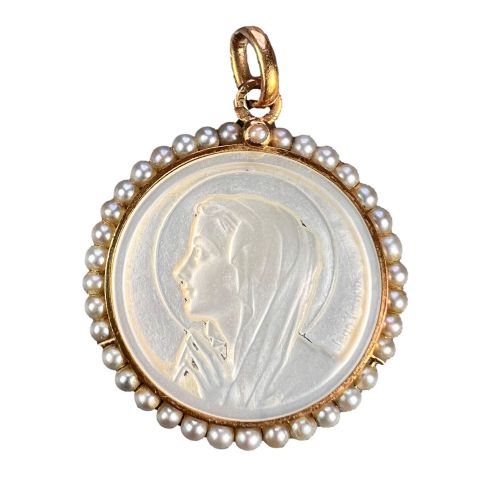
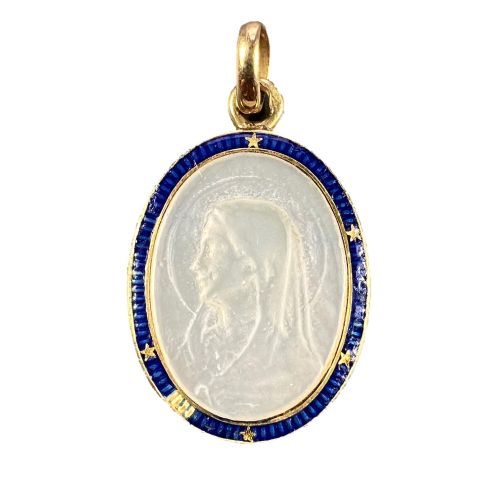
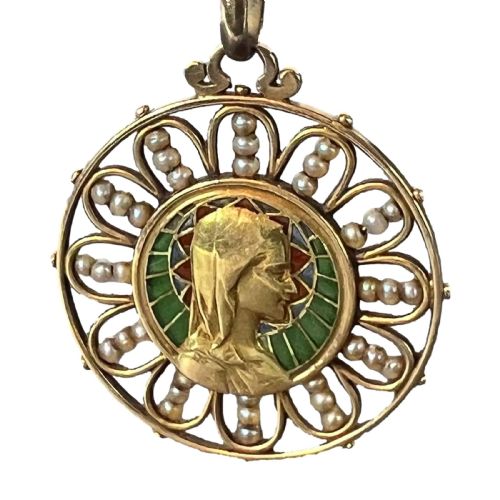
The forms vary from simple oval discs to complex crosses and radiant sunbursts designed to catch the light. Many examples incorporate delicate devotional symbolism, often pairing imagery of the Madonna and Child with floral motifs or angels. The prevailing aesthetic draws heavily from French religious art traditions, blending spiritual significance with the decorative philosophies of Art Nouveau and Art Deco.
Materials and Technique
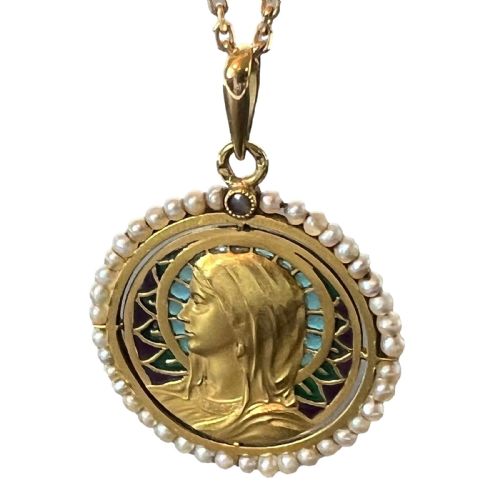
Makers fashioned these pendants primarily in eighteen-carat yellow, rose, and white gold, utilising the metal as a warm canvas for detailed embossing. The striking visual depth often comes from plique-à-jour enamel, which suspends translucent colour without a backing, or traditional opaque red and blue enamels that highlight specific symbols.
Organic elements frequently complement the metalwork, with mother-of-pearl plaques providing an iridescent background for carved figures. Artisans further enhanced select pieces by setting seed pearls or small diamonds into the borders, combining fine jewellery techniques with devotional iconography.
Even deer hunting horns occasionally found their way into French charm workshops alongside traditional holy figures.
Distinctions in Quality
The standard of a religious medal pendant rests largely on the clarity of the sculptural relief and the reputation of the medallist who designed the stamp. Pieces signed by known artists exhibit sharper facial expressions, more fluid drapery folds, and a meticulous attention to micro-detailing that cheaper commercial strikings lack.
Material complexity also dictates the tier of the piece, with delicate plique-à-jour enamel work and pristine mother-of-pearl backgrounds representing superior craftsmanship. The integration of gemstones and the crispness of the surrounding gold borders distinguish standard devotional items from master-grade miniature sculptures.
Emile Monier·Paul Brandt·Emile Dropsy·Ovide Yencesse·Jules Holy
The Religious Medal Pendant Glossary
- Plique-a-jour
- An enamelling technique where enamel is applied to open cells, creating a stained-glass effect that lets light pass through directly. This method requires immense skill from the goldsmith to prevent the enamel from cracking during firing.
- Medallion
- A large medal shaped as a pendant, often featuring detailed relief work on both sides. These serve as significant wearable tokens of faith or historical commemoration.
- Mother of Pearl
- The iridescent inner layer of mollusc shells, carved and polished for use as a luminous backing material in devotional jewellery. It adds a subtle play of shifting colours behind gold figures.
- Seed Pearl
- A tiny, naturally small pearl used in clusters or borders to accent fine antique jewellery. Their delicate scale demands careful hand-setting by the jeweller.
- Sacred Heart
- A traditional Christian symbol representing the heart of Jesus Christ as a vital motif of divine love. In these pendants, it is frequently rendered with flames, a crown of thorns, or radiating light beams.
Religious Medal Pendant: Frequently Asked Questions
What do these medals typically depict?
The iconography centres predominantly on the Virgin Mary, the Madonna and Child, and various venerated saints such as Saint Christopher and Saint John the Baptist. Other common subjects include the Sacred Heart, holy doves, and specific devotional titles like Notre Dame of Lourdes.
These sacred figures appear rendered in fine metal relief, often framed by decorative borders or enhanced with enamel and mother-of-pearl backgrounds.
How should I wear a religious medal pendant?
These pendants suspend easily from fine gold chains, making them suitable for daily wear either alone as a focal point or layered with other charms. Their compact size allows them to sit comfortably against the collarbone.
Because many examples feature delicate enamel or mother-of-pearl elements, it is wise to remove the pendant during vigorous physical activities to protect the surfaces.
Are these pendants distinctly French?
The vast majority of pieces originate from French workshops and include hallmarks denoting standard gold fineness used in France during the late nineteenth and early twentieth centuries. The stylistic vocabulary closely follows French religious art movements of the period.
Signature characteristics include the refined medallic art style pioneered by celebrated French sculptors and goldsmiths of the era.
How can I tell the period of a pendant?
Stylistic cues offer the clearest indication of date, with flowing organic lines pointing toward Art Nouveau designs around nineteen-hundred, and geometric precision signaling Art Deco influences into the nineteen-twenties and thirties. Maker signatures and French gold assay marks also help anchor pieces to specific decades.
Examining the manufacturing techniques, such as the application of plique-à-jour or the cut of the gold, further clarifies the timeline of production.