




Regency Straight Front Chest
A regency straight front chest provides clean architectural lines and rich timbers for any room.
Regency Straight Front Chest
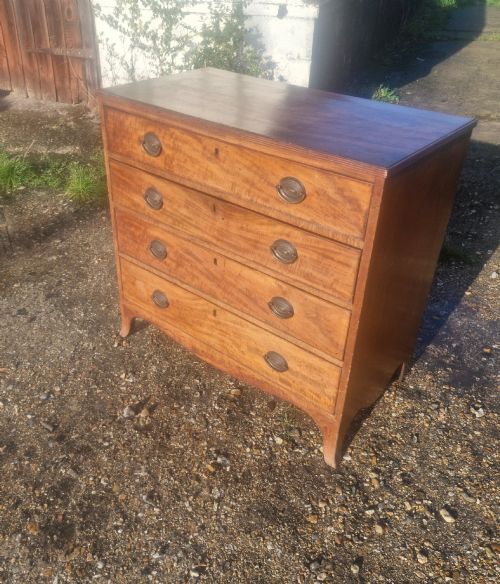
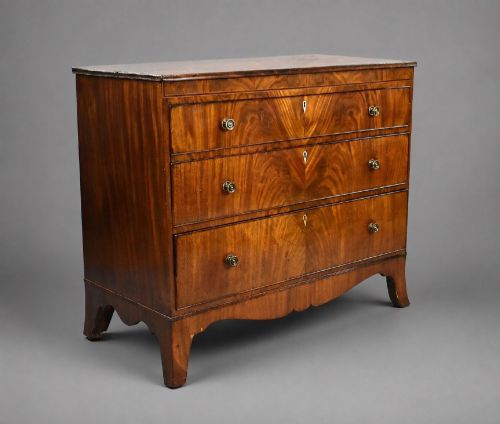
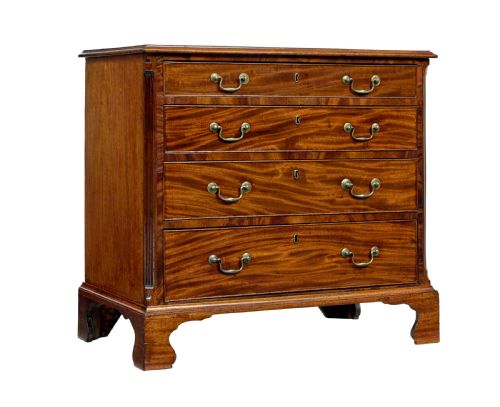
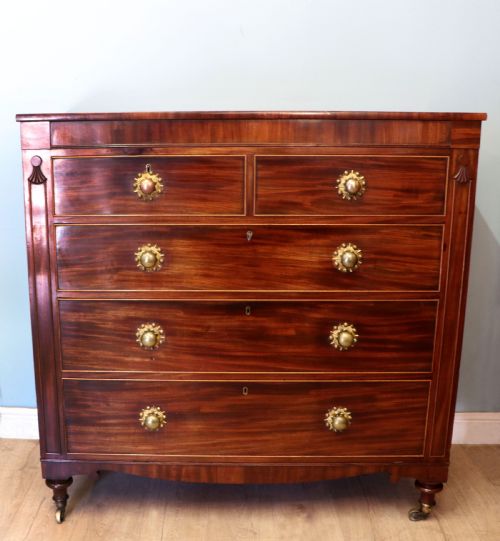
A regency straight front chest stands as a practical and formal storage piece from the early nineteenth century. These chests of drawers feature flat drawer fronts arranged vertically, avoiding the curves or bows seen in other designs.
Most examples encountered here belong to the Regency period or the wider nineteenth century. They typically take the form of standard chests of drawers with graduating drawer configurations.
The aesthetic draws on George III traditions while embracing simpler geometric forms. Buyers find pieces shaped by cabinet makers working within the Regency and Georgian style idioms.
How they were made
Makers constructed these carcasses from mahogany, frequently selecting figured or flame mahogany for the primary visual surfaces. Satinwood line inlay adds crisp contrasting borders to the drawer fronts and top edges.
Brass handles and escutcheons punctuate the dark timber grain across many of the listed examples. Bone details occasionally appear on keyhole escutcheons or drawer pulls, providing subtle tonal variation.
Regency Straight Front Chest Retail Price Guide 2026
Typical asking prices for regency straight front chest among the pieces listed under this phrase on Sellingantiques today, from the lower quarter to the upper quarter. They describe what is for sale here now, not the wider market.
Bone escutcheons on these chests offer a tactile, creamy contrast to dark mahogany.
What varies in quality
The selection of timber grain defines the visual merit of each piece, with figured and flame mahogany veneers commanding greater attention than plain boards. Satinwood line inlay executed with crisp precision demonstrates superior cabinet work.
Proportion and the handling of graduated drawers dictate the balance of the facade. Graduated drawers decrease in depth smoothly from top to bottom, maintaining visual harmony across the front.
The Regency Straight Front Chest Glossary
- Graduated drawers
- Drawers that decrease in depth progressively from the bottom to the top of the chest. This arrangement creates a balanced visual perspective.
- Flame mahogany
- A veneer cut from the fork of the mahogany tree where the grain twists. It produces a distinctive flickering flame pattern.
- Satinwood
- A pale, hard timber utilised for decorative stringing and inlay work. It contrasts sharply against dark mahogany surfaces.
- Escutcheon
- A protective plate surrounding a keyhole, frequently made of brass or bone. It prevents the timber surrounding the lock from sustaining damage.
Regency Straight Front Chest: Frequently Asked Questions
What rooms suit a regency straight front chest?
These chests offer deep storage capacity that functions well in bedrooms or hallways. Their flat profiles allow them to sit flush against walls without projecting too far into the floor space.
The sober architectural lines pair easily with both antique and modern interior schemes. They provide a stable surface for lamps, mirrors or decorative objects.
How do I identify a Regency period piece?
Look for timber selection, specific handle styles and the overall geometric restraint characteristic of the early nineteenth century. Mahogany and satinwood line inlay dominate pieces from this era.
Secondary woods and construction methods inside the carcass also help confirm the age. Comparing drawer linings and backboards provides further clues to the date of manufacture.
How should I care for mahogany timber?
Keep the wood away from direct sunlight and heat sources to prevent the veneers from drying out. Applying a traditional wax polish periodically helps maintain the natural lustre of the mahogany.
Avoid using silicone sprays or modern chemical cleaning products on antique surfaces. Gentle dusting with a dry cloth is sufficient for routine maintenance.
What distinguishes figured mahogany from plain timber?
Figured timber displays natural optical movement and pattern within the grain structure due to the growth of the tree. Plain mahogany presents a uniform, straight grain without the dramatic light-reflecting qualities.
Veneers cut from figured logs were reserved for the primary display surfaces of better quality pieces.