

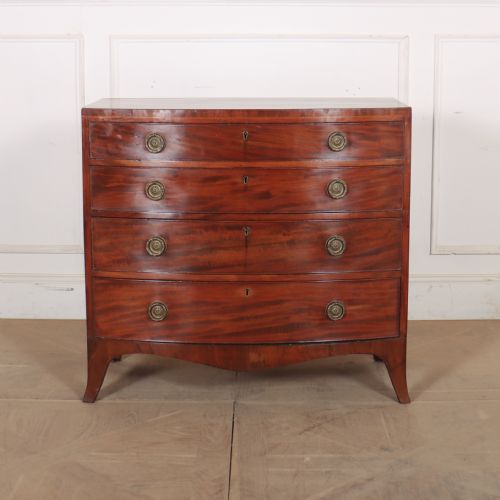


Regency Splayed Leg Chest
A regency splayed leg chest brings refined proportions and rich timber to a room, offering both practical storage and striking period character.
Regency Splayed Leg Chest
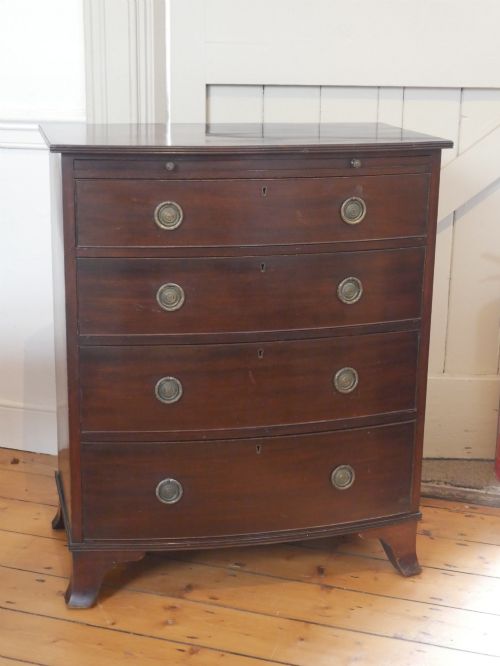
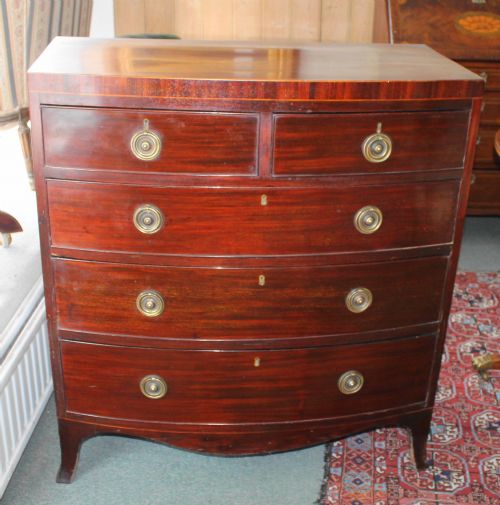
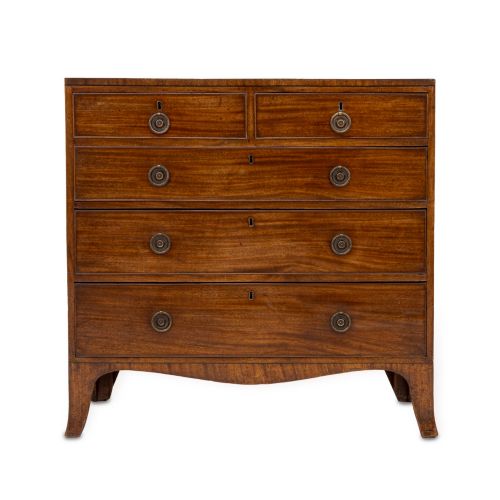
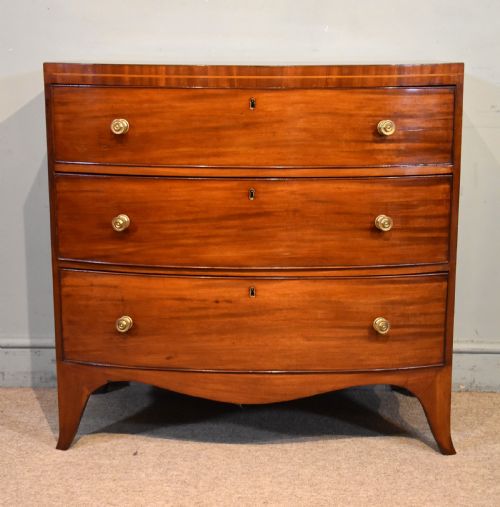
A regency splayed leg chest represents a specific form of drawer storage defined by its distinctive silhouette and architectural presence. Buyers seeking a regency splayed leg chest will encounter various interpretations of the form, predominantly executed in mahogany with bow fronts.
The pieces appearing on this page span the Regency period itself alongside related Georgian, nineteenth-century, and later revival examples from nineteen-twenty. Bow fronted forms dominate the selection, offering curved drawer fronts that soften the overall mass of the furniture.
Makers working during these periods employed traditional chest of drawers configurations, ranging from neat proportions to larger tallboy formats. Each piece demonstrates the characteristic joinery and timber selection associated with these historical eras.
Materials and construction methods
Cabinet makers relied heavily on mahogany as the primary timber, often enhanced by contrasting boxwood and satinwood inlay. Oak frequently served as a secondary wood for internal drawer linings and structural framing.
Surface decoration frequently involved fine stringing and inlay work, complemented by polished brass hardware. Timber was selected for grain figure, particularly across the curved drawer fronts that define the bow front style.
Listings span the Regency, Georgian, and nineteenth-century periods, alongside nineteen-twenty revival pieces constructed in mahogany, oak, and inlaid woods.
Judging quality and execution
Quality in these chests rests upon the crispness of the inlay work and the harmonious grain matching across the drawer fronts. Superior examples display careful timber selection where the mahogany figure flows naturally from the top down through each drawer.
Construction integrity is visible in the precision of the dovetail joints and the tidy fit of the drawers within their carcase. The refinement of the feet, whether bracket or alternative supports, also distinguishes finer cabinet work from more utilitarian pieces.
The Regency Splayed Leg Chest Glossary
- Bow front
- A convex curved cabinet front that projects outward at the centre. This shape gained immense popularity during the Regency and Georgian periods for chests of drawers.
- Caddy top
- A tabletop style with a raised, moulded edge resembling the lid of a tea caddy. It provides a distinct profile to the upper surface of the chest.
- Tallboy
- A tall chest of drawers consisting of one chest stacked directly on top of another. These pieces maximise vertical storage space.
- Satinwood
- A lustrous, yellowish timber imported from the tropics, frequently used for contrasting stringing and decorative inlays on mahogany furniture.
- Dovetail
- A traditional interlocking woodworking joint used to construct sturdy drawer boxes. Fine spacing of the pins indicates high craftsmanship.
Regency Splayed Leg Chest: Frequently Asked Questions
How do I date a mahogany chest?
Dating involves examining the secondary timbers, construction methods, and hardware styles used throughout the piece. Earlier pieces often feature hand-cut dovetails and oak linings, whereas later interpretations incorporate different joinery markers.
Stylistic cues like inlay motifs and foot shapes also help assign a piece to the Regency period or subsequent nineteenth-century revivals.
Where should I place a tallboy?
A tallboy requires a wall with sufficient vertical clearance and floor space to accommodate its substantial height. Because these chests offer significant storage capacity, they work well in bedrooms or dressing rooms.
Securing taller furniture to the wall provides stability and protects the historical carcase from accidental tipping.
What timber was used for these chests?
Mahogany serves as the primary timber across the pieces listed, valued for its durability and rich reddish-brown tone. Craftsmen often paired it with contrasting light woods such as boxwood and satinwood for decorative inlay.
Internal elements like drawer sides and backs typically utilise secondary timbers such as oak.