


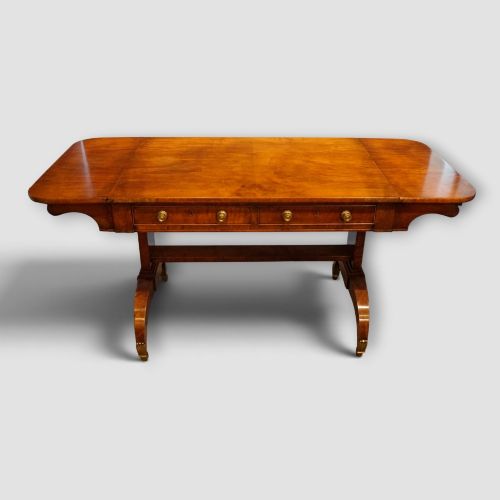
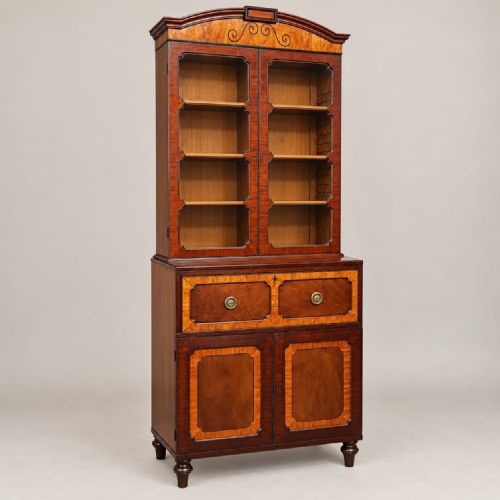
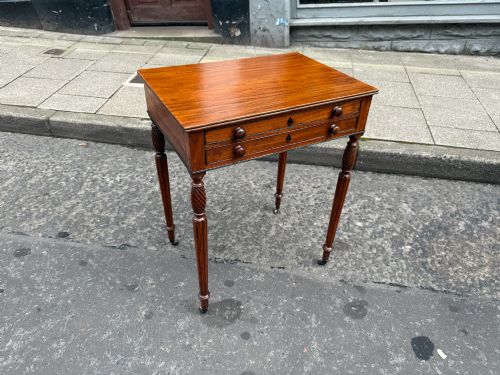


Regency Satinwood Desk
A regency satinwood desk offers fine golden timber work and compact writing surfaces, combining elegance with practical utility.
Regency Satinwood Desk
A regency satinwood desk is a sophisticated form of writing furniture typically dating from the early nineteenth century and the Georgian era. These pieces often feature contrasting bandings and neat proportions suited to refined interiors.
The selections available here showcase various formats, from compact writing cabinets and Davenport desks to larger freestanding writing tables. Satinwood forms the primary visual draw, often enhanced by mahogany, ebony or brass details.
Buyers seeking this phrase most frequently encounter Davenport desks, writing cabinets and smaller occasional writing tables from the Regency and late Georgian periods. These items reflect the period's taste for figured timbers and clever internal compartments.
What varies in quality
Quality rests principally on the choice of timber figure and the precision of the contrasting bandings. Highly figured satinwood with strong natural chatoyancy marks the finest examples.
The refinement of internal fittings, such as concealed drawers, stationary pigeonholes and original brass mounts, dictates the distinction between standard production and master cabinetwork.
Regency Satinwood Desk Retail Price Guide 2026
Typical asking prices for regency satinwood desk among the pieces listed under this phrase on Sellingantiques today, from the lower quarter to the upper quarter. They describe what is for sale here now, not the wider market.
Listings feature items from the Georgian, Regency and Victorian eras, utilising satinwood alongside mahogany, ebony and brass.
Gillows of Lancaster
The Regency Satinwood Desk Glossary
- Satinwood
- A hard, durable tropical timber with a natural golden sheen that takes a high polish. It forms the defining decorative surface for these desks.
- Davenport
- A small, compact writing desk featuring a sloped, hinged writing surface above a pedestal of side drawers. This form became popular during the Regency period.
- Banding
- A narrow strip of contrasting wood veneer inlaid around the perimeter of a table top or drawer front. It creates a neat visual border.
- Stringing
- Very thin lines of inlay, often in ebony or boxwood, used to outline panels and drawers on case furniture. It adds linear definition to the piece.
- Ormolu
- Gilded bronze mounts and decorative details applied to furniture. It provides a metallic accent against polished timber.
Regency Satinwood Desk: Frequently Asked Questions
What is a Davenport desk?
A Davenport is a compact writing desk featuring a sloping, leather-lined top that lifts to reveal storage. A bank of drawers usually opens to one side.
Cabinetmakers designed them for small spaces where a full-sized partner desk would prove impractical.
How do I care for satinwood?
Keep satinwood furniture away from direct sunlight and excessive heat sources to prevent the timber from fading and drying out. Regular dusting with a soft, dry cloth preserves the polished surface.
Apply a microcrystalline wax occasionally to nourish the wood and maintain its natural golden lustre.
Are these desks practical for daily use?
Many examples provide useful writing surfaces and organised storage for modern stationery or laptop use. Their compact proportions allow them to fit easily into sitting rooms or home offices.
Care should be taken with moisture and heavy wear to protect antique polished surfaces and leather inserts.
How do I identify a Regency piece?
Regency furniture typically dates from the early nineteenth century, displaying classical restraint and refined proportions. Look for specific decorative elements like brass inlay, ebony stringing and sabre legs.
Construction methods, such as hand-cut dovetails and solid secondary timbers, also help confirm the period.