


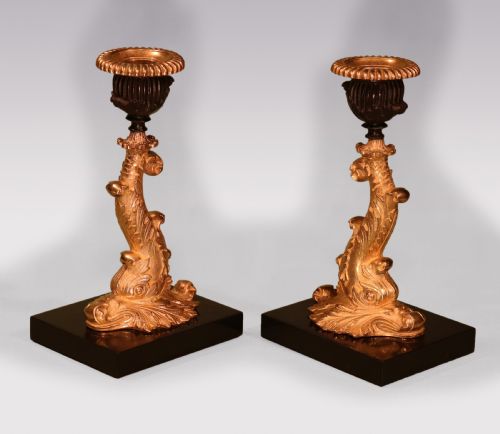

Regency Period Candlesticks
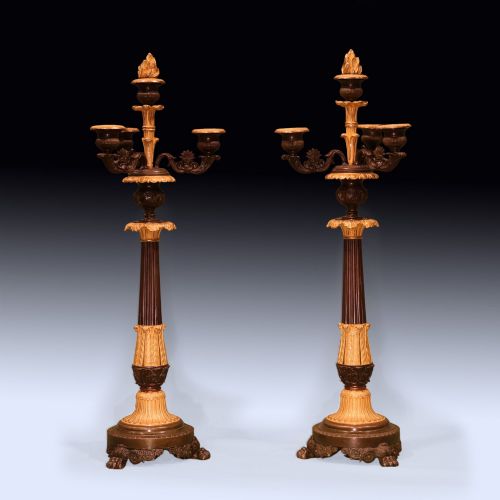
Regency period candlesticks bring classical proportion and gleaming metal to a mantelpiece, combining patinated bronze with bright ormolu.
Regency Period Candlesticks
Regency period candlesticks span the early nineteenth century, drawing heavily on Neoclassical and French Empire aesthetics. These pieces typically take the form of paired candlesticks, multi-light candelabra, chamber sticks, or table lustres designed to hold candles securely while reflecting their light.
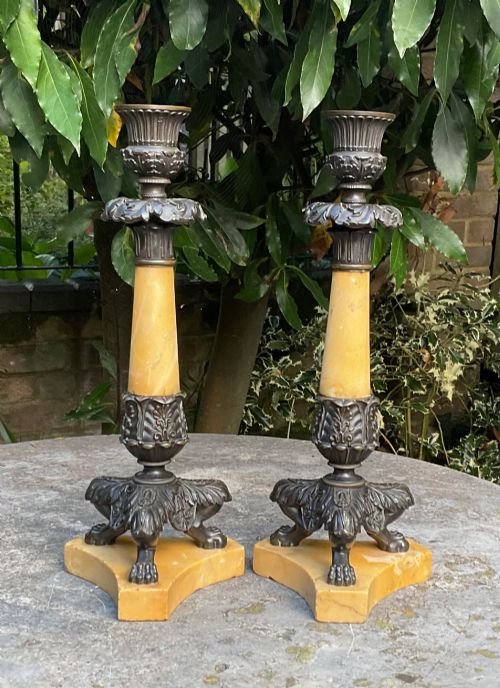
Brass and patinated bronze paired with ormolu dominate the available selection, often elevated on marble plinths. Examples range from simple brass column candlesticks and church candlesticks to elaborate figural designs incorporating dolphins, griffins, or lions.
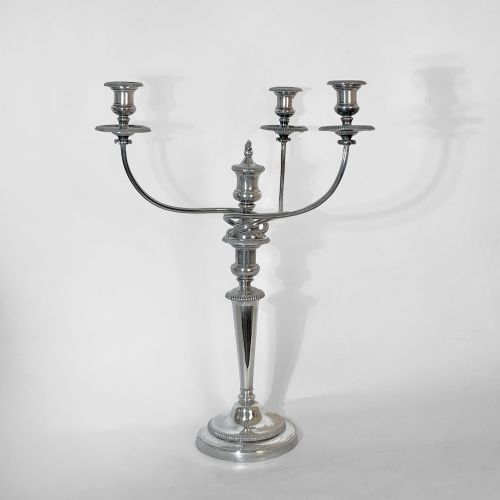
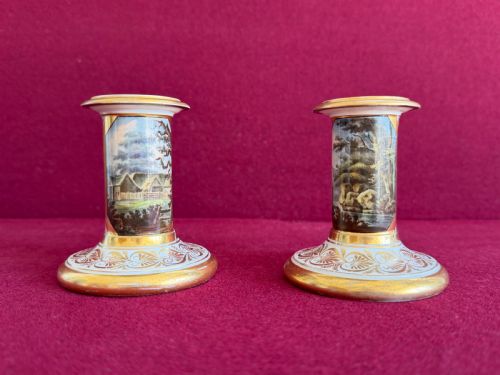
Buyers will also encounter porcelain candlesticks and Sheffield plated light fittings within this grouping. The overarching focus remains on classical form, architectural columns, and precise metalwork characteristic of the Regency and Georgian eras.
How they were made
Metal components rely on casting and chasing techniques, combining the dark surface of patinated bronze with the golden gleam of mercury-gilded ormolu. Brass examples are cast in sections and turned on a lathe before being assembled and polished.
Cut-glass elements such as lustres and table lustres involve hand-cutting facets into thick lead glass to refract candlelight effectively. Marble plinths are precisely sawn and polished to provide heavy, stable bases for the metalwork above.
Listings feature bronze, ormolu, brass, cut glass, and marble across Regency, Georgian, and French Empire styles.
What varies in quality
The refinement of the chasing separates standard production from superior examples, visible in the sharpness of leaf tips and the crisp detail of animal mounts like griffins and dolphins. Softer, worn casting details indicate secondary tiers of manufacture.
The choice of materials also dictates the standing of a piece, particularly the contrast between fire-gilt ormolu and simple lacquered brass. Combinations involving fine sienna marble plinths or high-clarity cut glass mark out the most ambitious commissions.
Barr Flight And Barr
The Regency Period Candlesticks Glossary
- Ormolu
- Gilt bronze created by applying an amalgam of gold and mercury to a bronze base and heating it to drive off the mercury. This technique produces a durable golden finish characteristic of decorative metalwork from the period.
- Patinated bronze
- Bronze that has been chemically treated to achieve a darkened, aged surface finish. It provides a dark contrast against bright ormolu mountings.
- Lustre
- A candlestick or table light hung with cut-glass pendants designed to refract and multiply the candlelight. These pendants catch the ambient room light even when unlit.
- Pricket
- A sharp metal spike set in the drip pan of a candlestick to secure the base of a large candle. They are frequently found on church candlesticks.
- Athenienne
- A tripod stand or decorative vessel derived from classical antiquity and adapted as a lamp or candlestick form during the Regency era.
Regency Period Candlesticks: Frequently Asked Questions
What is the difference between candlesticks and candelabra?
Candlesticks hold a single candle in a socket, whereas candelabra feature branched arms to hold multiple lights from one central stem.
Candelabra often incorporate adjustable arms or removable lustre attachments to vary the lighting effect.
How do I identify Regency period pieces?
Regency items typically display strict classical symmetry, architectural column forms, and motifs drawn from ancient Greece and Rome. Look for patinated bronze combined with ormolu and marble bases.
Proportions are generally clean and restrained compared to the later Victorian era.
Can I use antique candlesticks with modern candles?
Most antique sockets accommodate standard taper candles, though slight variations in nineteenth-century sizing occur. A small beeswax shim or snug fit ensures safety during use.
Care should be taken to extinguish candles before the flame reaches metal or glass components.
How should I clean ormolu and bronze?
Ormolu and patinated bronze require only gentle dusting with a soft, dry brush to prevent the accumulation of grit. Avoid metal polishes, chemical dips, or abrasives entirely, as these strip the historical gilding and patination.