


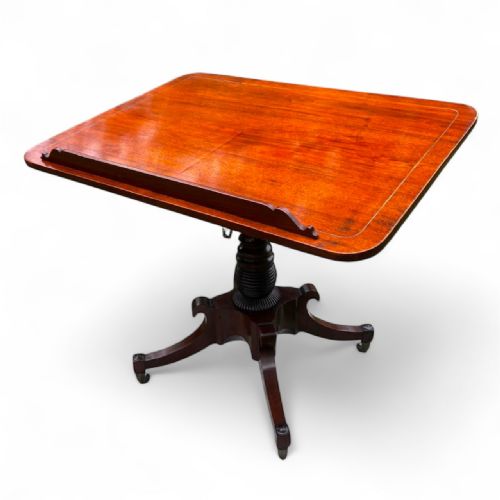




Regency Mahogany Portfolio Stand
These Regency mahogany portfolio stand examples provide an adjustable home for prints and drawings.
Regency Mahogany Portfolio Stand
A regency mahogany portfolio stand offers a sturdy timber frame designed to hold large sheets, folios and prints safely off the floor. These items appear across the Regency, Late Georgian and George IV periods, spanning the early decades of the nineteenth century.
The primary forms recorded on this page include dedicated folio stands and picture racks alongside related library and music furniture. Examples range from grand scale pieces down to compact reading tables and canterburys.
Makers working in English workshops constructed these items to meet the domestic and studio demands of artists, collectors and architects. Mahogany dominates the surviving pieces, often paired with secondary timbers such as oak and mounted with brass details.
How they were made
Joiners built the main frames using solid mahogany, selecting oak for secondary structural elements and internal framing where appropriate. Timber selection ensured the stands could support heavy paper loads without warping the uprights.
Workshops incorporated adjustable mechanisms and brass hardware to allow the racks to alter their angle for viewing. Metal inlay and brass castors frequently completed the construction on finer examples.
Regency Mahogany Portfolio Stand Retail Price Guide 2026
Typical asking prices for regency mahogany portfolio stand among the pieces listed under this phrase on Sellingantiques today, from the lower quarter to the upper quarter. They describe what is for sale here now, not the wider market.
Architects once used these exact racks to keep their grandest drawing mistakes safely out of the dog's reach.
What varies in quality
The distinction between standard utility items and master pieces lies in the ambition of the timber and the refinement of the mechanical adjustments. Grand scale stands with sophisticated ratchets and superior grain selection sit at the higher end of the range.
Integration of brass inlay and the presence of documented workshop attribution elevate specific pieces above standard provincial items. Construction depth, particularly the solidity of the base and the fidelity of the period joinery, determines the lasting stability of each stand.
Gillows of Lancaster
The Regency Mahogany Portfolio Stand Glossary
- Folio stand
- A hinged wooden rack designed to display and store large paper portfolios, prints or architectural drawings. These objects feature adjustable sides to hold materials at a readable angle.
- Canterbury
- A low stand featuring sloped partitions originally designed to hold sheet music or folios. This form shares construction materials and period aesthetics with the standard portfolio stand.
- Regency
- An English design period spanning the early nineteenth century defined by classical restraint and architectural lines. Pieces from this era often utilise dark timbers and brass mounts.
- Brass inlay
- The technique of embedding thin strips or motifs of brass flush into the wooden surface. This decorative method appears on select tables and stands from the period.
Regency Mahogany Portfolio Stand: Frequently Asked Questions
What is a regency mahogany portfolio stand used for?
These stands serve to hold large paper folios, artist prints, and architectural drawings in a upright or tilted position. They allow collectors to browse through collections without damaging individual sheets.
The adjustable framework supports different angles depending on whether the user is displaying a single large piece or sorting through a stack of papers.
Where were these stands placed in a home?
Historically, owners placed these racks in libraries, studios, and drawing rooms where large books and flat art collections needed accessible storage. Their mobility allowed them to move near light sources for viewing.
Today they function similarly in studies and living spaces, holding oversized books or contemporary prints.
Are all these stands adjustable?
Many examples incorporate mechanical ratchets or hinged supports to alter the width and tilt of the display bays. This adjustability accommodated varying thicknesses of paper folios.
Simpler racks maintained a fixed A-frame or compartment structure without moving parts.