

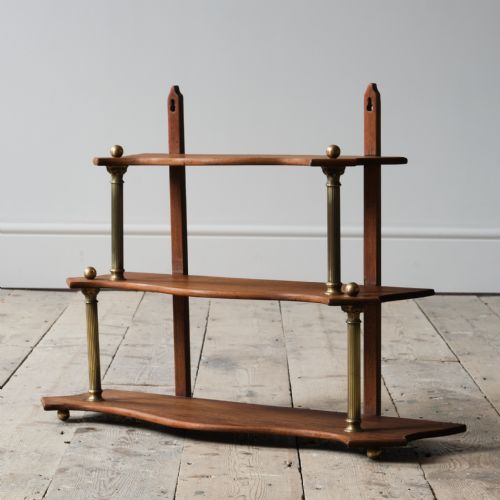
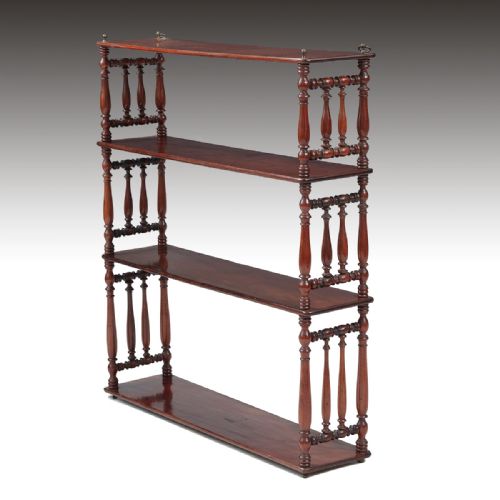


Regency Hanging Wall Shelves
Regency hanging wall shelves bring architectural order and warm timber tones to domestic walls.
Regency Hanging Wall Shelves
These pieces comprise sets of wall-mounted shelves, open shelving units, and corner cupboards designed to utilise vertical wall space in domestic interiors. The selection spans periods from the 18th century through the Regency, William IV, George IV, and Victorian eras.
Mahogany and rosewood dominate the material record, often paired with brass elements, glass, or mirrored backs. Pieces appear in various configurations including bow-fronted corner shelves, portable bookshelves, and hanging wall cabinets.
The version most commonly met on this page is the mahogany hanging shelf from the Regency period, frequently detailed with brass accents. Variants also include yew wood and tulipwood timbers alongside rococo revival styles.
Materials and construction
Cabinetmakers utilised dense cabinet timbers such as mahogany, rosewood, and yew wood to build these hanging structures. These woods were chosen for their deep grain and durability, frequently shaped into bow fronts and corner units.
Brass fittings and mirrored glass plates integrated into the construction to enhance both utility and light reflection within smaller rooms. Ormolu embellishments and tulipwood accents further enrich the surfaces of select pieces.
Regency Hanging Wall Shelves Retail Price Guide 2026
Typical asking prices for regency hanging wall shelves among the pieces listed under this phrase on Sellingantiques today, from the lower quarter to the upper quarter. They describe what is for sale here now, not the wider market.
Mahogany is the single most common timber found across these listings, often accompanied by rosewood and yew.
Judging quality
Quality rests upon the selection of timber figures, such as the rich grain of mahogany and rosewood, and the integration of secondary materials like brass and mirrored glass. Superior examples display harmonious proportions across bow-fronted profiles and corner formations.
The sophistication of the joinery and the refinement of brass mounts distinguish finer examples from standard utilitarian shelving. Maker attribution, such as work by Town and Emanuel, elevates a piece through documented workshop provenance.
Town and Emanuel
The Regency Hanging Wall Shelves Glossary
- Bow front
- A convex curved cabinet or shelving front that projects outward. This shape softens room corners and adds visual depth.
- Ormolu
- Gilded bronze mounts applied to furniture for decoration. It provides metallic contrast against dark timbers like mahogany.
- Rosewood
- A heavily grained, dense exotic timber valued for its deep reddish-brown colour and dark figuring. It appears frequently in Regency and William IV pieces.
- Corner cupboard
- A triangular cabinet designed to fit directly into the corner of a room. These units make efficient use of otherwise neglected spaces.
Regency Hanging Wall Shelves: Frequently Asked Questions
What are regency hanging wall shelves?
These are wall-mounted wooden tier systems and cabinets designed to hold books or decorative objects without taking up floor space.
Originating primarily in the Regency and 19th-century periods, they utilise sturdy timbers like mahogany and rosewood.
How were hanging wall shelves used?
They served to display small ornaments, porcelain, and portable books within domestic sitting rooms and libraries.
Corner versions and cabinets kept items dust-free or neatly arranged in specific architectural angles of a room.
How do I live with antique wall shelves?
Mount them securely to wall studs given the heavy density of woods like rosewood and mahogany.
Keep them away from direct heat sources to prevent the timber and veneer from splitting or warping over time.
How do I tell periods apart?
Regency and Georgian pieces rely on clean architectural lines and mahogany timbers, whereas William IV and Victorian items introduce rosewood and revival decorative styles.
Look at the secondary elements, such as brass mounts or mirrored backs, which shift in design across the 18th and 19th centuries.