
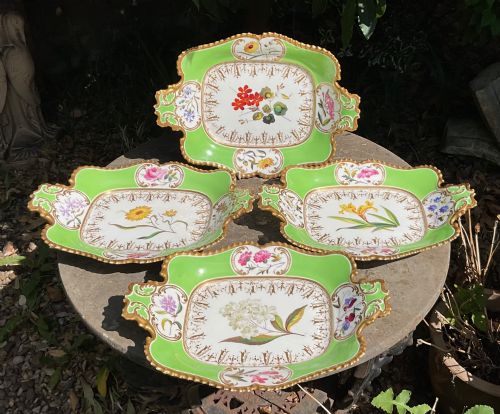
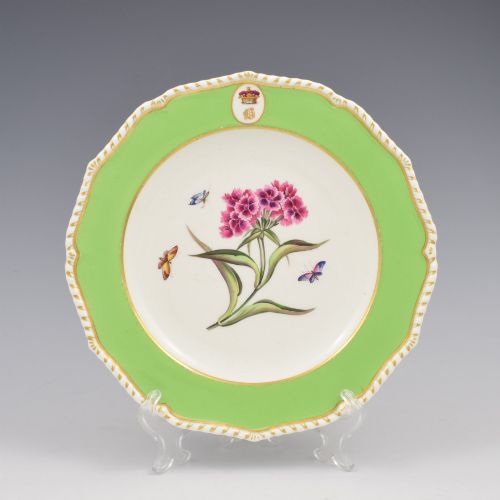


Regency Green Porcelain Plates
Regency green porcelain plates bring the botanical accuracy and gilded brilliance of the early nineteenth century straight to the table.
Regency Green Porcelain Plates
Regency green porcelain plates encompass cabinet plates, dessert plates, and individual dishes created during the Georgian and Regency periods. Buyers examining this page will frequently encounter apple green grounds combined with botanical paintings or armorial decoration.
The objects stem from esteemed factories of the early 1800s, often appearing as individual dessert plates or surviving fragments of larger dessert services. Forms range from simple circular plates to elaborately shaped dessert dishes designed for display or light dining.
How they were made
Potters shaped these pieces using porcelain and bone china, applying rich enamel glazes to create the characteristic green ground colours. Kiln firing fixed the body before hand-painted botanical studies or Chinoiserie motifs were added.
Gilding and gold leaf were applied by hand to borders and rims, then burnished to a soft shine. Skilled decorators such as Samuel Astles added precise brushwork over the glaze before secondary firing.
One early nineteenth-century pattern records a Bengal tiger design alongside standard botanical studies.
What varies in quality
The distinction between standard table wares and top-tier cabinet pieces lies in the precision of the hand-painted botanical or armorial details. Factory attribution also plays a role, with documented works from factories like Chamberlains Worcester or Flight Barr & Barr commanding greater attention.
The crispness of the gilt borders and the depth of the apple green enamel glaze dictate visual success. Plates retaining clear factory marks and specific pattern numbers show superior preservation of their original decorative intent.
Chamberlains Worcester·Bloor Derby·Spode·Minton·Flight Barr and Barr
The Regency Green Porcelain Plates Glossary
- Armorial plate
- A ceramic plate featuring a painted family crest, coat of arms, or heraldic device. These were typically commissioned by landed families for formal dining.
- Dessert plate
- A small plate intended for the final course of a formal meal, frequently produced with richer decoration than dinner wares. They often form part of a larger matching service.
- Gilding
- The application of gold leaf or gold paint to ceramic surfaces for decorative emphasis. In this period, it was usually hand-applied and burnished.
- Bone china
- A type of soft-paste porcelain containing bone ash, developed in England to improve durability and whiteness. It allowed makers to create thinner, more refined vessels.
- Enamel glaze
- A vitreous composition fused to the ceramic body during firing to provide a smooth, coloured surface. It protected the painted decoration underneath or served as a coloured background.
Regency Green Porcelain Plates: Frequently Asked Questions
How were regency green porcelain plates used?
These plates served primarily during the dessert course of formal Georgian and Regency dinners, holding fruit, sweetmeats, or confectionary. Wealthy households displayed them on sideboards or within cabinet furniture when not in active use.
Over time, many service plates transitioned from dining tables to pure decorative display objects. Their rich green grounds and botanical paintings made them ideal conversation pieces for drawing rooms.
Can I still use these plates for dining?
Using plates from the early nineteenth century for daily meals is generally discouraged due to their age and historical value. Hand-applied enamels and gold leaf are vulnerable to modern detergents and abrasive cleaning.
Gentle handling allows for occasional use at special dinners, but most owners prefer to exhibit them on plate stands or wall mounts. Hand washing in lukewarm water with mild soap is essential if they are used.
How do I identify a regency period plate?
Regency plates often feature distinct apple green backgrounds paired with botanical illustrations, armorial crests, or Chinoiserie motifs. The porcelain body is typically heavier than later Victorian wares but more refined than coarse earthenware.
Many pieces carry factory marks, pattern numbers, or painter inscriptions on the reverse side. Shape profiles also offer clues, showing the characteristic shallow wells and gadroon or scroll-moulded rims of the 1810s and 1820s.
What is the difference between porcelain and bone china?
Traditional porcelain relies on a mixture of china clay and petuntse, fired at high temperatures to create a dense, semi-translucent body. Bone china incorporates calcined animal bone into the clay mixture, increasing strength and whiteness.
Both materials appear across early nineteenth-century table wares and received similar enamel and gilt decoration. Bone china allowed English manufacturers to produce slightly thinner walls while retaining structural stability.