


Regency Children Portrait Painting
Regency children portrait painting captures early nineteenth-century youth through oil, watercolour, and silhouette, offering a direct window into domestic history.
Regency Children Portrait Painting
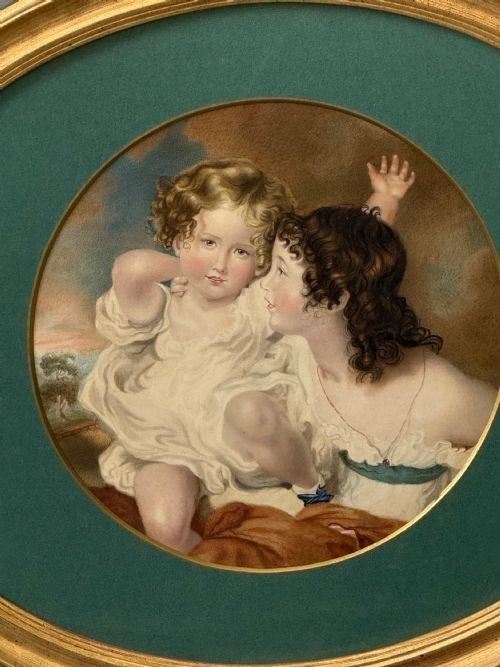
A regency children portrait painting depicts young subjects from the late eighteenth to the mid nineteenth century, ranging from formal studio canvases to intimate folk art and miniature watercolours. Buyers seek these works for their historical charm and the distinct character captured by period artists.
The selection here encompasses oils on canvas and board, delicate paper watercolours in ebonised or maple frames, and painted silhouettes. English naive art and academic Regency school pieces appear frequently alongside works reflecting the influence of Sir Thomas Lawrence.
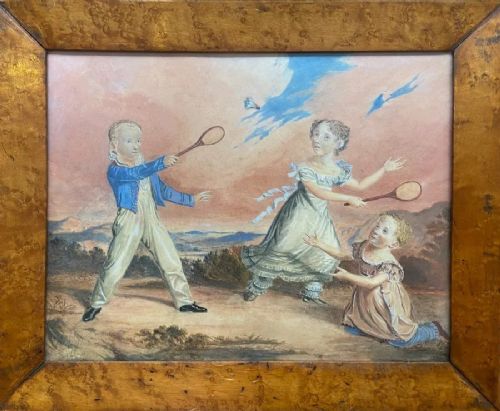
Subjects include individual girls in period dresses, young boys with toys or animals, and family groupings. These portraits record the clothing, pastimes, and social standing of children across Georgian, Regency, and early Victorian households.
Materials and Techniques
Artists of the period painted primarily with oil on canvas or wood board, or applied fine watercolour and ink pigments onto prepared paper and card. Many works retain their original period framing, utilising ebonised wood, maple veneer, or gilded surrounds.
Miniature paintings and silhouettes required precise handwork on a small scale, sometimes incorporating gum arabic to deepen the tones of watercolours. Larger canvases display traditional layering of oil paints, from initial priming to fine surface glazes.
Listings feature works spanning the eighteenth, nineteenth, and early twentieth centuries, executed in oil, watercolour, pastel, and ink.
Quality and Execution
Quality in these portraits rests upon the sureness of the draughtsmanship and the psychological engagement of the subject's face. Academic pieces show sophisticated handling of light and fabric texture, while naive works derive their appeal from charming directness and unpretentious perspective.
The survival of original surface condition, stable pigment adherence, and period-appropriate framing heavily influence the standing of an artwork. Finer works demonstrate careful attention to hands, clothing details, and accompanying props such as toys or pets.
Sir Thomas Lawrence·William Egley·Henry Scott·John Russell·Henry Edridge
The Regency Children Portrait Painting Glossary
- Regency
- A British historical period spanning roughly from 1811 to 1820, though the broader artistic style extends from the late eighteenth century into the reign of William IV. It is characterised by neoclassical elegance alongside emerging romantic sensibilities.
- Naive Art
- Artistic creation marked by a charming disregard for formal academic perspective and proportion, often produced by self-taught painters. These works offer sincere depictions of everyday domestic life and portraiture.
- Portrait Miniature
- A small, highly detailed painting executed on ivory, vellum, or card, designed to be held in the hand or worn as a keepsake. They gained immense popularity during the Georgian and Regency eras.
- Silhouette
- A portrait profile cut from dark paper or painted in solid black pigment onto a pale background, sometimes highlighted with gold. They served as an affordable and accurate method of recording likenesses before photography.
- Ebonised
- Wood finished with a dark stain or polish to imitate the appearance of expensive ebony. It is commonly found on frames housing nineteenth-century watercolours and silhouettes.
Regency Children Portrait Painting: Frequently Asked Questions
How do I identify a Regency child's portrait?
Examine the clothing, hair styling, and framing materials against documented styles of the period. High-waisted dresses for girls and skeleton suits for boys are typical indicators of the Regency decades.
Paintings often utilise specific colour palettes and framing techniques, such as convex glass or ebonised wood borders, which help anchor the date of the artwork.
What is the difference between naive and academic portraits?
Academic portraits follow strict rules of proportion, perspective, and lighting taught by official art academies. They aim for a naturalistic representation of the subject.
Naive portraits exhibit flat perspectives and simplified forms created by untutored hands. Their charm lies in emotional directness rather than technical accuracy.
Were these portraits painted from life?
Most commissioned portraits required the young sitter to pose in a studio for multiple sessions. Artists often used sketches to capture fleeting expressions before completing the canvas.
Some posthumous or memorial portraits relied on earlier miniatures, descriptions, or locks of hair to reconstruct the likeness of a child.
How should I care for antique watercolours?
Keep works on paper away from direct sunlight to prevent fading of sensitive pigments like watercolours and inks. Maintain stable indoor humidity levels to protect both the paper support and the original frame.
Displaying pieces behind conservation-grade glass offers essential protection against airborne pollutants and physical damage.