
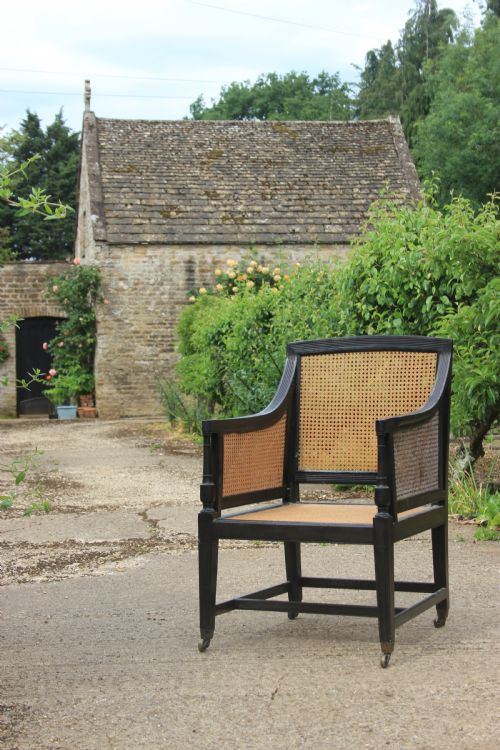
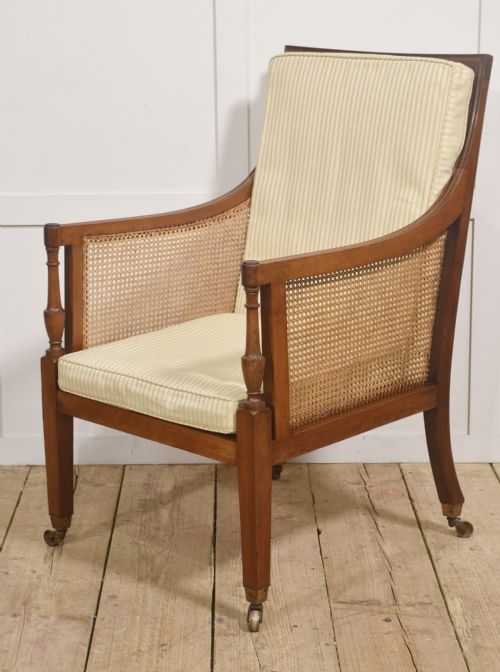


Regency Cane Seat Armchairs
Regency cane seat armchairs bring neoclassical line and woven lightness to a room, offering sturdy elbow support alongside airy seating.
Regency Cane Seat Armchairs
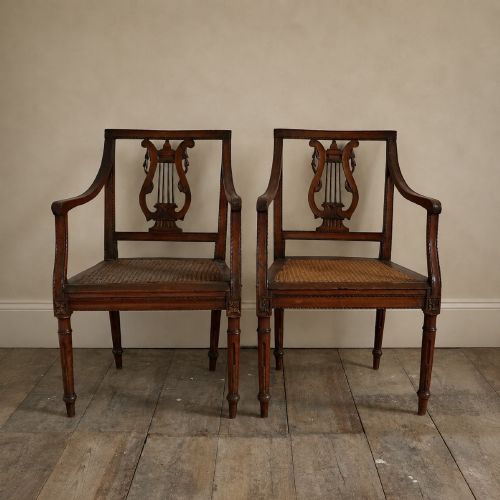
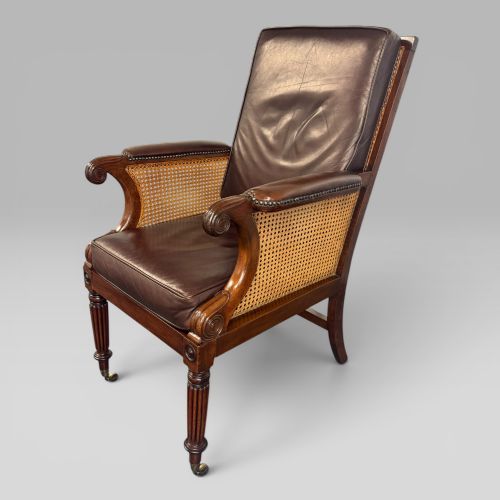
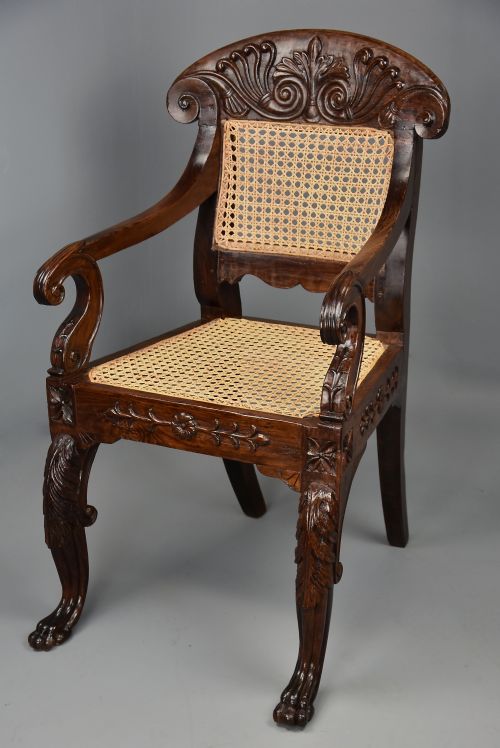
Regency cane seat armchairs combine structural timber frames with woven cane seating panels, appearing as library bergères, open armchairs, and dining elbow seats. The selection spans the primary Regency period alongside later revivals from the nineteenth and twentieth centuries, incorporating Anglo-Indian colonial variations.
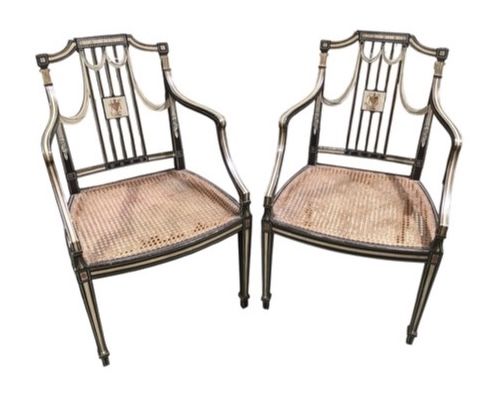
Mahogany forms the dominant timber choice across the listings, accompanied by rosewood, padouk, oak, and ebonised wood. Examples frequently feature painted or faux finishes, including faux rosewood and faux bamboo, reflecting the decorative tastes of the era.
Formats range from single library armchairs and matched pairs to larger dining sets and child's armchairs. Certain pieces incorporate specialist elements such as library steps, lyre backs, and curule frames.
How they were made
Frames rely upon dense hardwoods such as mahogany and ebony, shaped through joinery and occasionally augmented by brass mounts or parcel gilt details. Cane and rattan cane are hand-woven directly into the seat frames or dropped in to provide resilient support.
Surface decoration relies upon specialist paintwork, simulated graining to imitate exotic timbers like rosewood, and carved ornamentation including padouk relief work. These applied techniques define the aesthetic vocabulary of the period without relying upon structural excess.
The inventory encompasses library bergères, dining elbow chairs, metamorphic steps, and child's armchairs.
What varies in quality
The refinement of the timber carving and the crispness of the turning dictate the initial visual impact of the chair. Well-drawn proportions and generous seating dimensions distinguish superior examples from standard production pieces.
The integrity of the woven cane work and the original state of the painted or polished surface finishes determine the enduring character of each piece. Surviving gilding, original paint schemes, and secondary materials like leather inserts elevate the standing of an individual chair.
The Regency Cane Seat Armchairs Glossary
- Bergère
- An enclosed upholstered or cane-panelled armchair with closed sides, designed for comfort in libraries and withdrawing rooms. This form frequently incorporates a deep seat and caned back.
- Cane
- Woven material produced from the outer bark of rattan palms, valued for its strength and flexibility. It provides a cool, supportive surface for seating.
- Ebonised
- Timber treated with a dark finish to imitate expensive ebony wood. It appears frequently on Regency and nineteenth-century frames.
- Curule
- An ancient Roman X-shaped frame style revived during the classical periods. It provides structural bracing for open armchairs.
Regency Cane Seat Armchairs: Frequently Asked Questions
What is a bergere armchair?
A bergère is a fully enclosed armchair featuring solid sides filled with woven cane or upholstery. These chairs were designed for reading and leisure in nineteenth-century libraries.
They offer deep proportions and supportive backrests, distinguishing them from standard open dining armchairs.
How do I identify a Regency chair?
Regency chairs display classical neoclassical influences, drawing inspiration from ancient Roman, Greek, and Egyptian forms. Look for clean architectural lines, sabre legs, and turned supports.
Decoration often includes parcel gilt highlights, brass inlay, or painted finishes imitating exotic timbers.
Are cane seats durable?
Cane seating is remarkably resilient when maintained properly, offering flexible support that distributes weight evenly. The material withstands regular daily use while maintaining its tautness.
Original cane panels require moderate humidity to prevent brittleness, though replacement weaving remains a traditional craft.
What is faux rosewood?
Faux rosewood is a painted decorative finish where common timbers are manipulated to replicate the dark grain and warm hue of genuine rosewood. Artisans applied graining combs and glazes over a prepared ground.
This technique achieved fashionable exotic aesthetics during periods when imported tropical hardwoods were costly or restricted.